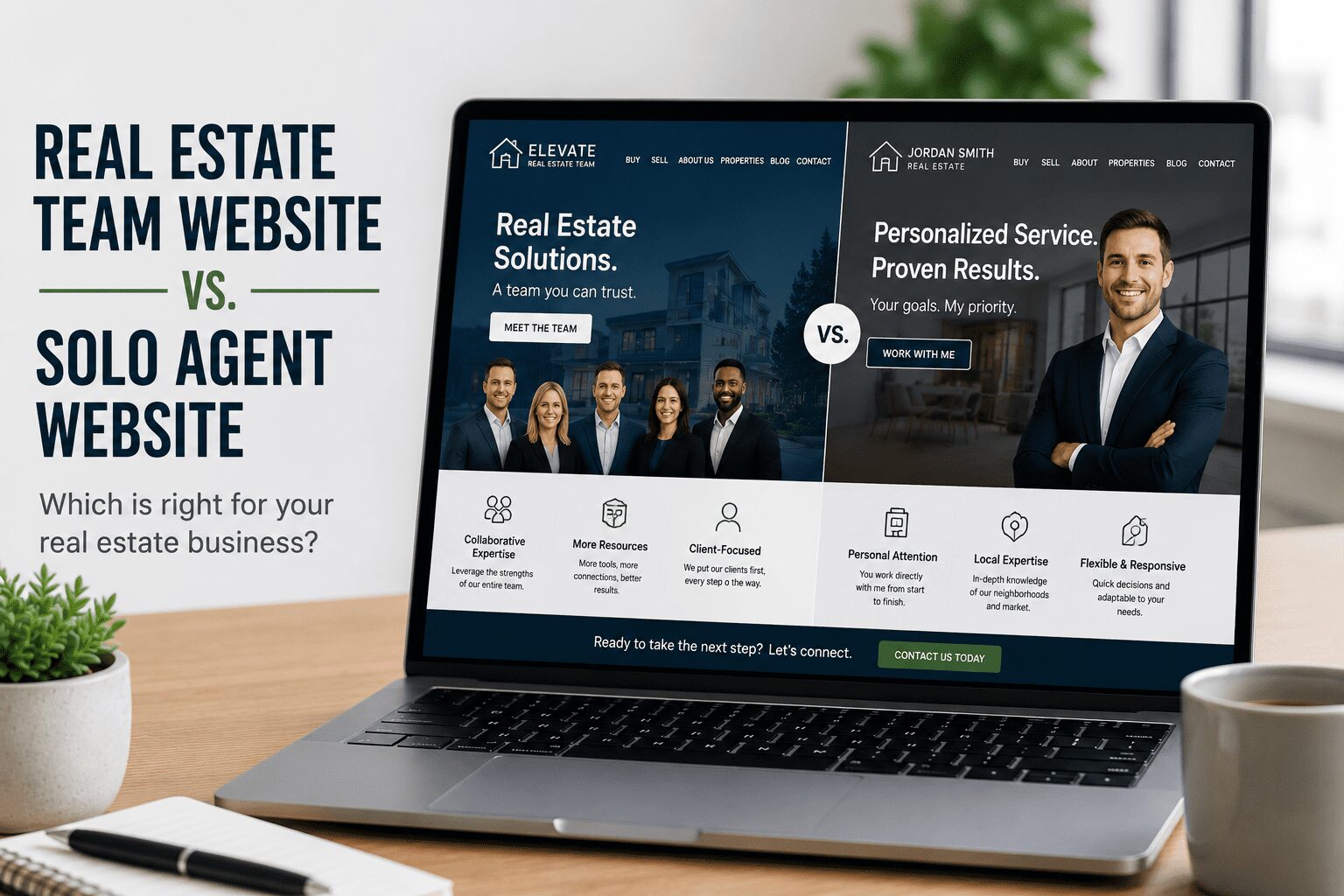
A solo agent website and a team website have different purposes, different audiences, and different structural requirements that affect the platform choice, the IDX configuration, the lead routing setup, and the content architecture. Building the wrong structure for your situation creates problems you eventually have to solve, either by rebuilding everything or by working around limitations that compound over time as your business grows. Understanding the differences before you build saves you from the more expensive discovery process of learning them after the fact.
What a Solo Agent Website Needs
A solo agent website is built around one person and one identity. The homepage establishes who you are, what market you serve, why a buyer or seller should choose to work with you specifically over any other agent in the area, and what the experience of working with you looks like. The IDX search is configured so every registration comes directly to you. Every contact form submission arrives in your inbox. Every testimonial, every piece of content, and every professional credential reinforces a single person’s expertise and authority in a specific market.
The content strategy for a solo agent site is also personal by design. Neighborhood guides that reflect your perspective on the areas you know. Market updates that carry your analysis of what the data means. Blog posts that communicate your voice and your point of view on the market. This personal content creates a relationship with buyers and sellers who find it before they ever contact you, which is one of the most significant conversion advantages a solo agent website can build over time.
The IDX configuration for a solo site is straightforward. All registrations route to the one agent who owns the site. The CRM integration connects directly. The follow-up sequences are built around that one agent’s communication style and capacity. The simplicity of the one-to-one structure means there is no confusion about who owns which lead, who should follow up, or how leads should be prioritized.
What a Team Website Needs
A team website has to balance the team brand with individual agent presence in a way that serves both the brand identity the team is building and the individual relationships each agent has with their own clients and sphere. Buyers and sellers who are referred to a specific agent on the team want to see that agent represented professionally on the site. Buyers who find the site through organic search may not have a specific agent in mind and need to be routed to the right team member based on the team’s internal structure.
Lead routing is the most operationally complex element of a team site that does not exist on a solo agent site. Depending on how the team operates, leads may need to be distributed round-robin among all buyer’s agents, routed based on the geographic area the buyer was searching, routed based on price point or property type, held centrally for the team lead to assign manually, or some combination of these depending on the lead source and buyer characteristics. The IDX configuration and CRM integration need to reflect the actual routing structure the team uses from the start rather than being retrofitted after the site is live.
Agent roster pages become a meaningful content component on a team site. Each agent’s profile page serves as a landing page for buyers and sellers who are researching specific team members, as a social proof element for buyers who are deciding whether to work with the team, and as a collection point for individual agent testimonials that add to the team’s overall credibility. Solo agent sites have no equivalent because the entire site already centers on one person.
Team sites also need more showcase pages and more neighborhood content to cover the broader geographic area that a team typically serves compared to a solo agent. A solo agent might focus intensively on three to five neighborhoods. A team might cover an entire metro area with different agents specialized in different parts of the market. The content architecture has to reflect that scope with a more extensive showcase page structure and neighborhood guide library.
The Transition From Solo to Team
Many agents build a solo agent website and later transition to a team structure as they hire buyer’s agents or partner with other agents. This transition is significantly easier when the original site is built on a platform that scales without requiring a complete rebuild. WordPress with IDX Broker allows you to add agent roster pages, configure lead routing logic within the CRM, expand the showcase page coverage to match a wider geographic area, and grow the site’s content infrastructure to support a team’s content production capacity.
Proprietary real estate website platforms often have specific limitations on how many agent profiles can be added, how leads can be routed among agents, and what customizations are possible as the team grows beyond the platform’s original design assumptions. These limitations only become visible after the team has grown past the point where the platform can accommodate it, which forces a rebuild at the worst possible moment, when the business is growing and time is most constrained. WordPress removes those ceilings by design.
Content Strategy Differences
A solo agent content strategy can be entirely personal, reflecting one agent’s voice, expertise, and perspective on the market. That personalization is a strength rather than a limitation because it creates a distinctive presence that buyers and sellers remember and return to.
A team content strategy often needs to be more brand-focused than person-focused, presenting the team as the expert rather than any individual member, particularly if agents join and leave the team over time. Building a content library around the team’s brand rather than around individual agent voices protects the content’s long-term value from turnover in the team’s membership.
What Stays the Same
Whether solo or team, the fundamentals do not change. IDX configured correctly for the site’s structure. Showcase pages built strategically for the market coverage you are targeting. Neighborhood content that supports organic search and establishes local expertise. A lead capture system that routes registrations to the right people efficiently. A CRM integration that ensures no lead falls through the cracks between registration and follow-up. These principles apply identically to a one-person operation and a ten-agent team. What changes is the complexity of the implementation, not the underlying logic.
Jeff and Paul at Ballen Brands build both solo and team BREW sites and can walk you through what the right structure looks like for your specific situation and growth trajectory. Reach them at 702-917-0755 or team@ballenbrands.com. The IDX Broker signup link on this page waives the setup fee.
Lori Ballen is a digital entrepreneur and content creator based in Las Vegas. She founded Ballen Brands, now owned and operated by her brothers Jeff and Paul Helvin.
Hey there! Just a quick heads-up: some of the links on this site are affiliate links, meaning I may earn a small commission if you make a purchase (including through the Amazon Associates program), at no extra cost to you. Occasionally, products featured here are gifted by brands.
I also use AI tools to help research and create content for you! While I love sharing strategies to help you succeed, please remember that everyone's journey is unique—individual results vary, and there are no guarantees. Thanks so much for stopping by!