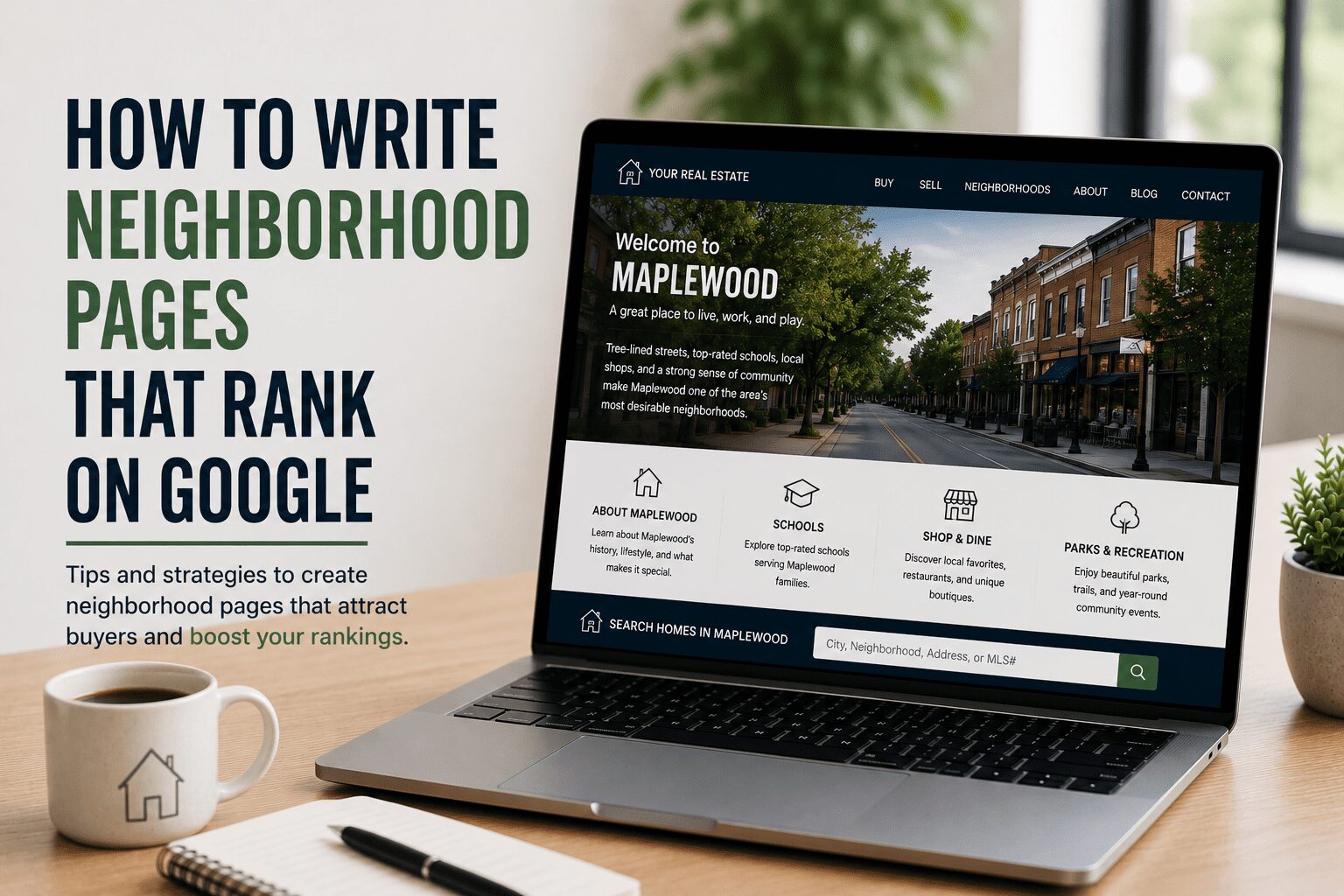
Neighborhood pages are among the highest-value content assets on a real estate website. When written correctly they rank for local searches, establish you as the recognized area expert with buyers and sellers who find them, serve both buyer and seller audiences simultaneously, and link directly into your IDX showcase pages to create a complete content and search funnel. When written poorly they sit in a search index with no impressions, no clicks, and no lead generation value. The difference between a neighborhood page that ranks and one that does not is almost entirely about content quality and strategic structure.
Start With the Right Keyword
The primary keyword for a neighborhood page is almost always a variation of the neighborhood name combined with real estate, homes for sale, or the city it belongs to. Summerlin Las Vegas homes for sale. Green Valley Henderson real estate. Henderson NV neighborhoods. These are the searches buyers and sellers run when they are thinking about a specific area and beginning their location research.
Use Google Search Console data from your existing pages, Google Autocomplete suggestions for your neighborhood names, and basic keyword research tools to identify which specific query variations have the most search volume for your target neighborhoods. Not all variations of the same search have equal volume. Summerlin homes for sale may have ten times the monthly search volume of Summerlin real estate even though they are semantically similar queries. Knowing which variation to target before writing the page is worth the ten minutes of research it takes.
Use the primary keyword naturally in the page title, the H1 heading, the URL slug, the meta description, the opening paragraph, and throughout the body content. Avoid stuffing the keyword in ways that feel unnatural to a reader. Write for the reader first and the search engine second. A page that ranks but delivers a poor reading experience does not convert visitors into leads, which defeats the purpose of the ranking.
Write Content That Requires Local Knowledge
The most common and most damaging mistake agents make with neighborhood pages is writing content that could have been generated by anyone with no specific knowledge of the area. Generic descriptions that mention proximity to shopping, good schools, and family-friendly amenities without specifying which shopping, which schools, and what makes the amenities distinctive could apply to dozens of communities across the country. That content does not rank because it does not provide anything specific enough to be valuable to a buyer researching that specific area.
Write about the actual experience of living in the neighborhood. What the streets feel like on a Saturday morning. What amenities are nearby and which ones residents actually use regularly. What the traffic situation is for the most common commute routes out of the neighborhood. Which specific schools serve the area and what the parent community says about them in terms of academics, sports programs, and school culture. What price ranges buyers should expect and how those ranges have shifted over the past two years. What types of buyers tend to be drawn to this neighborhood and why, whether it is families for the schools, retirees for the single-story options, or first-time buyers for the entry price points.
This is content that requires you to actually know the area well enough to write about it specifically. That is the point. It is content that national real estate websites, portal pages, and AI-generated neighborhood summaries cannot replicate with the same specificity, the same local texture, and the same credibility as someone who has been in hundreds of homes in that neighborhood and has talked to dozens of buyers who chose it for specific reasons.
Structure the Page for Both Buyers and Sellers
A well-built neighborhood page serves buyers and sellers simultaneously without feeling like it is trying to do two different things awkwardly. Buyers want to know what it is like to live there, what the typical home looks like, what the price range is, and what it feels like to be a resident. Sellers want to know that the agent writing the page actually understands their specific neighborhood, can speak credibly about its value, and is the right person to represent their home to buyers who are already researching the area.
A structure that works for both audiences includes an overview section that describes the neighborhood with genuine local specificity. A market data section with current median price, average days on market, inventory level, and recent price trend data specific to that neighborhood. A schools and education section that names the actual schools and includes a note on the district. An amenities and lifestyle section that names specific parks, restaurants, shopping centers, and community features. A property type section that describes what kinds of homes exist in the neighborhood, whether that is single-story ranch homes, gated communities, townhomes, or a mix. And a section on the agent’s experience and expertise in that specific area, which gives sellers the social proof that the person who wrote this page actually knows and works in the neighborhood.
Link to the Corresponding Showcase Page
Every neighborhood page should link directly to the corresponding IDX showcase page for that area. A buyer reading your Summerlin neighborhood guide who is ready to search current listings should be one click away from viewing every active listing in Summerlin on your IDX. That link should be placed naturally within the content, ideally near a mention of current prices or the current market, where the buyer’s intent to see actual listings is most likely to be active.
This internal link serves two distinct purposes. For the buyer, it creates a clear and frictionless path from research reading to property searching without requiring them to navigate back to your homepage and find the search tool. For the search engine, it passes authority from the neighborhood content page to the showcase page, which helps both pages rank better than they would as isolated pages without the relationship between them.
The showcase page should link back to the neighborhood guide as well, creating a bidirectional relationship that gives buyers arriving through either path access to both the listing search and the contextual neighborhood information. Some buyers arrive through a listing search and then want the neighborhood context. Others arrive through neighborhood content and then want to search listings. Both paths should lead naturally to both pieces.
Include Market Data and Keep It Current
Neighborhood pages that include specific, current market data perform better than those with only lifestyle content. The market data, median price, active listing count, days on market, and recent price trend, gives sellers who find the page a reason to read it for the information value rather than just the lifestyle description. It also gives search engines signals that the page contains substantive, data-driven content about a specific geographic area rather than generic marketing copy.
The maintenance commitment that comes with including market data is worth acknowledging clearly. A neighborhood page published with market data from two years ago is not useful to a buyer or seller today and may actively damage your credibility if the numbers are significantly different from current conditions. Plan to update neighborhood pages at least annually, and ideally every six months in markets where conditions are changing quickly. Search engines favor content that is maintained and updated over content that was published once and never touched again, which creates an additional SEO incentive beyond the credibility benefit.
The BREW system from Ballen Brands includes community pages as a standard component with the internal linking structure to showcase pages built into the architecture from the start. Jeff and Paul can walk you through how to structure and optimize these pages for your specific market and which neighborhoods to prioritize based on your business focus. Reach them at 702-917-0755 or team@ballenbrands.com.
Lori Ballen is a digital entrepreneur and content creator based in Las Vegas. She founded Ballen Brands, now owned and operated by her brothers Jeff and Paul Helvin.
Hey there! Just a quick heads-up: some of the links on this site are affiliate links, meaning I may earn a small commission if you make a purchase (including through the Amazon Associates program), at no extra cost to you. Occasionally, products featured here are gifted by brands.
I also use AI tools to help research and create content for you! While I love sharing strategies to help you succeed, please remember that everyone's journey is unique—individual results vary, and there are no guarantees. Thanks so much for stopping by!