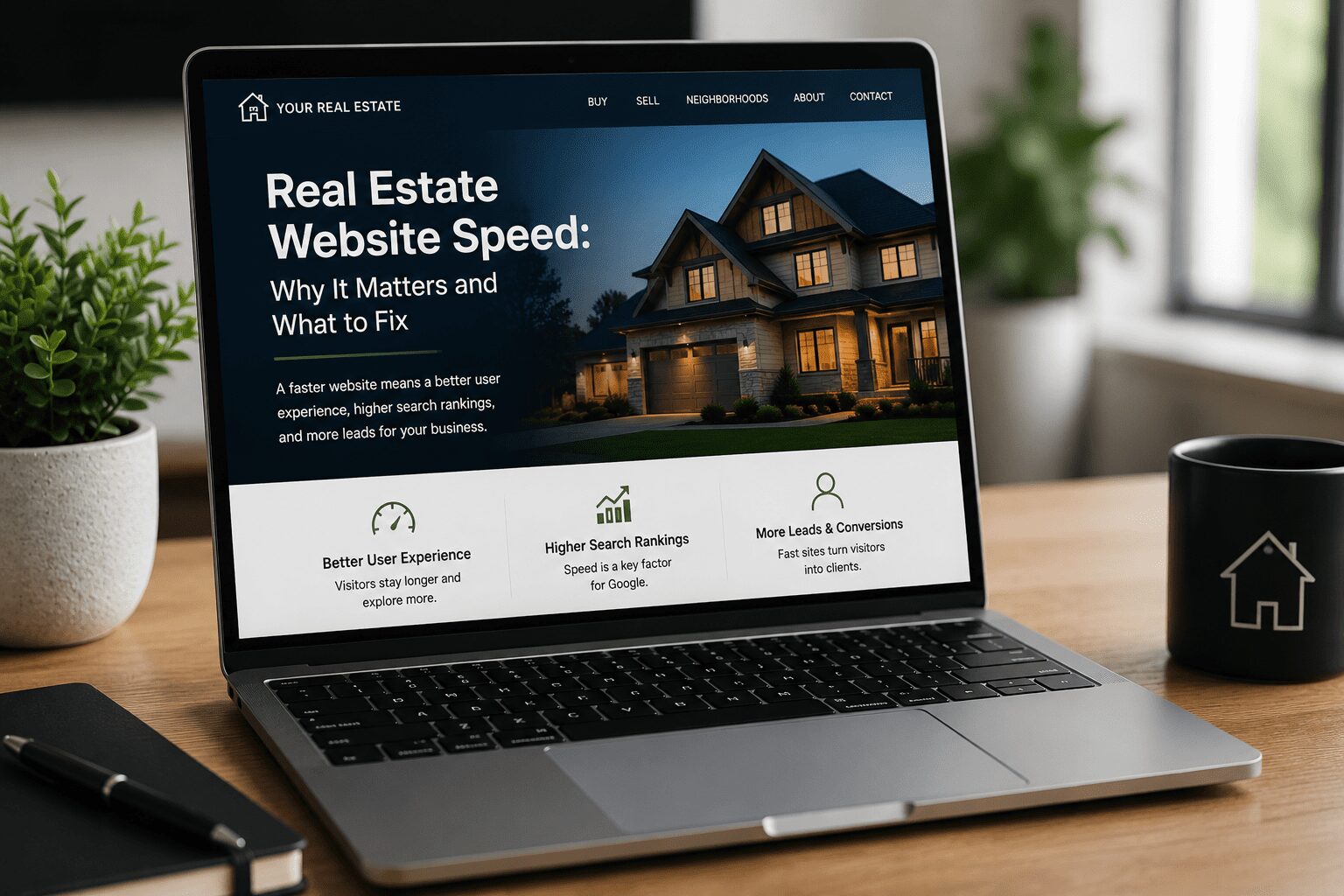
Real estate website speed matters for three distinct reasons that most agents have not thought about explicitly, and it affects all three simultaneously. Site speed affects the user experience buyers and sellers have when they visit your site. It affects how Google ranks your pages in organic search. And it directly affects your lead conversion rate by determining what percentage of visitors actually see your content before abandoning the page. Getting it wrong costs you across all three dimensions at once, which is why slow real estate websites consistently underperform their content investment by a wide margin.
How Speed Affects Leads Directly
A site that takes more than three seconds to load loses a substantial percentage of visitors before the page is fully rendered. Google’s own research shows that fifty-three percent of mobile site visits are abandoned if a page takes longer than three seconds to load. On mobile, where connection speeds vary significantly depending on location and network conditions and where buyers are often browsing in the car, at a showing, or on a break between activities, the dropout rate on slow sites is even higher than on desktop.
In real estate, where buyers are typically browsing multiple sites in a session and comparing options, a slow experience is a disqualifying one. A buyer who waited four seconds for your showcase page to load and then encountered a clunky, unresponsive IDX search has no reason to stay when Zillow loads instantly in a new tab. The investment you made in the page content, the showcase page structure, and the SEO that brought the buyer to your site produces nothing if the experience ends before they see any of it.
A buyer who never fully loads your showcase pages or IDX search cannot register as a lead. Speed is not a nice-to-have optimization. It is a prerequisite for every other lead generation mechanism on the site to function at all.
How Speed Affects Search Rankings
Google uses page speed as a direct ranking factor through its Core Web Vitals measurement system. Core Web Vitals measure three specific aspects of page performance: Largest Contentful Paint, which measures how long it takes for the main content of a page to load; First Input Delay, which measures how quickly the page responds to user interaction; and Cumulative Layout Shift, which measures how much the visible content moves around as the page loads. Pages that score poorly on these measures are at a disadvantage for organic rankings compared to faster pages covering the same topic in the same market.
For a real estate website competing for neighborhood search rankings and showcase page positions in Google, this matters in practical terms. Two showcase pages covering the same Las Vegas neighborhood with comparable content depth and comparable domain authority will not rank identically if one loads in 1.5 seconds and the other loads in 5 seconds. Google is making page experience a larger component of its ranking signals over time rather than a smaller one, which means the penalty for being slow compounds rather than remaining constant.
What Makes Real Estate Websites Slow
Real estate sites carry a specific set of speed risks that are different from typical content sites. Large uncompressed photos are the most common culprit. Listing detail pages with multiple high-resolution images, neighborhood guide pages with large hero photos, and homepage sections with multiple large graphics all create significant load weight that accumulates across every page request. Photos that are uploaded at the size a photographer delivers them without compression or resizing can be five to twenty times larger than they need to be for web display.
IDX search tools that are not optimized for performance add meaningful load time on pages where they are embedded. Some IDX configurations load the full search interface on every page even when the search tool is not actively being used by the visitor. This unnecessary resource loading slows every page on the site rather than only the pages where IDX search is the primary purpose.
Plugins that are not maintained, that are redundant in function, or that conflict with other plugins create JavaScript execution overhead that slows page rendering. A WordPress site that has accumulated twenty or thirty active plugins over several years often has significant redundancy and conflict loading that could be eliminated by auditing the plugin stack and removing anything that is not actively contributing value.
Shared hosting plans that are inadequate for the actual resource requirements of a real estate website are another common speed problem. A site running IDX data connections, image-heavy content, and multiple active plugins on a budget shared hosting plan that is also serving hundreds of other sites on the same server will experience slowdowns during peak traffic periods, which is precisely when buyers are most actively searching.
What to Fix First
Image optimization is the highest-impact fix for most agent websites because it addresses the most common and most significant source of page weight. Every image on your site should be compressed to web-appropriate file sizes before or immediately after upload. A plugin like Smush on WordPress handles this automatically, compressing new uploads at the time they are added and providing a bulk optimizer to process existing images that were uploaded without compression.
Caching is the second highest-impact fix. Caching stores pre-rendered versions of your pages so the server does not have to regenerate them from scratch with every visitor request. A caching plugin like Hummingbird or WP Rocket on WordPress handles this automatically once configured, and also provides minification of CSS and JavaScript files which reduces the size of the code resources that load with every page.
Hosting quality is the third factor and the one most agents underinvest in. A hosting plan that provides adequate CPU resources, memory, and server response time for a site running IDX data and consistent traffic is not the cheapest plan available. The BREW system from Ballen Brands includes hosting plans designed specifically for real estate website requirements. Hosting starts at $49 per month and includes the performance infrastructure appropriate for the workload a functioning real estate website generates.
How to Measure Your Current Performance
Google PageSpeed Insights is a free tool that analyzes any URL and produces a performance score along with a specific list of issues affecting the score and recommendations for how to address each one. Run your homepage, your most important showcase page, and a representative listing detail page through PageSpeed Insights and review both the mobile and desktop scores. Mobile performance is more important for a real estate website than desktop because the majority of property searches happen on mobile devices.
GTmetrix is another free tool that provides waterfall analysis showing exactly which resources are loading on each page, how long each one takes, and which ones are creating the most significant delays. The waterfall view is particularly useful for identifying third-party scripts, ads, or social media widgets that are adding load time you may not have been aware of.
The BREW system from Ballen Brands is built with Smush and Hummingbird as standard components because site speed is fundamental to everything else the site is supposed to accomplish. Jeff and Paul can review your current site’s performance and recommend specific improvements if you already have a site that is underperforming on speed. Reach them at 702-917-0755 or team@ballenbrands.com.
Lori Ballen is a digital entrepreneur and content creator based in Las Vegas. She founded Ballen Brands, now owned and operated by her brothers Jeff and Paul Helvin.
Hey there! Just a quick heads-up: some of the links on this site are affiliate links, meaning I may earn a small commission if you make a purchase (including through the Amazon Associates program), at no extra cost to you. Occasionally, products featured here are gifted by brands.
I also use AI tools to help research and create content for you! While I love sharing strategies to help you succeed, please remember that everyone's journey is unique—individual results vary, and there are no guarantees. Thanks so much for stopping by!