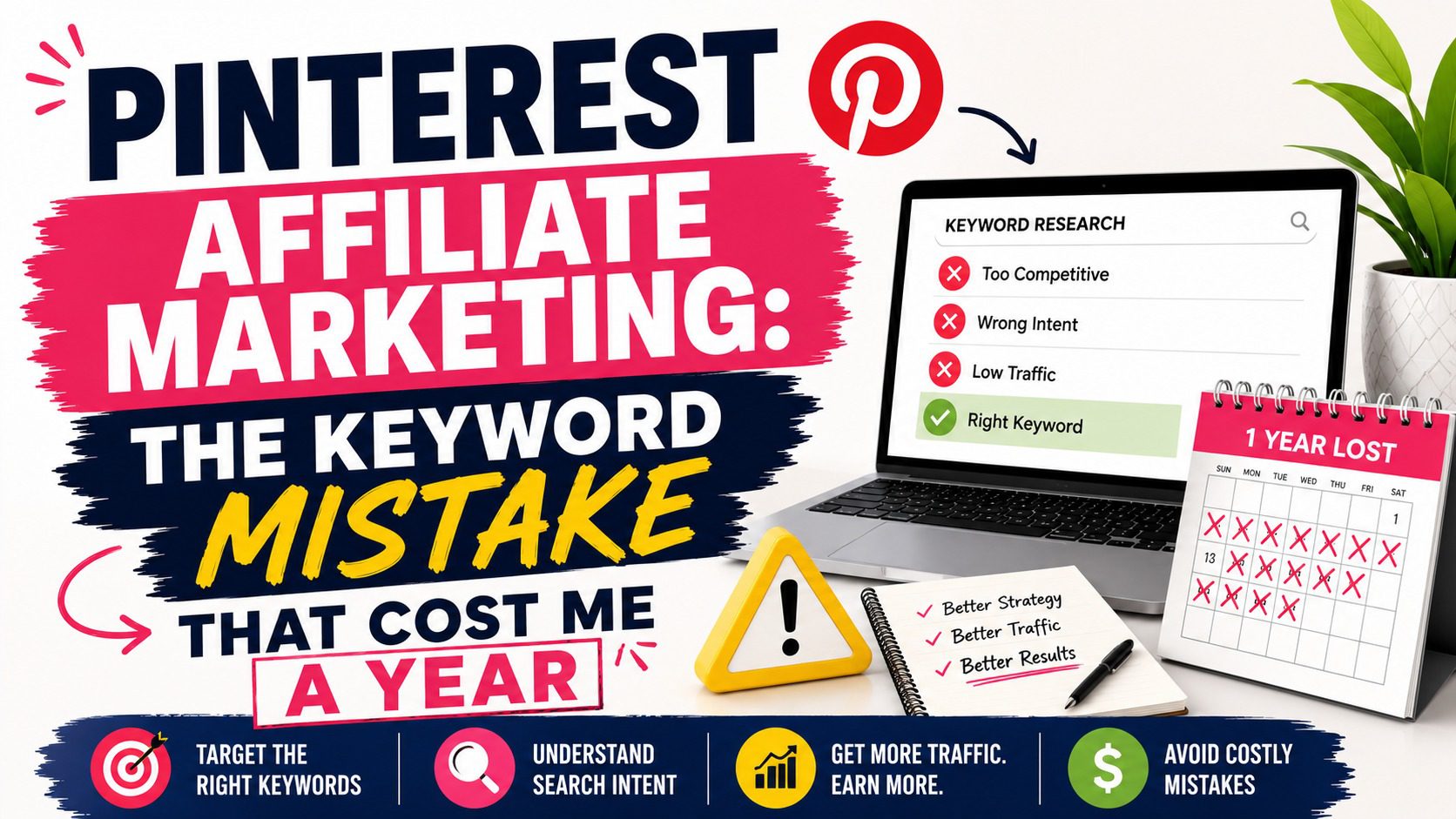
For most of a year, I made pins for keywords almost nobody was searching.
I didn’t know that. The phrases sounded right. They looked like things a person would type into Pinterest.
They weren’t. So the pins just sat there. Month after month, barely seen.
Pinterest affiliate marketing doesn’t fail because the strategy is hard. It fails because you’re aiming at words nobody types — and Pinterest will never tell you which words those are.
Pinterest Affiliate Marketing Is a Search Game. You’re Probably Guessing.
Here’s the whole chain. You make a pin. The pin shows up when someone searches a phrase. They click it. They land on your blog or your offer. Some small slice of them buys, and you earn.
Every link in that chain depends on the first one: does your pin show up for a phrase real people actually search?
If the answer is no, nothing else matters. The best pin design in the world doesn’t matter. A great blog post doesn’t matter. A strong affiliate offer doesn’t matter. Nobody sees it. The game is over before it starts.
And here’s the trap. You can’t tell which phrases work by looking at them. Phrases that sound popular are often completely dead. Phrases you’d never think to use are quietly enormous.
You can’t feel your way to this. You have to see the numbers.
Most people never do. They copy keywords off whoever’s pin is ranking above them. They reach for the words that sound professional. They pick the phrase that matches how they’d describe the topic to a friend. All of that is guessing in a nicer outfit. It feels like research. It isn’t. Research has numbers in it.
Real Numbers, So You See Exactly What I Mean
Let me show you four phrasings of the same basic topic. These are real monthly Pinterest search numbers.
“Pinterest traffic.” Sounds like something people search constantly, right? Actual Pinterest search volume: zero. If you built your whole affiliate strategy around that phrase, you’d be invisible. Not small. Invisible.
“Pinterest SEO.” The on-the-nose term for this exact skill. 970 searches a month. Real, but small.
“Pinterest affiliate marketing.” 8,260 searches a month. More than eight times bigger than “Pinterest SEO” — and to the person typing it, it means almost the same thing.
“Pinterest keywords.” Over 90,000 searches a month. Looks like the jackpot. It isn’t. Dig into who’s actually searching it and most of that volume is people hunting aesthetic keywords and profile-picture keywords — not marketers, not buyers. Massive number. Wrong human. Write a pin for it and you’ll pull in a crowd that bounces in three seconds.
Look at that spread. Same topic, four ways to say it, and the numbers run from zero to ninety thousand.
That’s the lesson, and it’s two parts. Volume alone is a trap — a huge number with the wrong searcher is worse than useless. And the obvious phrase is almost never the winner. You need real volume and the right intent, and you cannot eyeball either one.
For affiliate marketing specifically, this is the difference between a pin that earns for years and a pin that earns nothing, ever. A well-targeted pin keeps getting found long after you made it — still working months later, still sending clicks, still earning. A badly targeted pin is dead the day you post it. Same amount of work either way. One is an asset. The other is a wasted afternoon. The keyword is what decides which one you built.
Why You Can’t Just Use the Pinterest Search Bar
“But Lori, the search bar autofills suggestions when I start typing.” It does. And that’s better than nothing.
But the search bar gives you words. It does not give you numbers.
It’ll hand you ten ways to phrase your topic. It will not tell you which one gets 8,000 searches and which one gets eight. You’re still guessing — you’ve just got a shorter list to guess from.
I guessed for a long time. I picked the phrasing that sounded best to me. “Sounded best to me” is not data. It’s a feeling. And a feeling is how I lost the better part of a year pinning into silence.
The Tool That Shows the Actual Numbers: Pinclicks
I use Pinclicks for this. It does one job and does it well: it shows you the real monthly search volume for Pinterest keywords.
Here’s what I actually do with it. I type in a topic. Pinclicks lists every related keyword with its real search number attached. I sort by volume. In about ten seconds I can see which phrasing wins, which sounds-good terms are dead on arrival, and — this is the part that changed everything — which adjacent keywords I never would have guessed are quietly huge.
Every example I just walked you through — the zero, the 970, the 8,260, the 90,000 — that came straight out of Pinclicks. That isn’t me being clever. That’s me reading numbers off a screen before I make a single pin.
The adjacent keywords are where the real money hides. The obvious phrase — the one you’d type from memory — is usually thin. But right next to it sits a phrasing that means the same thing to a human and pulls several times the traffic. You would never find that by guessing. There’s nothing in your head telling you it exists. The tool just shows it to you, sitting there in the list, every single time.
That’s the whole pitch. Not magic. Just numbers, in front of you, before you commit hours of work to a phrase. If you want to stop guessing, start with Pinclicks and run one topic through it.
How to Research a Keyword Before You Make the Pin
- Start with the topic, not the phrasing. You have a blog post or an affiliate offer to promote. Don’t lock in a keyword yet. Just name the topic in plain words.
- Run the topic through Pinclicks. Pull every related keyword it returns. You want the whole list, not your favorite three.
- Sort by search volume. Now you’re looking at reality instead of your gut. The order will surprise you almost every time.
- Check the obvious term — and expect it to be small. The on-the-nose phrase is usually not the winner. Note its number. Do not marry it.
- Find the adjacent term that’s quietly huge. There is almost always a phrase that means nearly the same thing with five or ten times the volume. That’s your primary keyword.
- Sanity-check the intent. A big number is not enough. Ask who is typing it. If the volume is real but the searcher isn’t your buyer, skip it — no matter how good the number looks.
- Build the pin around the keyword you confirmed. The pin title, the description, the blog post it points to — all aimed at the phrase you verified, not the phrase you assumed.
That’s the entire job. Ten minutes of checking numbers before you spend hours making pins.
Do it in that order and your work compounds. Do it backwards — make the pins first, hope second — and you can pin every single day for a year into total silence. I know, because that was me.
What Changed When I Started Checking First
Once I targeted keywords people were actually searching, the pins started getting found. Found pins get clicks. Those clicks landed on my blog — and the blog earns from ads and affiliate links on every visit.
That’s the Pinterest income I’ve written about before — around $1,500 a month — and it did not move until the targeting did. Same pins. Same effort. Different keywords. That was the whole difference.
I’ll be honest about how that felt, because it wasn’t a clean victory. The first thing it did was sting. I had to look at months of pins I’d made with real care and admit they were aimed at nothing. That is not a fun afternoon. But it was also the most freeing thing — because it meant the problem was never my effort, and it was never my pins. It was one fixable input. I had been working hard in the wrong direction, and the wrong direction has a cure.
Pinterest affiliate marketing isn’t a volume problem. It’s an aim problem. Fix the aim first, and everything you were already doing finally starts to count.
Where to Go From Here
Two ways forward.
If you want to run this yourself, get Pinclicks and take one topic you’re about to pin. Look up the real numbers before you make anything. One session and you’ll see exactly which phrases you’ve been guessing wrong — it’s a little uncomfortable, and it’s the most useful ten minutes you’ll spend on Pinterest this month.
If you’d rather have someone do it with you — pick your keywords, read the data together, build the targeting around your actual offers until your pins start landing — that’s what Ballen Academy is for. I coach this directly, with the people doing it.
Pick one. But before you make your next pin, look up the number.
Pinterest will never tell you which words work. The numbers exist anyway. Look them up before you make the pin — not after a wasted year.
Frequently Asked Questions
Can you really make money with Pinterest affiliate marketing?
Yes — but it lives or dies on keyword targeting. A pin only earns if it gets found, and it only gets found if it’s built around a phrase people actually search. Get the keyword right and Pinterest affiliate marketing works. Guess at the keyword and even great pins earn nothing.
How do you find keywords for Pinterest?
Start with your topic, not a phrase. Run it through a Pinterest keyword tool that shows real search volume, sort by that volume, and look for the term with strong numbers and the right searcher behind it. The Pinterest search bar can suggest words, but it won’t show you the numbers — and the numbers are the entire point.
Do Pinterest keywords actually matter that much?
They’re the first domino. Pinterest is a search engine, so a pin’s reach is decided by whether it matches a phrase people type. Pin design, posting consistency, blog quality — all of it only pays off after the keyword is right. The keyword isn’t one factor among many. It’s the gate everything else has to pass through.
Is Pinterest affiliate marketing good for beginners?
It’s one of the more beginner-friendly paths, because you don’t need a following — you need findable pins. The catch is that beginners tend to guess at keywords and then quit when nothing happens. Learn to research keywords first, and you skip the most common reason people give up.
This post contains affiliate links. If you sign up through one of them, I may earn a commission at no extra cost to you. I only recommend tools I actually use.
Hey there! Just a quick heads-up: some of the links on this site are affiliate links, meaning I may earn a small commission if you make a purchase (including through the Amazon Associates program), at no extra cost to you. Occasionally, products featured here are gifted by brands.
I also use AI tools to help research and create content for you! While I love sharing strategies to help you succeed, please remember that everyone's journey is unique—individual results vary, and there are no guarantees. Thanks so much for stopping by!