Clicky

You’re Losing Money on Pinterest Affiliate Marketing: Here’s How to Fix It Today

This website contains affiliate links. Some products are gifted by the brand. As an Amazon Associate, I earn from qualifying purchases. The content on this website was created with the help of AI.

While I share money-making strategies, nothing is "typical", and outcomes are based on each individual. There are no guarantees.

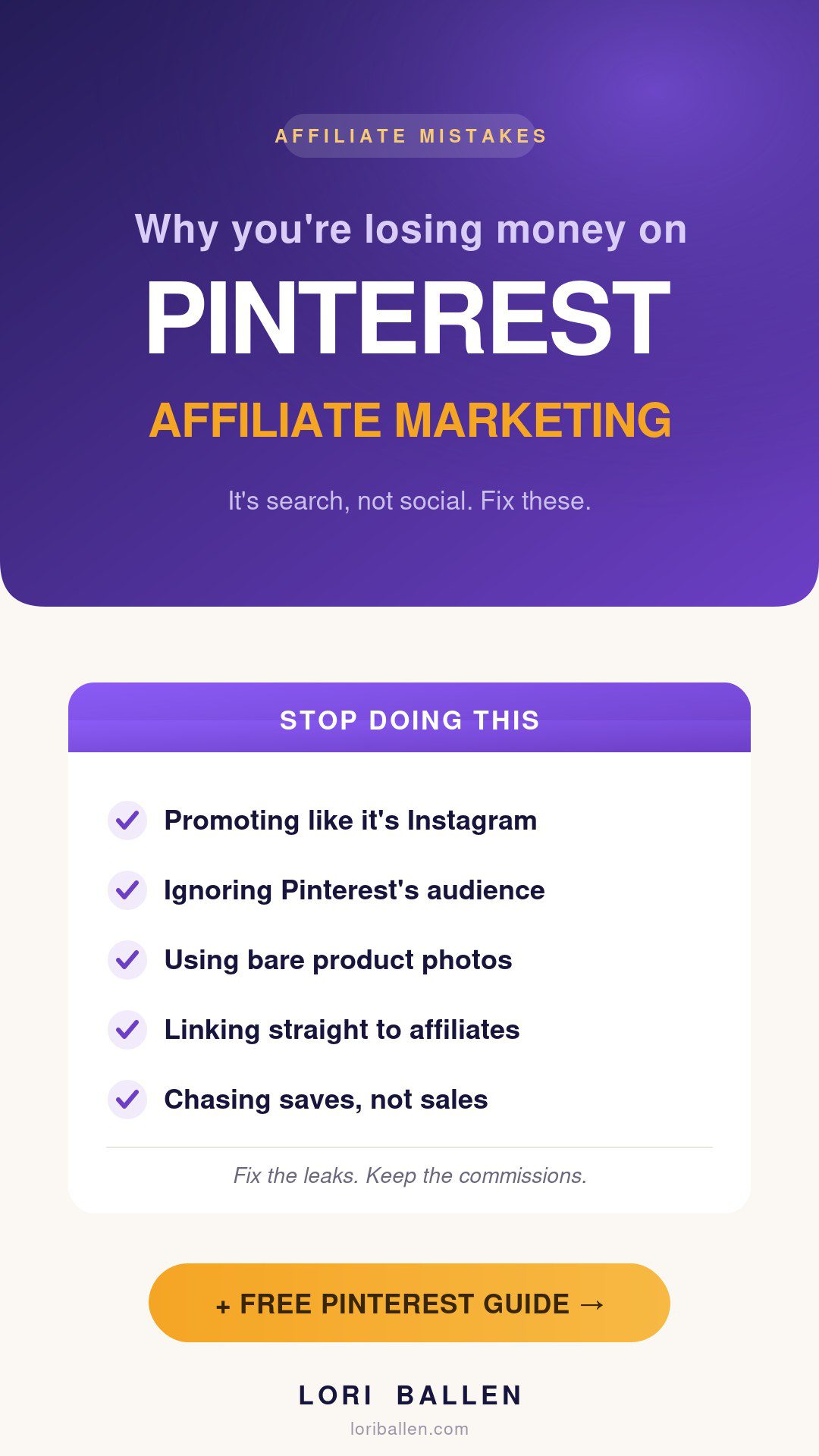
Most people attempting Pinterest affiliate marketing fail because they’re not using the right traffic-driving platforms and promoting affiliate products as if they’re selling directly. Pinterest isn’t a traditional social media platform—it’s a search engine with social features, which means the dynamics of successful promotion differ dramatically from Instagram or Facebook. Without understanding this crucial distinction, you’ll waste months creating content that generates clicks but zero conversions. Let me reveal exactly where most affiliates are losing money and how to fix it immediately.

The Pinterest Ad Behavior Problem

Pinterest’s algorithm punishes promotional content because the platform prioritizes saving, not sharing, making traditional affiliate marketing tactics completely ineffective. When you post a photo to Instagram with a caption pushing an affiliate link, your followers share it socially, amplifying your reach. Pinterest users behave differently—they save content they find valuable without necessarily trusting or recommending it to others. This fundamental difference means your affiliate strategy must evolve.

Pins with explicit promotional language perform worse than informative, benefit-driven pins. “Click here to buy at an amazing discount” generates fewer clicks and saves than “The best affordable kitchen scales for accurate baking under $50.” The second version focuses on the value proposition rather than the purchase opportunity, which aligns with how Pinterest users consume content.

Over-promotion burns out Pinterest’s algorithmic trust faster than any other social platform. The platform tracks which users consistently promote affiliate products and reduces their reach accordingly. Many affiliates notice their pins suddenly stop performing after 30-45 days of heavy promotion, not realizing they’ve triggered Pinterest’s detection systems.

Unpacking the Audience Problem

Pinterest audiences are willing to click but often not willing to buy, creating a conversion gap that defeats affiliate marketing profitability. The platform skews heavily female and heavily toward home, lifestyle, DIY, and wellness categories. If your affiliate products don’t naturally fit these categories, you’re fighting against audience behavior rather than with it.

Users saving your pins doesn’t mean they’ll click the affiliate link, and clicking doesn’t mean they’ll purchase. A pin about budget home decor might generate 5,000 saves and 500 clicks, but if only 10 of those clicks convert to purchases, your earnings are minimal. The conversion gap between Pinterest traffic and actual sales is enormous because users are primarily focused on inspiration rather than purchasing intent.

Niche audiences on Pinterest perform better than broad product recommendations. Rather than promoting “affordable kitchen tools,” focus on “best gifts for people who love baking” or “affordable kitchen tools for small apartment kitchens.” These narrower angles attract more purchase-ready audiences willing to engage with affiliate links.

The Content Mismatch Problem

Most affiliate marketers fail on Pinterest because they use product photos as pins, which don’t save or convert as effectively as lifestyle and inspirational content. A generic photo of a coffee maker gets ignored. A lifestyle photo showing the coffee maker in a beautiful morning routine context gets saved repeatedly. Pinterest’s algorithm favors rich, inspiring visual content over basic product images.

Create pins that show products being used in aspirational scenarios rather than standalone product shots. Rather than promoting “affordable standing desk,” create a pin showing an organized home office setup featuring that standing desk. The aspirational context positions the affiliate product as part of a desirable lifestyle rather than as a standalone item to purchase.

Tools like Ideogram help you quickly generate lifestyle-focused pin designs that align with Pinterest aesthetics. Instead of manually creating every pin, use AI design tools to produce variations of high-performing pin concepts. This allows rapid testing to identify which contexts and lifestyle scenarios resonate most with your specific audience.

The Strategy Mismatch Problem

Successful Pinterest affiliates treat the platform as a content library rather than a daily posting social media channel. Most affiliates post once daily and expect consistent traffic, not realizing Pinterest users discover content through search, not feeds. Pins you created months ago continue driving traffic, while Instagram posts disappear within 24 hours.

Create comprehensive resource pins that address specific problems your audience faces, then support them with Tailwind scheduling to maintain consistent impressions. Rather than posting one kitchen scale review, create 10 variations of kitchen scale pins addressing different use cases: “scales for bakers,” “scales for small kitchens,” “scales under $50,” etc. Use Tailwind to distribute these strategically over months, building cumulative visibility.

Link your pins to longer blog content rather than directly to affiliate links whenever possible. Pins directly linking to affiliate products have lower click-through rates and conversion rates. Pins linking to blog articles you’ve written about products perform better because readers perceive them as educational rather than purely promotional. Once they’re reading your blog, you can place affiliate links naturally within the content.

The Niche Selection Problem

Choosing affiliate product categories that don’t align with Pinterest’s core audience demographics guarantees failure, regardless of your effort. Promoting car accessories, business software, or professional equipment on Pinterest is swimming upstream. Pinterest excels with home decor, wellness, lifestyle, crafts, DIY, fashion, fitness, and personal development products.

Evaluate potential affiliate product niches by how well they match Pinterest’s documented audience interests. Before committing months to a niche, spend one week studying what performs best in that category. Look for pins with thousands of saves and high-quality designs. If you can’t find successful examples in your chosen niche, that’s a signal the niche isn’t suitable for Pinterest affiliate marketing.

Use tools like PinClicks to analyze existing pin performance in your target niche before investing heavily. See what types of pins are generating the most clicks and engagement. This competitive analysis reveals whether your chosen niche has Pinterest demand before you waste time building content for an audience that simply isn’t there.

The Account Authority Problem

New Pinterest accounts with zero followers and minimal engagement start with zero algorithmic advantage, forcing you to build credibility before expecting real traffic. Unlike Instagram where you can buy followers, Pinterest’s algorithm relies on saved content and engagement. A brand new account promoting affiliate products immediately looks like a spam account, triggering suppression before you gain traction.

Build account authority by posting non-affiliate valuable content for 2-4 weeks before aggressively promoting affiliate products. Share inspiration pins about your niche, lifestyle content, and educational material. Build followers and engagement naturally. Once your account demonstrates it’s genuinely interested in the niche rather than pure promotion, the algorithm treats your affiliate pins more favorably.

Link your Pinterest profile to a blog or website to increase algorithmic trust and credibility. Accounts without external website links are treated with more skepticism. If you’re an affiliate marketer, having a real blog or website backing up your Pinterest profile dramatically increases your account authority and pin distribution.

The Traffic Quality Problem

Pinterest traffic looks impressive in volume but converts poorly because users aren’t in “buying mode” when they arrive at your landing pages. Someone inspired by your lifestyle pin saves it, then potentially clicks it weeks later. By that time, they’ve moved on from the initial inspiration and forgotten why they saved the pin. This timing mismatch destroys conversion rates.

Create urgency and re-engagement through email marketing to convert Pinterest traffic into actual customers. When visitors arrive from Pinterest, capture their email address before directing them to affiliate products. Send follow-up emails with the product recommendation, which keeps the initial inspiration fresh and dramatically improves conversion rates over cold affiliate link clicks.

Use Lasso to organize and track your affiliate links, ensuring you’re maximizing commission tracking even when traffic quality isn’t perfect. While Pinterest traffic requires more conversion optimization than other sources, proper tracking reveals which products, categories, and strategies generate actual commissions rather than just vanity traffic metrics.

The Optimization Failure Problem

Most Pinterest affiliates set up their campaigns and never optimize, missing opportunities to improve conversion rates as they learn what works. The first version of your pin design, copy, and landing page strategy probably isn’t optimal. Successful affiliates test variations systematically, identify top performers, and double down on what works.

Test different pin designs, headlines, and descriptions to identify high-conversion combinations. Create 5-10 variations of pins for the same product with different aesthetics or headlines. Track which perform better. Double down on variations that generate clicks and eventual conversions rather than just pins with the most saves.

Measure success by actual affiliate commissions and sales, not by pins saved or pins clicked. Many affiliates celebrate 5,000 pin saves and 200 clicks without realizing zero clicks converted to purchases. Focus entirely on conversion optimization rather than vanity metrics. This mindset shift transforms Pinterest from a frustrating low-conversion platform into a steady affiliate income stream.

Recommended Tools for Pinterest Affiliate Success

  • PinClicks – Pinterest analytics and niche research platform
  • Tailwind – Pinterest scheduling and automation tool
  • Lasso – Affiliate link management and tracking
  • Ideogram – AI-powered pin design creation

Frequently Asked Questions

Can you actually make money with Pinterest affiliate marketing?

Yes, but it requires significantly more time and optimization than other affiliate channels because Pinterest traffic converts poorly without specific strategies. Most Pinterest affiliates give up too early before optimizing for quality over quantity. Those who focus on conversion optimization and proper audience selection eventually build profitable income streams from Pinterest traffic.

How many Pinterest followers do you need to make money?

Follower count matters far less than pin performance and audience quality. Accounts with 5,000 followers generating high-quality pins often outperform accounts with 50,000 followers with mediocre pins. Focus entirely on pin quality and audience targeting rather than chasing follower numbers. Many successful Pinterest affiliates have small follower counts but massive pin reach through organic distribution.

What’s the average commission from Pinterest affiliate links?

Average commissions depend entirely on the affiliate products you promote, ranging from 1-20% depending on category and affiliate program. Home and lifestyle affiliate programs typically offer lower commissions (2-5%), while software and courses offer higher commissions (20-30%). Your selection of high-commission affiliate products dramatically impacts profitability regardless of traffic volume.

How long does it take to make $1,000 monthly from Pinterest affiliates?

Most affiliates need 4-8 months of consistent optimization before reaching $1,000 monthly, though timeline varies based on niche selection and traffic quality. The first two months focus on figuring out what works. Months three through six involve scaling what works. By month seven, sustainable income becomes possible if you’ve chosen a profitable niche with proper audience alignment.

Should I promote multiple affiliate products or focus on one?

Start with a single high-quality affiliate product to master Pinterest marketing before scaling to multiple products. Once you understand how to convert Pinterest traffic into customers for one product, expanding to complementary products becomes easier. Many affiliates fail because they diversify too quickly without mastering conversion optimization for any single product.

Keep Learning

Ready to fix your Pinterest affiliate strategy and start earning real commissions? Continue your education through these trusted resources:

  • Ballen Academy – Complete courses on Pinterest marketing and affiliate strategies
  • Books – In-depth guides on social media affiliate marketing
  • Substack – Weekly insights on Pinterest and content strategies
  • YouTube – Video tutorials on Pinterest success strategies

Discover more from Lori Ballen Digital Marketing

Subscribe to get the latest posts sent to your email.

Picture of Lori Ballen

Lori Ballen

I teach creators how to build a life of flow and freedom by focusing on what matters most.

Learn My Strategies

Table of Contents

Picture of Lori Ballen

Lori Ballen

I started over after a 25 year marriage. I was 45. Slowly, I recovered and built a multiple six-figure business which I run alone. I don't have employees, but I do have great systems. I teach everything I have learned on this blog. I teach my specific strategies in my group coaching program at Ballen Academy.

Discover more from Lori Ballen Digital Marketing

Subscribe now to keep reading and get access to the full archive.

Continue reading

Free Course

 Learn SEO, Affiliate Marketing, Blogging, Video, and more.

Lori Ballen SEO

Get My Tutorials…

I send out my best video tutorials and written guides + invites to live streams and evens.

Receive the latest news

Get My Stupid Simple Cheat Sheet for 2022

And more great tutorials.

I put my best strategies in these guides!