This website contains affiliate links. Some products are gifted by the brand. As an Amazon Associate, I earn from qualifying purchases. The content on this website was created with the help of AI.
While I share money-making strategies, nothing is "typical", and outcomes are based on each individual. There are no guarantees.
When my Pinterest traffic dropped by 20,000 views overnight, I panicked. I hadn’t changed much—just tweaked a few board titles I thought could be clearer. But that small edit sent Pinterest’s algorithm into a tailspin. My rankings vanished.
Instead of undoing everything, I slowed down. I analyzed which boards lost the most traffic, checked their old keywords in PinClicks, and realized I’d stripped out strong search phrases in favor of “prettier” ones. I rewrote each title, added my main keywords back, and pinned fresh content that matched.
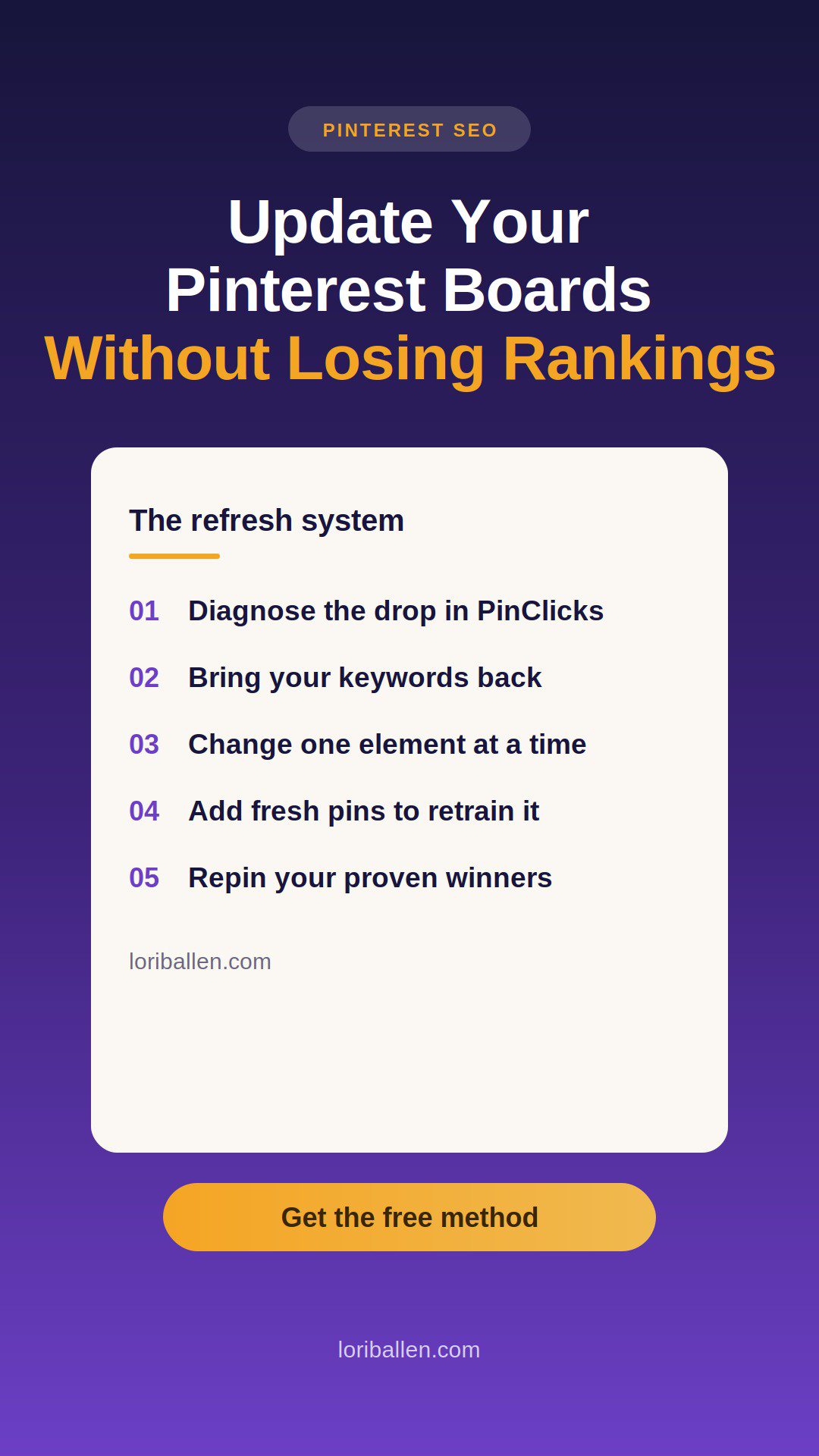
Within a week, I started seeing impressions climb again. By day ten, my reach was higher than before. That’s when it hit me: Pinterest doesn’t punish updates—it punishes chaos. Edit one thing at a time. Keep your keywords. Feed the algorithm fresh signals. That’s how I brought my 20K views back.
Why Multiple Boards Matter
Instead of undoing everything, I went into detective mode. I pulled up my analytics in my pinclicks ranking tracker, and saw exactly where the drop started — right after those title edits. That’s when I realized Pinterest had no clue what my boards were about anymore. I’d gotten too clever with my wording and stripped out every strong keyword that once told the algorithm, “Hey, this belongs here.”
So I rebuilt it from the ground up. I brought my keywords back, cleaned up my descriptions, and added five fresh pins to each board to retrain Pinterest’s focus. Within a few days, the numbers started turning around — proof that clarity beats creativity every single time when it comes to SEO.
How to Optimize Your Boards for SEO
Once I understood what went wrong, I started testing small, calculated changes. I picked one board — my “Cozy Living Room Ideas” — and used it as my experiment. I adjusted the title first, leaving the description alone so Pinterest wouldn’t have to relearn everything at once. Then I pinned three new posts with those same keywords front and center.
Within 48 hours, impressions doubled. That’s when I realized how sensitive Pinterest is to signals of consistency. Every keyword, every image, every pin description matters. The moment you align them, the algorithm rewards you. From then on, I stopped editing ten things at once and started treating each board like a live SEO project — one clean move at a time.
Visual Consistency Matters
After that test worked, I scaled the process across my profile. I tackled one board per week, starting with the ones losing the most traction. I’d open PinClicks, check which keywords were driving impressions, and make sure those phrases were still visible in the title, description, and first few pin captions. Then I’d schedule a few fresh pins through Tailwind to keep momentum steady.
That’s when things started compounding. The boards I optimized early began feeding traffic to the others.
My profile engagement rose across the board, and even my older pins started ranking again. It wasn’t luck—it was discipline. Pinterest rewards structure, not speed.
Why Board Descriptions Affect Rankings
Once I fixed my board descriptions, the results were immediate.
Traffic started flowing from search again, not just from repins. That’s when I realized descriptions aren’t filler — they’re the bridge between Pinterest’s algorithm and the people actually saving your content. When you write them clearly, both sides understand you. Now, before I hit publish on any new board, I ask two questions: Does Pinterest know what this board is about, and would a real person follow it? If the answer to either is no, I rewrite it.
That one habit alone keeps my boards ranking, my traffic steady, and my pins showing up in front of the right audience week after week.
When to Update Board Descriptions
Updating board descriptions became part of my regular Pinterest maintenance routine. I stopped waiting for traffic dips to force a reaction and started reviewing everything quarterly — the same way you’d service a car before it breaks down.
I’d open PinClicks, look at search trends, and rewrite weak descriptions with phrases already gaining traction across my niche.
The impact was clear every time. Within a few weeks, boards that had gone flat started climbing again in impressions and outbound clicks. The lesson was simple: Pinterest rewards relevance. When you refresh your language before it goes stale, you stay visible — and your content keeps circulating long after it’s posted.
Editing Board Titles Without Losing Rankings
When I change a board title, I treat it like a high-stakes SEO move — not a quick fix. I’ve learned that Pinterest reads title edits as a complete context shift, so the key is precision, not creativity. Before touching anything, I check which keywords are driving that board’s impressions in PinClicks. Then I build around those terms instead of replacing them.
If a board already ranks, I’ll expand the phrase slightly rather than rewrite it. “DIY Home Projects” becomes “DIY Home Projects and Simple Decor Ideas.” That one addition tells Pinterest, “Same topic, broader reach.” The next day, I’ll post three new pins using those exact words in the title and description — proof to the algorithm that nothing broke, I just made it better.
Reindexing After Board Edits
Reindexing is the waiting game that most creators skip — and that’s where they lose. After a big edit, Pinterest needs time to crawl, test, and reclassify your board. I used to panic when impressions dipped, but now I know it’s part of the cycle. That dip is just Pinterest figuring out where you belong in the new keyword landscape.
When I edit a title or description, I immediately post five new pins that reinforce the change. It’s like handing Pinterest a map. Within a week, the metrics start rising again, and by week two, everything locks back in. The key isn’t avoiding dips — it’s managing them through steady, keyword-aligned activity.
You’ll know reindexing is complete when your analytics show upward movement in impressions and keyword visibility for that board. Tools like PinClicks’ Rank Tracker make this easy to spot — you’ll start seeing new keyword rankings shift upward once Pinterest locks in the changes.
Why Rankings Sometimes Drop After Edits
When my rankings dip now, I don’t panic — I track. I open PinClicks, look at which keywords lost ground, and cross-check them with the edits I made. Nine times out of ten, the dip lines up with a keyword I weakened or removed. Instead of chasing numbers, I fix alignment. I bring the term back, update a few pin titles, and add new pins that reinforce the topic.
Almost every time, visibility rebounds higher than before. That’s how Pinterest works — it doesn’t punish change; it tests confidence. If you stay consistent with your content signals, it learns to trust you again. The secret isn’t avoiding dips. It’s teaching Pinterest who you are every single time you make a move.
How to Update Without Losing Traffic
The goal when updating boards is control, not speed. I’ve learned to move one piece at a time — title first, then description, then visuals. It’s the only way to protect keyword history while showing Pinterest I’m evolving, not starting over. When I make changes in layers, my rankings barely dip.
If I overhaul everything at once, Pinterest has to relearn the entire board from scratch. That’s when impressions stall. Now, I think of each edit as a signal — one clear message at a time. Slow, steady updates backed by fresh, keyword-aligned pins always outperform big, flashy changes.
Why Fresh Pins Stabilize SEO
Fresh pins are my reset button. Whenever a board slows down or goes through edits, I don’t wait for traffic to fix itself — I feed Pinterest proof. I create a new batch of pins around the same keywords and schedule them out daily. That slow, steady activity tells the algorithm the board is alive and aligned with current search behavior.
Within days, impressions start to rise again. It’s not about volume; it’s about precision. Ten intentional pins built around your strongest keywords will outperform fifty random uploads every time. Fresh pins are how you rebuild momentum — quietly, consistently, and on your own timeline.
Repinning Old Content Strategically
Repinning old content is my insurance policy. When a board feels shaky after edits, I don’t reinvent everything — I revive what’s already proven to work. I pull my top-performing pins from PinClicks, clean up their titles and descriptions with the board’s new keywords, and repin them strategically.
Two or three per day is all it takes to rebuild authority. Those pins already have engagement history, which tells Pinterest they’re trustworthy. By blending them with fresh content, I speed up recovery and strengthen rankings. It’s not about starting over — it’s about teaching the algorithm, again and again, why my content deserves to stay at the top.
Start by identifying your strongest performers. Use PinClicks or Pinterest Analytics to locate pins with high impressions, saves, and outbound clicks. These pins already carry authority in Pinterest’s system. When you repin them to your refreshed board, they act as “anchors” that reinforce your topic relevance.
Before you repin, refresh each pin’s title and description to match your new board focus. If you’ve shifted from “DIY Crafts” to “Boho Home Projects,” update the language accordingly so Pinterest understands the new connection. Keep the edits natural — avoid keyword stuffing — but make sure your main search terms are present.
Stick to repinning 5–10 evergreen pins that truly fit the updated board. Repinning too many at once can overwhelm Pinterest’s testing phase. A few well-optimized pins spaced out over several days will yield better, steadier results.
When done right, these repins help stabilize traffic faster and teach Pinterest how your new board direction ties to content that already performs — giving you a strong foundation for future growth.