Let me ask you a question. Does this sound like your website? You’ve shelled out thousands of dollars and spent who knows how many hours on a digital business card… that does nothing. It just sits there, collecting digital dust. Most real estate agents are told they need a flashy website with all the bells and whistles, a high-powered property search, and a dozen other “must-have” features. But the truth is, those sites are practically designed to fail.
Why? Because they are all making the exact same mistake.
In the next few minutes, I’m going to show you the simple framework that turned my real estate agent website from a ghost town into a lead-generating machine that actually brings in clients. And here’s the secret: you have to stop trying to be a cheap copy of Zillow.
The Problem
Let’s be brutally honest. Your clients are not coming to your website for your property search. They just aren’t. Portals like Zillow get hundreds of millions of visitors every single month. They have billion-dollar teams dedicated to making their search experience better than you could ever hope to compete with.
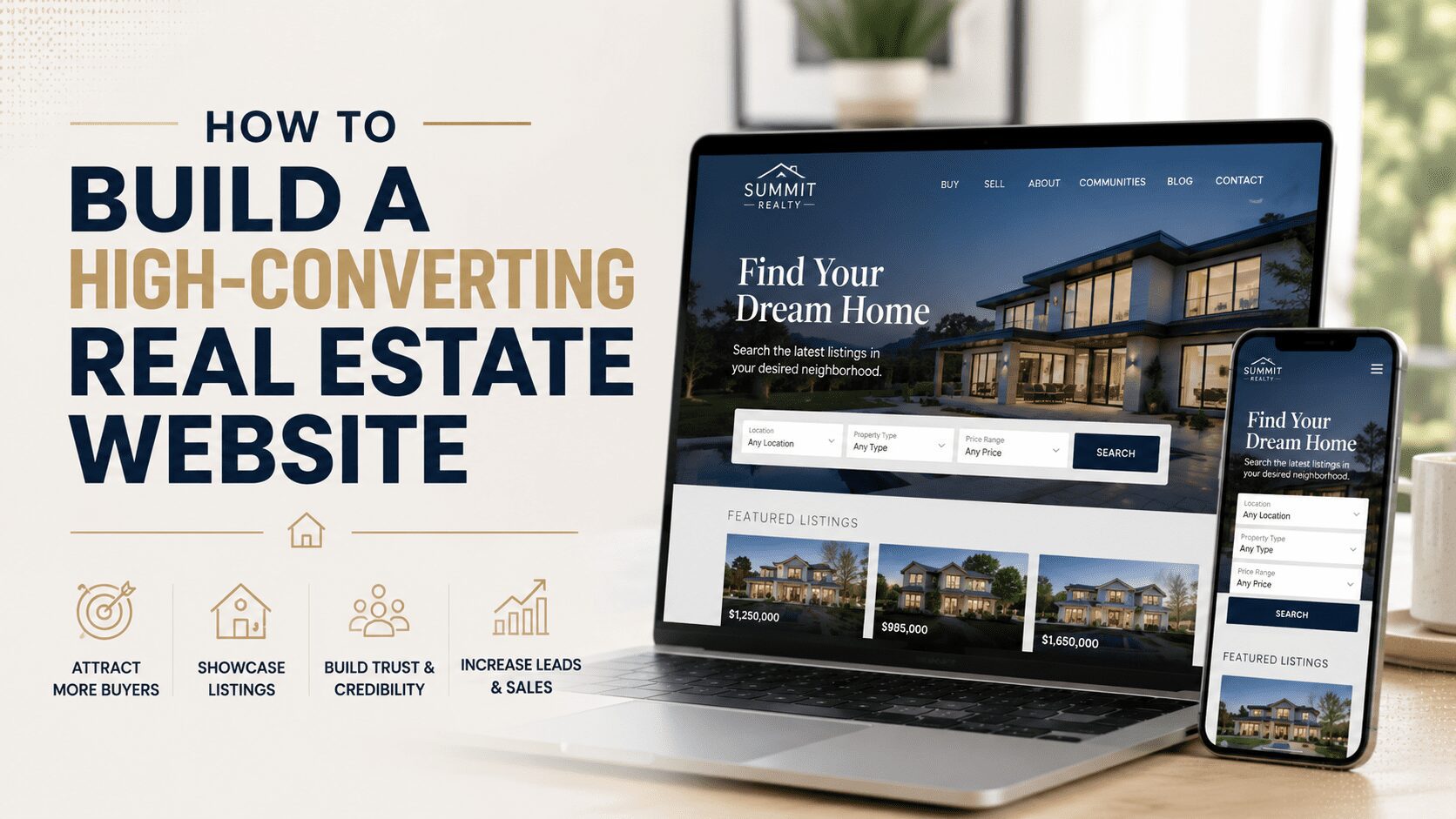
So when a potential buyer or seller lands on your site and the first thing they see is a giant, generic “Search for Homes” bar, their first thought isn’t “Wow, how helpful!” It’s, “This is just a slower, clunkier version of Zillow.” And poof. They’re gone.
The real problem is that most agent websites are built on a totally flawed idea. They’re built to showcase properties. But people don’t choose an agent because they have the best list of houses. They choose an agent because they need a trusted guide for one of the biggest, most complicated financial decisions of their lives. Your website is failing because it’s talking about houses, when it should be talking about trust, expertise, and the one thing Zillow can never offer: a personal relationship with you.
The Core Shift: Stop Selling Houses, Start Selling You
This is the mindset shift that changes everything. Your website is not an inventory catalog. It is a lead generation tool, a trust-building engine, and your platform to prove you’re the expert. The goal is to turn visitors into clients, not to help them browse the same listings they already scrolled past on a national portal.
Go ahead, take a look at five different agent websites in your market. I guarantee you’ll see the same mistake on almost every single one: the property search, the IDX feed, is the spine of the entire site. Everything else—the about page, the blog, the contact form—is just a tiny planet orbiting a giant, ineffective star.
The architecture that actually wins in today’s market flips this completely. Your site’s spine needs to be built on what converts people: your expertise, your local authority, your social proof, and a clear, transparent process. The property search is just an add-on, a feature you can bolt on later—it’s not the front door to your business. When you make this shift, you stop competing with Zillow and you start competing in a category of one: you.
The ‘You-First’ Homepage Framework
So, what does this actually look like? It all starts with your homepage. Look, we all know that first impressions are everything online. We’re talking seconds, and a huge part of that impression is based purely on design. Your homepage has to immediately tell people who you are, what you do, and why they should choose you over anyone else.
So, scrap the giant search bar at the top. Seriously. The very first thing a visitor should see is a professional, warm, high-resolution photo or video of you. Not a stock photo of a house. Not a picture of a generic, smiling family. You. This is a people business, so put a person front and center.
Right next to that image, you need a clear, powerful value proposition. This is not “Helping you find your dream home.” That’s what every agent says. Your value proposition has to be specific and focused on the client’s problem.
Are you an expert in helping first-time buyers in a certain area? “I help first-time buyers navigate Austin’s competitive market, stress-free.”
Do you specialize in downsizing for retirees? “My proven 5-step process helps retirees sell their family home for top dollar and find their perfect next chapter.”
This combination of a great photo and a specific promise immediately tells visitors who you are, who you help, and what makes you different. Then, instead of funneling them into a search, you guide them toward your main conversion tool.
The Irresistible Offer, Your IDX Replacement
Instead of that useless search bar, your homepage’s main call to action needs to be an irresistible offer—a piece of high-value, gated content that a potential client would happily trade their email address for. This is the real core of your new lead-gen engine.
Remember, buyers and sellers don’t start their journey by calling an agent. They start online, researching. Your job is to meet them there by offering them the exact information they’re searching for.
This could be:
- A downloadable PDF: “The Ultimate First-Time Homebuyer’s Checklist for [Your City].”
- A neighborhood guide: “The 10 Best Suburbs for Young Families in [Your County].”
- A market report: “The Q2 2026 Seller’s Report: What Your [Neighborhood] Home Is Really Worth.”
- A home valuation tool: A “What’s My Home Worth?” landing page is a classic for a reason—it works.
These offers are powerful because they do three things perfectly. First, they provide real value right away, establishing you as a knowledgeable expert. Second, they segment your audience for you—someone downloading a seller’s guide is probably a seller lead. And third, they capture an email address in a low-pressure way. This lets you start the most important part of the whole process: automated follow-up and nurturing through your CRM.
You’re no longer begging them to use your second-rate search tool; you’re giving them a solution to their problem, and in return, they’re becoming a qualified lead in your pipeline.
Content and Testimonials That Build Real Trust
Once you’ve made that first connection, the rest of your site is designed to build on it. This is where you prove you’re the expert your homepage promised you were. The two best ways to do this are with hyper-local content and strategic social proof.
First, content. Your website needs a blog or a video section where you answer your ideal client’s biggest questions. Focus on creating hyper-local content that makes you the undisputed neighborhood guru.
Write articles like:
- “A Local’s Guide to the Pros and Cons of Living in [Neighborhood].”
- “Top 5 Overlooked Fixes That Add 10% to Your Home’s Value in [City].”
- “School District Showdown: A Deep Dive into [School 1] vs. [School 2].”
This kind of content is amazing for local SEO and drives organic traffic from people who are actively researching your area. It builds your authority and gives you an endless supply of things to share on social media and in your email newsletters.
Second, you need to show off your social proof where it actually matters. Don’t just hide your testimonials on a separate page that nobody visits. Sprinkle your best reviews and client success stories throughout your site, especially next to your calls-to-action.
Put a powerful quote right beside your “Download the Seller’s Guide” button. Feature a video testimonial on your “About Me” page. When a visitor is on the fence about giving you their info or booking a call, a glowing review from a past client can be the final nudge they need. It shows them that real people, just like them, have trusted you and had a fantastic experience.
Conclusion
Alright, let’s recap the framework.
First, you build a ‘You-First’ Homepage. It leads with your personal brand and a specific value proposition, NOT a generic search bar.
Second, you replace that search bar with an Irresistible Offer, like a seller’s guide or a market report, that generates qualified leads you can actually nurture.
And third, you back it all up with hyper-local content and strategically placed testimonials that build unshakable trust and authority.
This is how you stop being a bad copy of Zillow and start being the go-to real estate authority in your market. A website that converts isn’t about having the fanciest tech; it’s about building a system that generates trust at scale.
Now, if you’re listening to all this and thinking it sounds like a lot of work, you’re right. But it’s work that pays off. If you’re a do-it-yourselfer, you have the blueprint. But if you’d rather have a team of experts build this kind of high-performance website for you, that’s exactly what Ballen Brands does. They specialize in building these ‘You-First’ websites for agents who want to dominate their market.
If you want to see exactly how this framework looks on a live site, you can visit my website in the description below. And if you’re serious about turning your website into a client-generating machine, make sure you subscribe. I’m sharing new strategies every single week to help you build a smarter, more profitable real estate business. Thanks for watching, and I’ll see you in the next one.
Hey there! Just a quick heads-up: some of the links on this site are affiliate links, meaning I may earn a small commission if you make a purchase (including through the Amazon Associates program), at no extra cost to you. Occasionally, products featured here are gifted by brands.
I also use AI tools to help research and create content for you! While I love sharing strategies to help you succeed, please remember that everyone's journey is unique—individual results vary, and there are no guarantees. Thanks so much for stopping by!