This website contains affiliate links. Some products are gifted by the brand. As an Amazon Associate, I earn from qualifying purchases. The content on this website was created with the help of AI.
While I share money-making strategies, nothing is "typical", and outcomes are based on each individual. There are no guarantees.
Balancing Act: Juggling Entrepreneurship and Personal Life After 40
The narrative around entrepreneurship is typically written by people in their twenties—people with energy to burn, no family obligations, and time to work 80-hour weeks. But the reality of entrepreneurship after 40 is completely different. You have responsibilities, commitments, and zero interest in sacrificing everything for a business. You’ve learned that success isn’t about how much you work; it’s about how intelligently you work. This isn’t a disadvantage; it’s actually your superpower.
Building a business after 40 requires a different approach than the startup-culture narrative suggests, but it’s an approach that produces better results. You’re not chasing VC funding or explosive growth. You’re building something sustainable that generates income without consuming your life. Many of the most successful entrepreneurs over 40 started side hustles while working full-time jobs, then transitioned to full-time entrepreneurship once the business could support their lifestyle. The path is slower but more sustainable, and you maintain income security throughout the transition.
The Reality of Entrepreneurship Over 40
By the time you’re 40, you’ve likely accumulated responsibilities that prevent you from taking extreme risks. Maybe you have a mortgage, kids in school, aging parents who need support, or health conditions that require stability. These aren’t limitations; they’re actually constraints that force you to be smarter and more strategic. You can’t afford to waste time on ideas that won’t work. You have to validate before you build. You have to start before you’re ready. You have to be disciplined with resources.
The best part about starting a business after 40 is that you’ve likely succeeded at other things, so you know how to handle setbacks, manage stress, and persist through difficulty. You’ve navigated career changes, raised children, managed finances, and overcome obstacles. That experience is invaluable. Most successful businesses fail not because the idea is bad, but because the founder quit when things got hard. You’re past the age where quitting at the first sign of difficulty is likely. You have grit.
Starting a Business While Working Full-Time
The most realistic path for someone over 40 is building a side business for 6-18 months while maintaining a full-time job. This approach eliminates financial risk, provides a safety net if the business fails, and allows you to validate the business model before quitting your day job. Many successful businesses over 40 started exactly this way. You don’t have to choose between security and entrepreneurship; you can have both simultaneously.
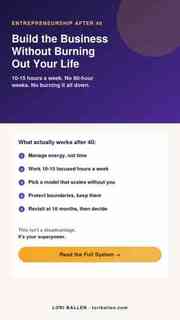
A side business working 10-15 hours weekly is manageable even with a demanding job, family, and other commitments. You’re not committing to 80-hour weeks. You’re committing to consistent, strategic work during designated time blocks. Early morning before your family wakes up, lunch breaks, evenings after kids are in bed, or weekends. Many people over 40 have successfully built side hustles with these constraints. The secret is ruthless prioritization and willingness to eliminate low-value activities.
Track your time ruthlessly for 2 weeks and identify where hours actually go. Most people discover significant time waste: excessive social media, streaming, unproductive meetings, or activities that feel important but generate no actual results. Once you identify where time is disappearing, you can reclaim 10-15 hours weekly without sacrificing work, family, or health. This is your side hustle time. Protect it like you protect a business meeting.
Choosing a Business Model Designed for Balance
Not all business models are equally compatible with the balanced lifestyle you need after 40. Choose models that can be delegated, systematized, or scaled without proportional increases in hours. Service-based businesses like consulting or coaching require you to be present for every engagement—not ideal when you have limited time. Product-based or content-based businesses can be automated and systematized, allowing you to generate income without constant personal involvement.
An affiliate marketing blog or digital products business is more compatible with a balanced lifestyle than a service business requiring 20+ billable hours weekly. A dropshipping store with automated marketing and customer service is better than managing a team of freelancers. A course selling to an audience while you create passive affiliate income is better than one-on-one coaching. Think about the direction you’re trying to move: toward more freedom, not less. Choose business models that increase freedom as you scale.
Coaching platforms like Blueprint Coaching allow you to package your expertise into scalable formats. Group coaching, courses, and membership models let you serve 100 people with the same effort that would serve 5 in one-on-one coaching. This is the leverage that makes entrepreneurship over 40 work. You’re trading client capacity for client reach.
Managing Energy, Not Just Time
After 40, energy management is more important than time management. You have the same 24 hours as everyone else, but your energy is finite. Building a business while maintaining a full-time job, family responsibilities, and health requires protecting your energy as fiercely as you protect your time. This means saying no to things that drain you, prioritizing sleep, exercise, and relationships, and being strategic about when you work on your business.
Work on your business during your peak energy hours, not leftover scraps of time. If you’re a morning person, that’s your business building time. If you’re a night owl, protect late nights for business work. If you hit an energy crash at 3 PM, don’t try to build your business during that time—do it before or after. Most people waste their best energy on their job, then try to work on their business when they’re exhausted. Flip this dynamic. Protect your peak energy for what matters most to you.
Respect your energy boundaries around rest and relationships. A business that requires sacrificing your marriage, health, or relationship with your children isn’t a success; it’s a failure in life design. Set boundaries: no business work after 9 PM, no business work on weekends, no skipping exercise or time with family. These constraints force you to be disciplined and efficient. They also keep you healthy and sane, which enables long-term success.
Handling the Guilt and Overwhelm
Many entrepreneurs over 40 struggle with guilt—guilt that they’re not spending enough time on their business, guilt that they’re not giving enough to their job, guilt that they’re not present enough for their family. This guilt is worth examining because it’s usually based on false expectations, not reality. You don’t need to be exceptional at everything. You need to be sufficient at the things that matter and excellent at the things you choose to focus on.
Accept that you’re not going to be perfect in any role right now, and that’s okay. You might be a pretty good employee but not a top performer (because you’re protecting time for your business). You might be a present parent but not the one coordinating every school activity (because you have other priorities). You might be building a business but not at the same speed as someone working full-time on it. Perfection isn’t the goal; progress is.
Many successful entrepreneurs find that starting a business actually improves their job performance. The confidence, skills, and perspective they develop as entrepreneurs makes them better at their day job. The discipline they develop for their business makes them more efficient at work. The control they’re building in their business reduces stress about workplace situations they can’t control. Rather than competing, these things often reinforce each other.
The Financial Reality of Building Slowly
Building a business over 18-36 months while working full-time is slower than going all-in, but it comes with critical financial advantages. You’re maintaining income security. You’re not burning savings. You’re not stressed about needing the business to succeed immediately because your family’s basic needs are covered by your job. This pressure relief actually helps you make better decisions. You can say no to bad clients, invest in the right tools, and take strategic risks that an underfunded, desperate entrepreneur cannot.
Most successful businesses over 40 eventually transition to full-time entrepreneurship once the business generates $3,000-5,000 monthly. At that point, you have enough income to cover some of your personal expenses while you continue growing. You don’t need to replace your entire salary on day one. You need to replace it gradually. This approach gives you security while transitioning and allows for a much smoother transition than a hard quit to full-time entrepreneurship.
Building a Support System
Entrepreneurship after 40 is harder without a support system, yet many entrepreneurs try to do it alone. Share your entrepreneurial goals with your spouse or partner. Help them understand your timeline and what you need from them. Sometimes you need them to take kids to soccer so you can work on your business. Sometimes you need them to be your sounding board when things are hard. A supportive partner transforms what might be a source of relationship stress into something that strengthens your relationship.
Connect with other entrepreneurs in similar seasons of life—people also balancing entrepreneurship with substantial personal and professional responsibilities. Online communities, mastermind groups, and coaching from someone like Lasso experts provide not just business advice but emotional support and perspective. You realize you’re not alone. Others are navigating the same challenges. Shared experience is incredibly powerful.
The Unexpected Advantages of Starting Over 40
Starting a business after 40 comes with advantages that younger entrepreneurs don’t have. Your network is decades in the making. People know you, respect you, and want to help. Your judgment is better because you’ve seen more cycles and can identify patterns. Your risk tolerance is appropriate because you understand what actually matters. You’re not trying to change the world; you’re trying to build something that works. That mindset is incredibly powerful.
You also have perspective that money and fame are not the same as fulfillment. This means you can make business decisions based on what actually serves your life, not what impresses others. If a business would require traveling constantly and you value being home, you don’t take it. If an opportunity requires becoming someone you’re not, you pass. This clarity about values is rare in younger entrepreneurs and invaluable in building a sustainable life.
Timeline Expectations
Expect 18-36 months of side business building before reaching $5,000 monthly income with a business you started part-time. This is the realistic timeline if you’re working 10-15 hours weekly on the business while maintaining a full-time job. It’s not as fast as someone going all-in, but it’s dramatically more stable. Within 3 years, you can have a viable business generating serious income while having maintained financial security throughout the process.
Set markers for decision points: at 18 months, evaluate whether you want to transition to full-time entrepreneurship. At that point, you’ll have real data about whether the business is working, whether you’re enjoying it, and whether you have enough income to take the next step. This timeline gives you opportunity to adjust course if needed without having blown up your financial security.
Recommended Tools
- Blueprint Coaching – Coaching platform for packaging expertise into scalable offerings
- Lasso – Link management for entrepreneurs building affiliate income
- ViralVue – Social media automation for consistent content distribution
Frequently Asked Questions
How do I handle my boss and employer finding out I’m building a business?
First, check your employment agreement—most allow side business work as long as there’s no conflict of interest or time theft from your employer. You’re building on your own time, on your own equipment, in your own space. That’s completely legitimate. That said, you don’t need to advertise it. Be professional at work, don’t talk about your business constantly, and don’t do business work during company time. Most employers don’t care what you do on your own time as long as the work gets done.
What if my spouse is not supportive of my entrepreneurial goals?
This is a real conversation to have directly and honestly. Help them understand what you’re trying to build, why it matters to you, and what you need from them. Maybe they’re worried about finances—show them the plan and timeline. Maybe they feel neglected—set boundaries that protect time together. Maybe they think you’re unrealistic—invite them to track your progress. Often, initial skepticism comes from lack of understanding, and real conversation solves it. If it doesn’t, working with a couples counselor might help you navigate this.
Is it realistic to build a business while working full-time and parenting?
Yes, but with realistic expectations about the timeline and intensity. You won’t build as fast as someone working 60 hours weekly on their business. But you will build sustainably, with security, and without sacrificing your family. Many successful entrepreneurs started exactly this way. The key is accepting that slow progress is still progress. You’re not trying to build the next unicorn; you’re trying to build something that works for your life.
Should I quit my job to focus full-time on my business?
Not until your business generates enough income that you’re comfortable. The traditional advice to “follow your passion” and “quit your job” works for people with significant savings or startup funding. Most people over 40 need income security. Build your business to a point where it can support itself and supplement your job income. Then, when you’re comfortable with the risk, make the transition. You might find you never need to quit—many successful entrepreneurs maintain both income streams indefinitely.
How do I avoid burnout while building a business and working full-time?
Set non-negotiable boundaries: protected sleep, exercise, and time with family. These aren’t luxuries; they’re maintenance. Your mental and physical health enable entrepreneurship; sacrifice them and you’ll burn out. Also, set a cap on business hours—maybe 15 hours weekly is your max. When you hit that cap, you stop. You’re not working 80-hour weeks. This constraint forces efficiency and prevents burnout. Many entrepreneurs find that protecting these boundaries actually leads to better business results because they’re working smarter, not just harder.
Keep Learning
Building a sustainable business while maintaining a balanced life is one of the most important skills for entrepreneurs over 40. Visit Ballen Academy for courses on building businesses without burning out. Explore the Books section for books on entrepreneurship and life balance. Follow the latest insights on Substack for weekly tips on sustainable entrepreneurship. Check out the YouTube channel for video content on building entrepreneurship while maintaining work and life balance.
Related
Discover more from Lori Ballen Digital Marketing
Subscribe to get the latest posts sent to your email.