This page contains affiliate links — if you click through and sign up or buy, I may earn a commission at no extra cost to you. I only ever recommend tools and programs I actually use.
How I Run A Profitable Solo Business With No Employees
An LLC, one accounting system, and three income buckets are the entire backend of my solo content business. Here is how each piece works.
Go deeper on running a solo business
Affiliate Marketing: Content to Commissions
How to turn the tools you already use into a real income stream.
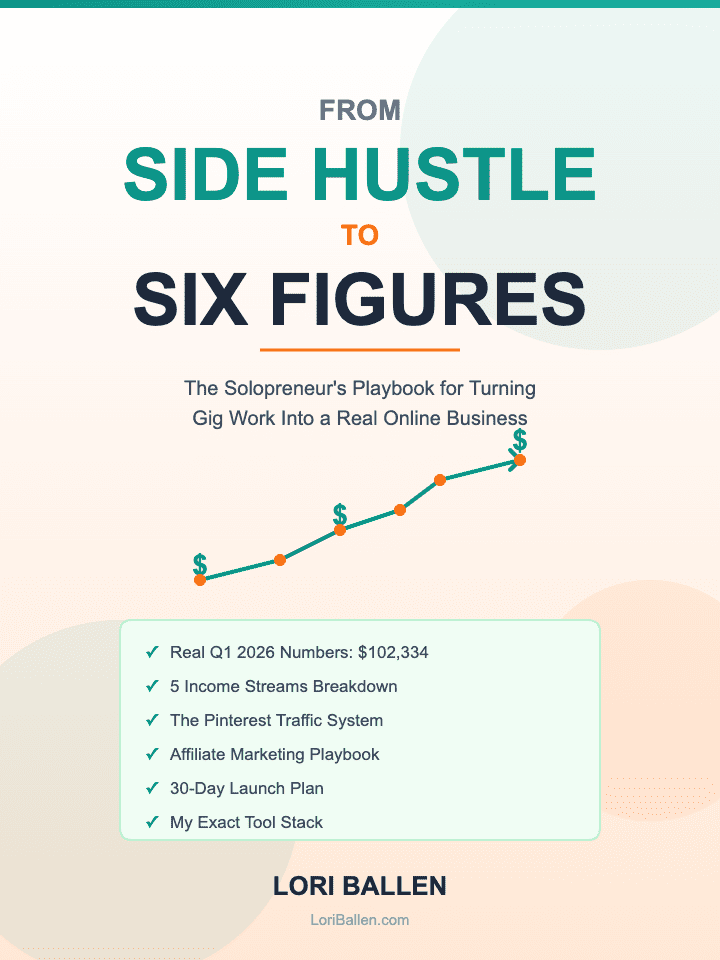
Side Hustle to Six Figures
The solopreneur playbook for building income without a team.
The software that tracks every dollar
One of the links below is an affiliate link — if you sign up or buy through it I may earn a commission at no extra cost to you. I only ever share tools I actually use.
QuickBooks
The accounting software I run every dollar through so I can see exactly where my income actually comes from.
The backend of a one-person business
The systems, step by step
Check off each one as you set up your own backend.
“Eighty percent of my effort goes on the top twenty percent of my income. That’s the whole rule.”
— Lori Ballen
Questions about running a solo business
Do I need an LLC to start a solo content business?
You can start without one, but forming an LLC and getting the right business license early sets you up with real tax advantages and legitimacy as you grow.
What software do you use to track income?
I run everything through QuickBooks and break it down by line item so I can see exactly which platform or tool each dollar came from.
How do you decide which affiliate tools to keep promoting?
Conversion, not commission size. If my audience is not actually buying through a tool, I stop promoting it regardless of the payout.
Can one income bucket really support a business on its own?
Yes. Each of my three buckets, coaching, affiliate marketing, and publishing, is strong enough to stand alone, which is exactly what makes the whole business more stable.
Full Video Transcript
Prefer reading to watching? Here is the whole video.
$500,000 a year is what I dreamed about being a single woman solopreneur. I’m 72.2% profitable, I have no employees, and I run my entire business off of software. I did not become a successful creator by sharing guru status. I became successful by sharing from the messy middle — this is what I’m learning, this is what I’m discovering, these are my ahas.
Right now I’m in the most beautiful place I’ve ever been in my life. I came home from Alaska, and I never work on vacation, but I took the last two days off. I came home with a little bit of that cruise crud and just wanted to lay around and binge the shows I missed while I was gone. I did a little morning work but not much after that, and I thought, what a joy this is to not have to feel like I have to get up and perform.
I asked myself, if you had to say one reason why this is possible today, what’s the real reason you’re able to go lay down and do nothing? I can give you a bunch of reasons, but the best one is that I simplify. I’m not trying to build ten million projects at the same time. I’m doing more of what already works.
It makes me sad when somebody leaves the program because they didn’t turn out successful, but I can tell you exactly why, every single time, and for most of us it’s the same thing: you didn’t pick one platform, learn it, discipline yourself, go all in, and milk it for everything it is. You went into other places instead.
So let me share a bit of the business side. One, I have an LLC. I’m not going to consult you on taxes or business advice, but I started one many years ago mainly for tax advantages — there are tax advantages to being an LLC versus a sole proprietor. I also have a business license and creator insurance that protects me as a creator. I’m telling you this so you understand this is a real, legit business that makes good money, and I want you to start thinking that way too. I’m a business. I don’t mean run out and get all this stuff done immediately, but it helps to think of it not as a side hustle.
Second, I put all my money through QuickBooks, a software I pay for, and I set up rules, so if money comes in from TikTok, it goes into that category. When I run a P&L I can see every line item of exactly who I made money from and what it is. This morning I uploaded this to ChatGPT, and it told me exactly where to go on YouTube based on these numbers — it said I should double down on this, write this ebook. It’s a pretty incredible thing when you feed your P&L statement to your favorite AI tool. Some people say that’s the worst thing you could do, and of course there are no account numbers on there, but you can still link your bank account.
Business license requirements are based on your own state, every state is different, and some might say don’t worry about it until you hit a certain income. Taxes and business licenses are two different things — if you need a business license to make money online in your state, you should have one. I even do DBAs: doing business as Ballen Method, doing business as Ballen Academy, just protecting my assets. I go down to the post office, fill out the forms, they notarize it, and I’ve got a DBA. This is just the way I’m set up, but it didn’t start that way, it evolved over time.
My business right now is on track to make about $500,000 this year. Could it do more? Sure. Could it do less? Sure. No money is ever guaranteed, and I’m in the top percentage of creators. I also know people making millions, and I know people making nothing, so don’t bank on any of this.
Here’s kind of how the breakdown works, and I know a lot of you could build something very similar if it was what you wanted, or just one of these buckets. When I say simplify, what I’ve done is take what used to be fifty buckets down to three. Real estate isn’t part of this — I do have a real estate business too — but these are my three content creator buckets.
The first is affiliate income. That’s when I promote a product or service that isn’t mine and earn a commission — could be TikTok Shop, Amazon influencer, software affiliates, anything like that. Anytime I make money from an affiliate, I give it a line item. As soon as I make a dollar, it gets its own line. Let’s say you’re into beauty and fashion for women over 50 and you’re doing the Nordstrom sale, promoting links through your LTK software — I’d put LTK there, not Nordstrom, because it’s going through my LTK channel. If I’m a YouTube affiliate, YouTube has affiliates too, and I wish they’d add software, but they have products, so if I pack for Alaska and link the suitcase, I’d put YouTube affiliate.
Individual software gets its own line item, so I have twenty little line items under my affiliate income, and that number is $104,758 so far this year. I could live off affiliate income alone if I wanted to — that could even be $250,000 by year end, since usually fourth quarter is the best. This is what we all could be doing: if you have a YouTube presence, you’ve got to think, what tool can I talk about that’s in the description of every video, and then you have to hold that tool accountable for conversion.
For example, vidIQ reached out and offered me 50% on every signup plus a landing page. It doesn’t do much for me, I’m just not interested, because it doesn’t convert very well for me — vidIQ is one of my worst converting tools. Opus Clip does great, converting long form into short form, people like that, so that’s where I tend to focus. Obviously TikTok and Amazon are pretty good too. That’s one bucket, affiliate income, and what I tend to do is watch all three buckets move somewhat independently, so I’m never attached to any one. If a platform or tool were to change, something else is usually moving at the same time.
I’m grateful I don’t have everything banked into one or two software programs, because I think AI is going to replace a lot of them — why would we have separate tools? I just canceled PinClicks yesterday, good for Pinterest but I don’t think I really need it anymore. I still love Repurpose, but I think that’ll go away over time too — that’s the one where if you post on YouTube it also goes to TikTok and other platforms, but Claude’s going to replace that at some point.
I do the 80/20 rule: 80% of my effort goes on the top 20% of my income. That’s what you have to look at, and you can’t do that if your attention is scattered everywhere. What I’m noticing is my average video might only get a thousand or two thousand views, and those become some of my best coaching clients — you just haven’t figured out the optimization piece yet, but I think the important thing is to ask who is my audience and what am I going to teach them.
If I used my metrics as a measure of success, I’d quit. I want to cry when ten out of my last ten videos underperform, but what I’ve learned is you do enough of those and something takes off, and when it does it feeds everything. While I was in Alaska, one video did better than my average — didn’t go viral but did better — and I got 10 new coaching clients, sold a ton of ebooks, and ad revenue went up. Those smaller numbers are your true loyal people. We have to let go of the metric of how many people watch the video and worry more about who we’re actually talking to and how we help them.
If you post videos on how to start a YouTube channel and it doesn’t go anywhere after two videos a week for 90 days, then I’d say pivot. But if you’re pivoting because you haven’t done enough consistency, that’s different — you just haven’t tested long enough. You all need products, day one. Get your products. If you have any reach, any audience, even one person, get a product. AI can help you spit this stuff out in no time, you could take five videos and make it a course.
For example, I did a Substack class a couple weeks ago, opened it to the public, which I only do for an extra call. I thought, I have enough people wanting to learn Substack who don’t want to learn everything else I do, so I tried it. Had good turnout, saved the two-hour video, uploaded it to Kit, an email program, put the ebook and resources in the email, and now people are buying the playback. So if you sat down and created a two-hour master class, whether anyone shows up live or not, that becomes your product.
Bucket two, most exciting for me, is publishing. A year ago I didn’t have a Substack. I got my first paid subscriber in January. I didn’t have newsletter sponsorships or ebooks — these are all new this year, so to date it’s lower than everything else because it just started, but it’s $33,000 for the first half of the year. That’s what an executive admin makes these days, and that includes blog ad revenue, ebook sales, reward programs on social, newsletter sponsorships, Substack subscribers, and YouTube ad revenue. Not the biggest bucket, but definitely the fastest growing.
Third is coaching and webinars, that’s around $100,000 right now. If I doubled everything this year, it’d be around $210,000 for affiliate income, $70,000-ish for publishing, and $200,000 for coaching. How many of us could just do one of these buckets? You don’t have to do all three. What if YouTube alone brought in a hundred grand a year? Some of you could quit your jobs. It depends on everybody’s perception of money — some people hear a hundred thousand and think that’s not a lot, others think they could live on that and quit their job. It depends where you’re at.
I like to show you what I’m actually doing, not just theory. After my divorce, I laid on the floor and cried and wanted to die, not because of losing my husband necessarily, but because I felt old. I dreamed of retiring and traveling and speaking, and then I went job hunting because I had a 13-year-old at home and our business was intertwined and I didn’t know if my teaching business would grow enough.
I interviewed to be a team leader at Keller Williams offices, and the offers started coming in around $60,000 to $75,000, and I wanted to puke. I couldn’t put my kid through college on that — the art schools were as expensive as Ivy League schools, and I needed loans for all that. I had two choices: sacrifice the future I wanted for both of us, or burn the boats and double down on myself and go all in, because I wasn’t going to have a ceiling on what I could make. Somebody else’s rules, somebody else’s cap — no thank you.
So I looked at my entire business. I had the real estate business, and I could probably generate more leads there, but I hated the mechanics of it. It was enough to pay legal fees and have things coming in, but I wanted to teach, I wanted to create, so I said, burn the boat, go all in on YouTube, and that was my answer.
Over time things developed. TikTok didn’t exist for me until 2022, Amazon didn’t exist for me until a couple years before that — these income streams come and go, they have seasons. But if you don’t pick a hub, if you don’t pick one thing and learn the language and what works… Every time you finish a month, you should upload your analytics to AI and ask, what can we learn here, then double down on what worked.
I sit here with an income report saying I’m a 55-year-old solopreneur, a Gen Xer, because it works. Why wouldn’t I do it over and over again? Because YouTube isn’t about your subscribers, it’s about who’s never heard of you before — that’s who YouTube sends to you, and they will buy. Some of you have said, I’ve been following you for years and finally pulled the trigger. That’s okay too, those turn into really loyal people.
These strangers coming in will buy your ebook on how to bring in 100k on YouTube. You show up twice a week, make two videos, attach whatever makes you money — your ebooks, PDFs, spreadsheets, guides, templates, workflows, your mini course. That’s what my entire business is driven from: YouTube. Substack is climbing, I can see it being a second YouTube. I couldn’t have done any of this if I hadn’t simplified, if I hadn’t picked one hub as my main hub.
YouTube is the reason I am what I am and could do what I do today, and it spins off into all this other stuff: coaching, digital product sales, ad revenue, sponsorships, newsletters. In every YouTube video, pin a first comment. I wish I’d learned that years ago. I cannot tell you how many people don’t read the description, they go straight to the first comment, and mine is always pinned, saying join my Substack, grab a guide, get my notes, whatever my offer is, sign up for coaching — that’s the hub.
If you’re on Substack you still have a hub that spins out, if you’re on TikTok you have a hub that spins out, you just have to figure out who you’re creating for and how you solve their problem, and if you can do that, you make the money. I’ll tell you to diversify and not put all your eggs in one basket, but for the beginning you’ve got to pick something. If you think you’re going to write and be a writer, you’re a blogger, a Substacker, an email newsletter person — that’s where I’d send you, you’re a publisher. If you’re a creator, you’re on YouTube, TikTok, Instagram, but pick one.
If you’re new, my suggestion is no less than one video a week. If you’re more experienced, try to get two, and make them different — the second could be a Q&A, an interview, a thought of the day, one talking head video and one specific tip, or one talking head and one software you’d like to share. If you’re new, the more you make the better because the algorithm learns you faster, but if you’re more experienced, one to two a week is enough — if I do three, they kind of die off, and that’s another reason I love it, it’s balanced.
I don’t do a bunch of shorts anymore. My specialty right now is long form. I do a little short-form travel content, but I’m mostly hanging out in long form. Aging is really hard on camera, it made me quit YouTube before — I took almost a year off, then went completely faceless, just screen shares. It doesn’t work anymore. YouTube really wants people, it wants shows and people with people, it doesn’t even want the specific teaching strategies like it used to, it wants storytelling. Tell a story, it works really well.
I try really hard to just look at the dot on the camera and not my face, because if I see my face I’ll think I don’t want to be on there today, but I know what drives the whole engine, so I show up, I practice, and I hit publish. Tell a story.
If you’re brand new, go tell a story. Why you left your job, why you got laid off. Don’t worry yet about what your channel’s going to be about, just practice storytelling, document the steps, document where you failed, document where you almost quit. People want to see it, hear it, feel it, they want those stories, they don’t want gurus. You’re here because you can relate to me, not because I make $500,000 a year — you like the money, but you’re drawn to seeing yourself in me, and that’s who you have to be on camera. Tell stories. They love it.
Ready to build a system behind your own income?
Not ready to buy yet? Get Letters from Lori for more like this.
Hey there! Just a quick heads-up: some of the links on this site are affiliate links, meaning I may earn a small commission if you make a purchase (including through the Amazon Associates program), at no extra cost to you. Occasionally, products featured here are gifted by brands.
I also use AI tools to help research and create content for you! While I love sharing strategies to help you succeed, please remember that everyone's journey is unique—individual results vary, and there are no guarantees. Thanks so much for stopping by!
