This page contains affiliate links — if you click through and sign up or buy, I may earn a commission at no extra cost to you. I only ever recommend tools and programs I actually use.
Best Digital Products to Sell That Don’t Require Shipping
I used to think affiliate marketing was my favorite way to make money online. Then a spreadsheet I opened on a whim, one nobody asked me to sell, turned into one of my best-selling digital products. Here’s what I’m actually creating, how I find the ideas, and how I use AI to build and design the whole thing without ever opening a design program.
Turn your own idea into a product
From Idea to Income
Take a simple idea and shape it into a digital product people actually buy.
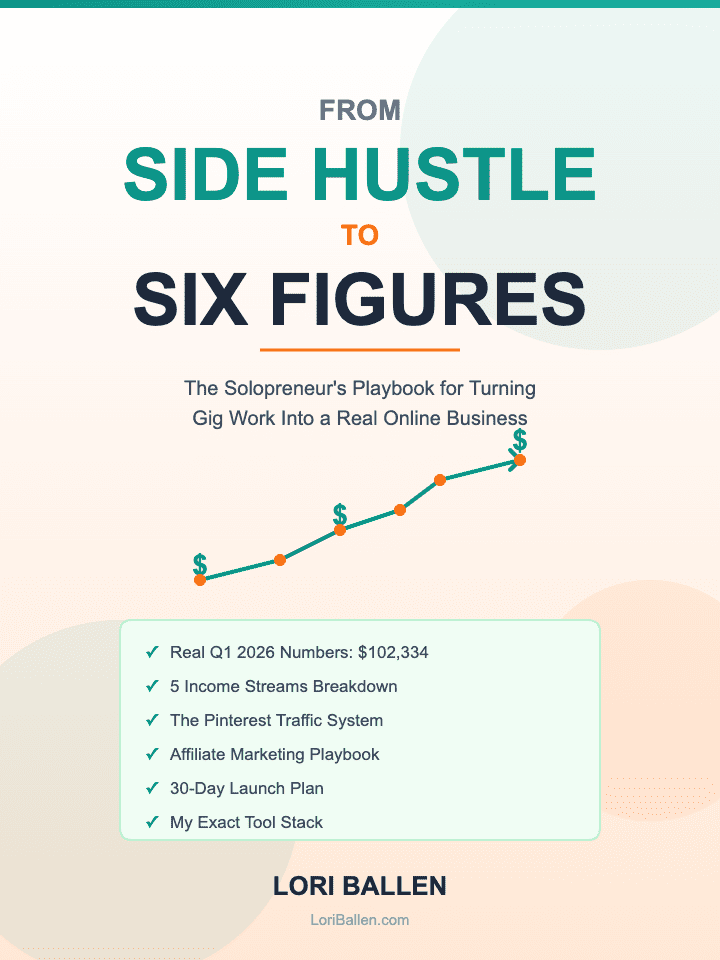
Side Hustle to Six Figures
My playbook for turning a small side hustle into a real, sustainable business.
What actually sells right now
Solve a real problem
The digital products that sell aren’t always printables or filters. They’re the ones that fix a specific, annoying problem for a specific person.
You already have the idea
My best-selling spreadsheet wasn’t planned. I was showing something else on a video, someone spotted it in the background, and the comments told me what to sell.
Let AI do the heavy lifting
I don’t brain dump into AI and let it write the whole thing. I have it interview me, in my own words, then format and design what comes out.
Pick one platform to start
YouTube, Substack, Instagram, a blog. Pick the one your audience is already on and go deep there before you try to be everywhere.
How I find and build a digital product
This is the exact process I use, whether the product ends up being an ebook, a spreadsheet, or a set of templates.
Find what you can talk about every day
Pick a topic you could talk about, live, and breathe without running out of things to say. That’s the topic that can carry a channel, a blog, or a newsletter.
Study who’s actually listening
Look at your existing audience before you guess. Age range, what they comment on, what they already ask you for. That tells you what to build before you build it.
Ask AI to interview you
Instead of asking AI to write the product from scratch, tell it to interview you about the topic. Your answers, in your own words, become the raw material.
Let AI design it, conversationally
Ask for a cover, ask for a bio section, ask it to move a checkbox or change the colors to match your brand. No design software, no dragging boxes around.
Sell it where your audience already is
Attach a storefront to your videos, drop a link in your newsletter, or link it from your blog. Don’t make people hunt for the buy button.
Want the full playbook?
From Idea to Income walks through this entire process, start to finish, so you can build your own first digital product.
Get From Idea to Income →“The best digital product is the one you can create from what you already know and deliver to someone who needs it.”— Lori Ballen
Get Letters from Lori
My weekly notes on building a one-person business after 50: what I’m building, what’s working, and what I’d do if I were starting over. Free, straight to your inbox.
Read the full video transcript
If you’re not creating and selling digital products, you’re doing it wrong. I was doing it wrong. I had no idea that PDFs and downloadables were still so sellable. In this video I’m going to talk about what I’m creating, how I’m selling it, and how you can create and build an audience for your own digital products and ebooks.
I used to say my favorite way to make money was affiliate marketing, promoting a product or service that’s not mine and earning a commission. I started doing affiliate marketing with software back in 2013, teaching a particular type of software so people would sign up and I’d earn a commission. It was never me promoting something just because they were paying me. It was always something I was actually using and teaching strategies for. That’s how this whole engine started, the stuff I teach today.
The lesson is adding value to an audience that has a problem you can solve or something you can improve in their life. Maybe you’re a menopause specialist helping people through that phase of life. Maybe you recently retired and you’re living on the road and can help people start or improve that lifestyle. It could be gardening, a hobby, parenting, grandparenting, single life, any of these things.
Don’t think you have to sell make-money-online content to make money. Is that a lucrative niche? Absolutely, and I happen to be in it because I’ve always taught people how to generate business and leads, whether real estate leads, or when I had a catering company, or a baby store. I’ve bounced around and done a lot of things, but the one consistent thing I’ve always done is lead generation. You’ve got to generate leads, then make offers. What can you provide that helps people and that you can also sell?
For some of you that could be as simple as your favorite recipe book or one-pot meals. It could be a spreadsheet. Funny thing is, a lot of times you don’t even know something is valuable until people start asking what it is. I was showing something on YouTube once and popped open a spreadsheet to grab a link, and everybody in the comments asked what that was and if they could buy it. That became one of my first digital products, just because everybody wanted that spreadsheet.
So you might think something you know or do is silly, or just a “you” thing, but when you show it to other people they light up and want it. It could be an AI prompt that makes your life easier, or how you manage a schedule. My top digital products outside of my coaching program are ebooks. Someone asked me why anyone would buy an ebook when AI is so big and they could just ask it anything. Well, AI isn’t delivering an organized, printable ebook that’s you, your experience, your personality, your values. People value that. If they already follow you in some way, they want what you specifically have to offer.
Also, people don’t always go to AI first. We assume everyone is resourceful like us, but most people are wired to go to a person before Google or an AI search. They’ll ask Facebook who knows a good plumber before they’ll search it themselves. Don’t assume other people do what you do.
I remember when I got big on YouTube, people said video wouldn’t work anymore because people want to read. I laughed, because you’re assuming everyone likes to read the way you do. Check the demographics: YouTube is huge right now for Gen X and boomers watching on their TVs, and it’s really pushing long-form, show-style horizontal content. It depends on your demographic what they’re watching.
So step one: my own results and income aren’t typical or guaranteed, but the opportunity is available to anyone who can publish on a platform, create content, and make offers. That’s going to look different for everybody. You can do all of this on TikTok, Instagram, YouTube, a blog, or Substack. Where is your audience?
Let’s say you already have an audience on Substack, which is now my number two income-generating platform (I got my first paid subscriber there in January and had no idea it would become what it is). Say you’re writing a newsletter about reinvention in midlife, or the third or fourth quarter of life, the good and the hard parts, but you haven’t made an offer beyond the paid subscription. You can promote and sell your own products if it’s a natural flow. Substack doesn’t want people spamming the network with third-party promotions, and they say so in their terms. But you can drop a link in your newsletter, mention a coaching program, use the perks tab. If you haven’t started on digital products and you already have an audience, you’re leaving money on the table. Create a checklist on whatever you specialize in.
Here’s how to discover what to offer. With my coaching clients, everyone gets stuck at the same place: they don’t know what to offer, because most people don’t truly know who their audience is. They don’t spend enough time looking. When I look at my own audience, especially on a platform like Substack, most are over 40, average age somewhere around 47 to 54, right in that midlife range. Some platforms skew younger, some older. My YouTube audience is a bit older, and now Substack is skewing that way too, probably because I keep saying “I’m 55” and that attracts people my age, the people who relate to me and become clients and customers.
Many of you watching me on Substack are starting your own Substack because of me, then charging for subscribers, but you haven’t taken the next step of offering digital products. So step one is analyzing who your audience is. If you don’t have one yet, hang tight, I’ll cover that. If you do have an audience, you’re in the best position, because you’re not capitalizing on what you already have.
I’m very analytical and I love using AI for analysis. If you have a Substack, you can connect it to Claude (I assume ChatGPT can do something similar) and say, “go into my Substack, analyze my top notes and articles that brought in paid subscribers, and tell me what my top topics are.” You might be surprised. You can ask it to identify your audience, even create an avatar: it might say your reader is a midlife woman reinventing herself now that the kids are leaving the nest, and she’s becoming a Substack writer. Once it identifies that audience, you can ask it to help you create a product: what’s her problem, what does she need help with, what questions can you personally answer?
The more you use AI conversationally, just chatting, the better it gets at creating valuable things for you. I’ll go for a 45-minute walk with headphones in and just brain dump everything I experienced that day, what I liked, what I didn’t. If I have time I’ll ask it to interview me back, asking things like what moment I discovered something, or what I’d tell a younger version of myself. It digs in deeper. Then I can take that whole transcript, my words, my thoughts, and use AI to help turn it into an ebook, a spreadsheet template, Pinterest pin templates, Instagram story ideas, whatever I want to sell. It’s saved in my AI files until I delete it, ready to become articles, videos, short-form clips, guides.
You’d do the same for YouTube or Instagram: analyze and identify who’s following you, what they’re learning, what problems and questions they have, what they’re already enjoying. If you have analytics, that’s easy to find. Then decide what content to create next and what your offer is. That’s the process to run with AI. If you’re not using AI, do it yourself with spreadsheets and notes, it’s just slower and less complete.
Say the AI suggests a worksheet. It can create coloring books based on inspiration or quotes, a great example for women inspiring other women who don’t know what to create. Sell it for a few dollars, or use a third-party printer that ships it with colored markers, or sell it on Amazon and suggest the markers alongside it, or start an Etsy shop. Ask Claude what kind of offer to make and it will suggest a format.
If it says make a worksheet, tell it you don’t want AI to write it for you, you want to be the one behind it, your words and thoughts, and have it interview you to get there. It’ll ask questions, and when it has enough it creates the downloadable worksheet, as a PDF, images, or HTML for a blog. If the first version looks plain, you can simply say “make this pretty,” or specify your brand colors and fonts, or a mood like soft and feminine, or bold red and black. It sets it all up. If you don’t like where the checkboxes are, you don’t have to open and edit anything yourself, just say “make the checkboxes bigger” and it does it. No more dragging boxes around.
If there’s no branding, say so, and if it already knows you from your website, Substack profile, Instagram, or LinkedIn bio, it’ll pull in your name, URL, and social handles. You can ask for a short bio at the bottom and upload a photo. Suddenly you have four or five pages, a real promo item, plus a cover.
Right now my best sellers are AI prompt packs, which is how I started, and full ebooks at $27, all on Ballen Publishing dot com. They’re me, my teaching, my words, brain dumped and shaped, and at the end I always ask AI what I should have included that I didn’t. It might suggest warnings, a disclaimer, a personal story, or more of my own numbers, like a screenshot of my profit and loss. It’ll start pointing that out. Claude has something called skills: once you build this process and save it as a skill, you can upload any future transcript, voice dump, or blog file and say “do the same thing with this,” and it identifies your audience and tells you what to create. Then you’re on rinse and repeat, and you’ve bought back a ton of time.
Now, if you don’t have an audience yet and want to sell digital products, first figure out what you could talk about every day. For me it might be genealogy: DNA, ancestry, helping adoptees find their parents, tracing family history, traveling to family history sites. I ask myself, could I talk about it every day, live it, breathe it? Most people who get into genealogy are in midlife and beyond because they finally have the time, once the kids are older, to pick it up as a hobby.
Then ask where that audience is. Gen X and boomers, probably Facebook and YouTube. Millennials, more Instagram. If you’re aiming younger, more TikTok and Instagram with short-form content over long-form. Pick one platform. Ask yourself if you want to make video every day or write. I’m single, I don’t have someone following me around with a camera, so sometimes I’ll prop my phone against something on the table, or use a tripod and just record myself at the computer for twenty minutes, or even let my Ring camera pick up motion as I walk by. Not great quality, but it works as a starting point.
Then I’ll clip it down. If it’s on my phone I filter through it; CapCut is one of the easiest editors, you can upload the whole video and trim by sliding in from the ends, save the original, and cut what you want, or edit and add music right inside TikTok. I’ll ask ChatGPT to help me pick a topic to talk about that day related to whatever I’m offering, it’ll suggest options, I’ll pick one, then ask for on-screen text with a compelling hook and a description with hashtags, and copy it over.
People always ask how I create so much content in a day, and it’s because I have systems. I do roughly the same things every day: working on the computer, filming something, doing a product review, sitting by the pool, cooking dinner. Those are all opportunities to grab a quick clip with music and a voiceover.
I know people who’ve built their entire digital marketing business off Instagram alone, or Substack alone, or YouTube alone, or TikTok alone. Pick one to start because you don’t have the time or resources to learn every algorithm and every platform’s language at once. Ask yourself: video or something else? If it’s long-form video, you’re a YouTube person, and the nice thing about YouTube is you only need to record once or twice a week. I’ll often just get up and film a video before a coaching call, whatever’s on my mind or on my list. Long-form videos can all become short-form clips afterward.
YouTube also lets you attach a store, so if you have
Once you know what you can talk about every day, who wants to hear it, and which platform they’re on, you can go research whether there’s a real opportunity in that niche. In most cases there is; every now and then something’s too small to be worth it. But if enough people would subscribe or buy your ebooks, that same audience could eventually want coaching, consultations, templates, spreadsheets, recipes, books, or guides.
I have a friend nearby who teaches line dancing live and has a YouTube channel. What else could she sell? She could record her lessons and attach a “buy my ten lessons” link to every video. She could sell a step-by-step guide, because I personally struggle turning the other direction mid-dance, so a written guide with the steps spelled out would genuinely help. There’s a version of this for almost anyone, whether you want to write or make video. Even a simple video of you doing something, with a song and text over it, might be all you ever need. You might never have to talk on camera at all.
So identify what you can talk about, bring AI in to help, take a transcript like this one, upload it, and ask your AI to help you figure out your next steps. It’ll walk you through it from there. It’s not any more complicated than that.
I’m Lori Ballen. Let me know what questions you have, I’m happy to make more videos on this. I also run a coaching group at Ballen Academy, we meet every couple of weeks for two-hour live calls where I show you what I’m doing in real time, pull up the numbers, answer questions, and give personal advice together as a group.
Pick one idea from this page and build it this week
Get From Idea to Income →Not ready to buy yet? Get Letters from Lori, my weekly field notes.
Hey there! Just a quick heads-up: some of the links on this site are affiliate links, meaning I may earn a small commission if you make a purchase (including through the Amazon Associates program), at no extra cost to you. Occasionally, products featured here are gifted by brands.
I also use AI tools to help research and create content for you! While I love sharing strategies to help you succeed, please remember that everyone's journey is unique—individual results vary, and there are no guarantees. Thanks so much for stopping by!
