Update: I wrote a newer, complete version of this guide with my real numbers: How Does Substack Work? A Plain-English Guide.
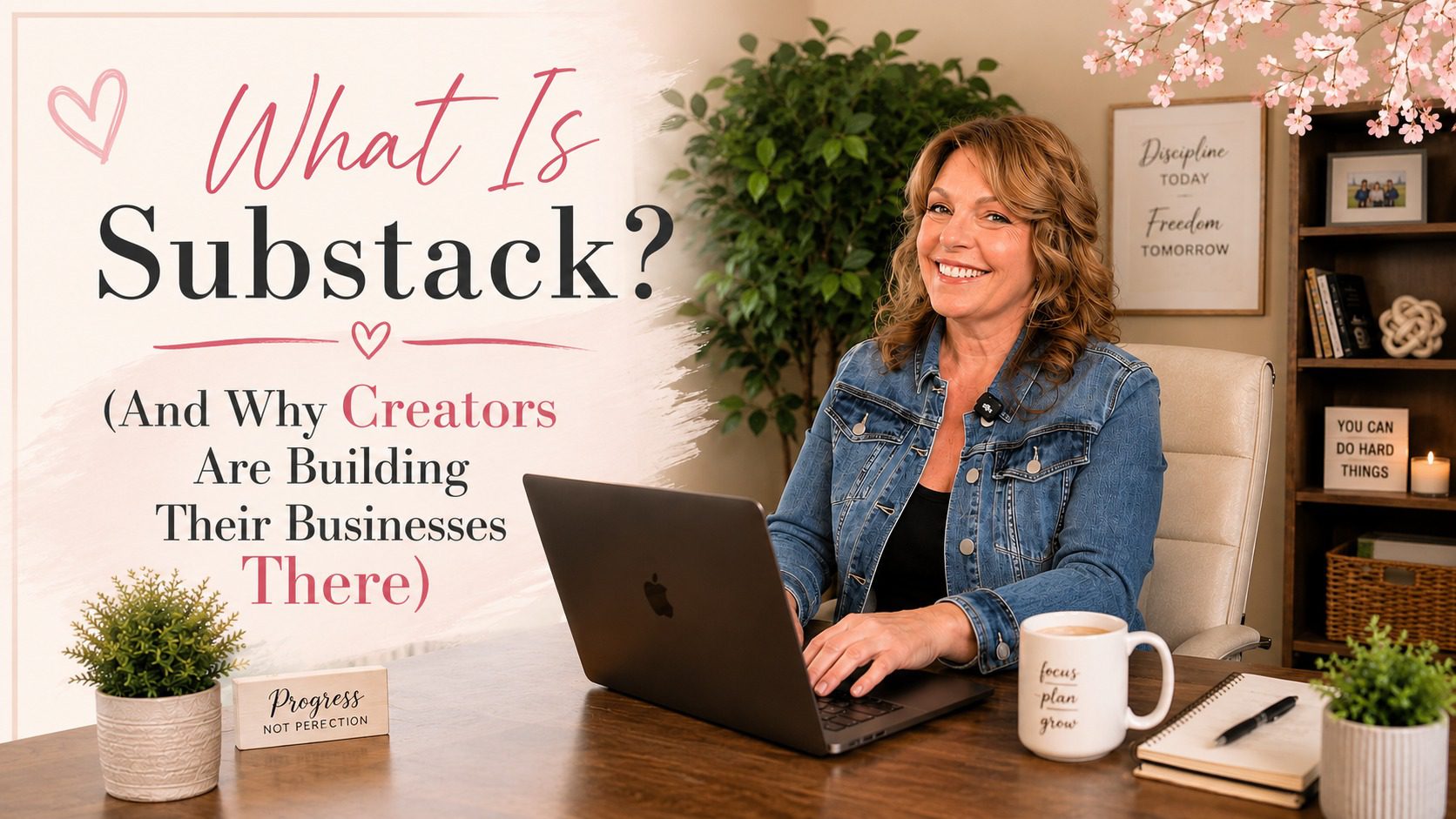
You keep hearing the word Substack. Maybe from a creator you follow, maybe in a conversation about email lists or newsletters, maybe because someone told you it’s a great way to get paid to write. But what actually is it — and is it worth your time?
Here’s the plain-English version, and then I’ll tell you exactly what I’m doing with it and where you can learn more.
What Is Substack?
Substack is a publishing platform that lets you send newsletters directly to your subscribers’ inboxes. You sign up, pick a name for your publication, and start writing. Readers subscribe — for free or for a monthly or annual fee — and your content lands in their email.
That’s the core of it.
But Substack has grown into something bigger than just email. It’s now a full publishing ecosystem with newsletters, short-form notes, podcasts, video, and a built-in discovery network. You can think of it as a combination of a blog, an email platform, a podcast host, and a social media feed — all in one place, all owned by you.
The biggest difference between Substack and a traditional email service provider like Mailchimp or ConvertKit is this: Substack has its own built-in audience. When you publish on Substack, other Substack readers can discover you through recommendations, the Substack feed, and search. You’re not just building a list in isolation — you’re publishing inside a community that can grow your list for you.
How the Free vs. Paid Model Works
Every Substack publication can have both free and paid tiers. You decide what’s public and what’s behind a paywall.
Free subscribers get whatever you choose to give them — maybe a weekly newsletter, a few notes, access to your back catalog. Paid subscribers get everything: full access to paywalled posts, deeper content, early releases, whatever you set up as your paid offering. Substack takes 10% of paid subscription revenue. Everything else is yours.
You don’t have to charge for anything. Plenty of creators use Substack as a free newsletter to build an audience and drive traffic elsewhere — to their courses, their coaching, their affiliate content. The paid subscription option is there when you’re ready for it, but it’s not required from day one.
If you want to understand how to set up both tiers strategically — what to give away, what to gate, how to convert free readers to paid — that’s exactly what I cover in my Substack 101 guide. It’s the no-fluff breakdown I wish I’d had when I started.
Substack Notes: The Social Layer
Substack Notes is a short-form feed that lives inside the platform — think of it like Twitter or Threads, but your audience is made up of Substack readers and writers who are already interested in the kind of content you publish.
You can post thoughts, quotes, links, images, and short updates. Other writers and readers can like, comment, and restack your notes, which puts them in front of their own audiences. It’s one of the fastest organic growth levers on Substack right now — especially if you’re just starting out and your subscriber count is still small.
Notes don’t go to your subscribers’ inboxes the way newsletters do. They live in the feed. But they still build recognition, attract new subscribers, and keep your publication active between longer posts. A lot of creators get their first few hundred subscribers entirely from consistent Notes activity before they even publish their first full newsletter.
Podcasts on Substack
Substack also hosts audio. You can publish podcast episodes directly to your Substack publication, and subscribers can listen through the Substack app, through Spotify, or through an RSS feed. If you’re already podcasting somewhere else, you can migrate or cross-post. If you’ve never started a podcast, Substack is one of the easier places to begin — no separate hosting setup, no extra subscriptions.
Paid subscribers can access exclusive podcast episodes behind a paywall, which gives you another reason for readers to upgrade. You could build an entire audio content library as a paid-only feature without ever touching a separate podcast platform.
Who Is Substack Actually For?
Substack works well for writers, coaches, content creators, bloggers, journalists, educators, and anyone who has an audience they want to own — or want to build. The platform skews toward people who have something to say and an interest in connecting directly with readers, not through an algorithm.
It’s also a strong fit for creators who are already producing content elsewhere and want to go deeper with their most engaged audience. Your YouTube viewers, your Pinterest traffic, your blog readers — a Substack newsletter is where the people who really want to follow you end up. It’s a more intimate, higher-trust channel than social media.
It’s not ideal if you need heavy e-commerce, complex sales funnels, or deep marketing automation baked in. Substack is a publishing and community platform first. It does email well, but it’s not a CRM.
How Creators Actually Make Money on Substack
There are a few income layers available on Substack:
Paid subscriptions are the most direct. Readers pay monthly or annually to access your full content. Even a small list converts at a surprisingly high rate when readers already trust you — 5% of 1,000 free subscribers paying $8/month is $400/month in recurring revenue with no extra work.
Recommendations let you recommend other Substack publications to your subscribers, and other writers can recommend yours. When someone subscribes to a publication you recommend, you can set up a reciprocal arrangement. This is how many creators grow to thousands of subscribers without paid ads.
Affiliate content woven into your newsletter is fair game. You own what you write, and nothing stops you from including relevant affiliate links in your posts the same way you would on a blog. Your Substack audience is already warm — conversion on thoughtful affiliate recommendations tends to be strong.
Driving traffic to other offers is one of the most underused strategies. Your newsletter doesn’t have to be the product — it can be the funnel. Courses, coaching, digital products, Amazon storefronts, memberships — your Substack list is a direct line to the people most likely to buy.
Want the full system — how to set up your publication, price your paid tier, write your welcome sequence, and turn readers into paying subscribers? I laid it all out in Substack 101: A No-Fluff Guide to Building and Growing a Paid Newsletter. It’s what I used to build my own paid subscriber base and it skips everything that doesn’t matter for people who just want to get up and running.
Why Substack Over Other Email Platforms?
The main argument for Substack over something like Mailchimp, ConvertKit, or Klaviyo comes down to two things: built-in discovery and simplicity.
Traditional email service providers are tools. They send your emails and give you analytics. That’s it. You’re entirely responsible for growing your list. Substack is a platform with its own audience, its own feed, its own recommendation engine. The network helps you grow in ways that standalone email tools can’t.
The tradeoff is features. Substack is simpler and less customizable than dedicated email marketing platforms. If you need advanced automations, tagging systems, or deep segmentation, you’ll hit a wall quickly. But for most content creators who want to build a direct-to-reader relationship without spending hours in a complicated back end, Substack is genuinely easier to start and stick with.
I use both — Substack for the community and content layer, a separate email platform for my more structured marketing sequences. That’s a setup that makes sense once you’re running multiple systems, but it’s absolutely not where you need to start.
What I’m Building on Substack
My Substack publication is called The Real Time Creator. It’s where I document what I’m actually doing in my business — what’s working, what’s not, what I’m testing, and the systems behind it all. I publish newsletters, short notes, and podcast episodes. Some content is free. The deeper strategy posts, income breakdowns, and tutorials are for paid subscribers.
It’s not theory. It’s real-time — written while I’m inside the process, not looking back on it from a distance. If you want proof over hype, that’s the place.
You can subscribe — free or paid — at loriballen.substack.com. Free gets you a solid look at what I’m building. Paid gets you the full picture.
Ready to Start Your Own Substack?
If you’ve been thinking about starting a newsletter — or you already have one somewhere and want to know if moving to Substack makes sense — Substack 101 walks you through the whole setup from scratch. It covers what to name your publication, how to structure your free and paid content, what to send first, and how to get your first 100 subscribers faster than you’d expect.
And if you want to see what a Substack looks like in practice before you build one — from the inside, not just the outside — come read mine. That’s what it’s there for.
Hey there! Just a quick heads-up: some of the links on this site are affiliate links, meaning I may earn a small commission if you make a purchase (including through the Amazon Associates program), at no extra cost to you. Occasionally, products featured here are gifted by brands.
I also use AI tools to help research and create content for you! While I love sharing strategies to help you succeed, please remember that everyone's journey is unique—individual results vary, and there are no guarantees. Thanks so much for stopping by!