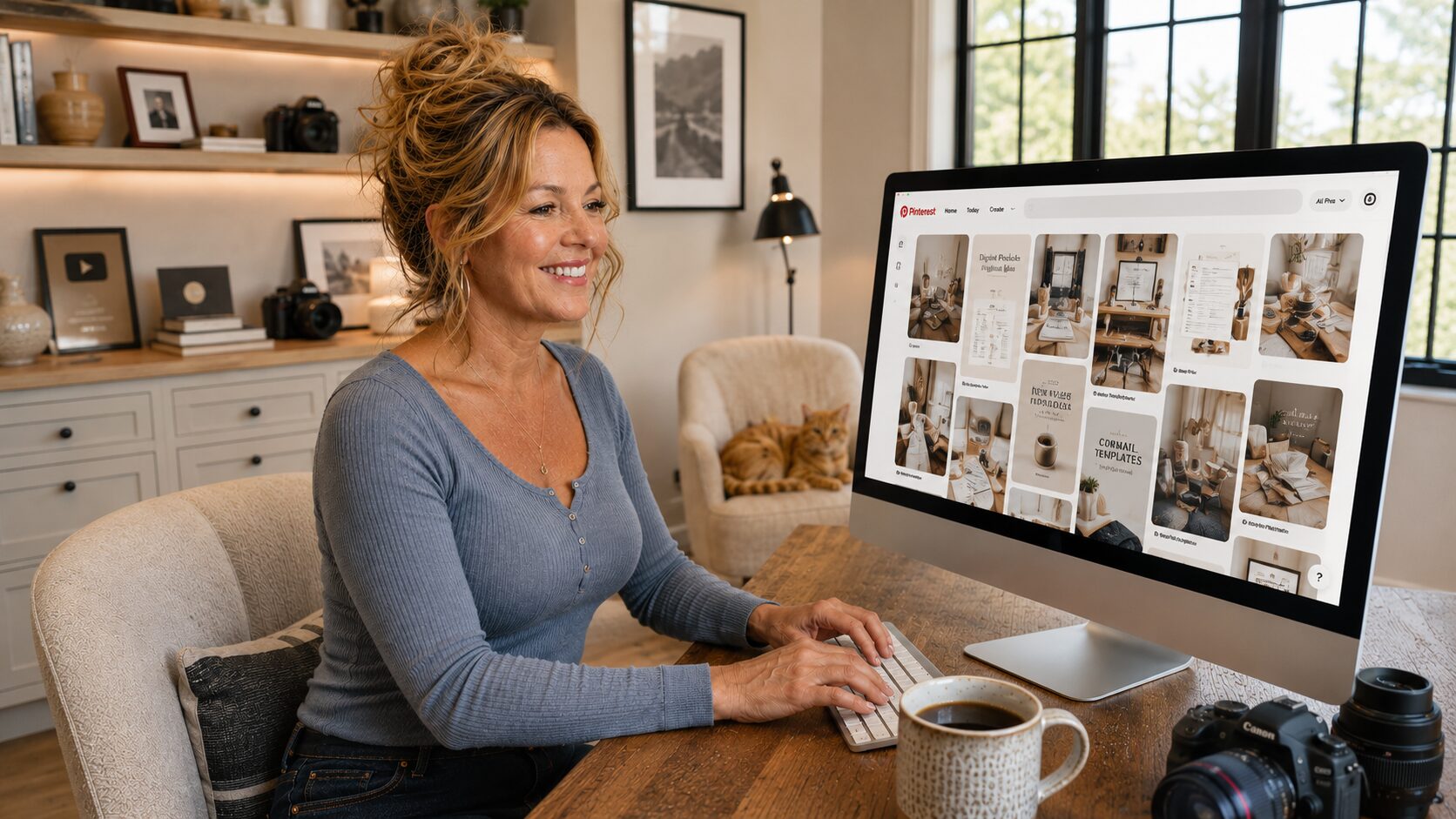
I treated Pinterest like Google for way too long. I’d take a keyword that crushed it on my blog, slap it on a pin, and wonder why nothing happened. Here’s the thing nobody told me back then: Pinterest is a search engine, just like Google. But it is not the same search engine. Run a Google playbook on Pinterest and you’ll get Google-sized disappointment.
So I built my own framework for it, the one I actually use, and I named it after the only person I could blame if it didn’t work. The BALLEN Method. Six steps, one per letter, and every one of them is something Pinterest rewards that Google either ignores or does completely differently.
Before I walk you through it, the one thing that’s the same on both: they’re both search engines. Somebody types a thing, the algorithm ranks results by relevance, and both reward keywords, engagement, and showing up consistently. That part carries over. Everything after that is where people get burned.
Here’s the framework.
B — Build Keywords First
On both platforms, you research keywords before you make the thing. Not after. I know it’s tempting to make the pin and figure out keywords later. Don’t. Guessing at keywords without checking that real traffic exists behind them is the fastest way I know to pour hours into content nobody finds.
But here’s the Pinterest twist: you can’t use Google’s numbers. Pinterest doesn’t hand its search data out publicly, and the general SEO tools barely scratch it. I use Pinclicks to get actual Pinterest keyword volume, because a phrase pulling 50,000 searches a month on Google might pull 500 on Pinterest. Or the other way around. Research first, on Pinterest’s own data. That’s B.
A — Aim the Image at the Keyword
Google reads text. Your article can be a wall of plain words and still rank, because Google’s reading the words. Pinterest is visual, and the image decides whether your perfect keywords ever get a chance.
You can have a flawless pin title and description, and if the image is weak or generic, nobody clicks, and your keywords never get to do their job. So the image isn’t decoration. It’s the gate. I use Ideogram to make original images specific to the exact keyword I’m targeting, because Pinterest actually looks at the picture and uses what it sees to decide what your pin is about. When the image clearly matches the keyword, it backs up your words instead of confusing the algorithm. There is no version of this on Google. None. That’s A.
L — Layer Text on the Pin
Here’s a Pinterest-only signal: it reads the text you put on the image itself. The words on your pin graphic aren’t just for the human scrolling, they’re another keyword signal Pinterest files you under.
Google does not crawl text inside your images for ranking. Pinterest does. So that text overlay is doing double duty, telling the person what they’re looking at and telling Pinterest what it’s about. Layer your keyword right onto the graphic. That’s the first L.
L — Load Keywords in the Right Fields
On Google, your heavy-hitter spots are the title tag, the H1, the meta description, and the first few paragraphs. On Pinterest, completely different fields carry the weight: the pin title, the pin description, the board name, the board description, and your profile bio.
Different fields, different weights. If you’re only optimizing the pin and ignoring your board names and your bio, you’re leaving signal on the table. Load all of them. That’s the second L.
E — Even Your Language to the Platform
This one’s subtle but it matters. On Google, people ask questions. “How do I organize a small home office.” They’re information-seeking. On Pinterest, that same person is in inspiration mode and phrases it differently. “Small home office organization ideas.” Noun-heavy, picturing an outcome, not asking a question.
Same human, same topic, totally different words. So even out your phrasing to match where people are. Write your Pinterest keywords in browse-mode language, not Google-question language. That’s E.
N — Never Stop Feeding
A good Google article can rank for years. You write it once, freshen it now and then, and it keeps working while you sleep. Pinterest is different, and this trips up bloggers especially. Pinterest treats a fresh pin image as fresh content, even when it points to the same exact URL.
So keeping a post alive on Pinterest means making new pins for it over time, not publishing one and walking away. Here’s what that looks like for me: I write the article once, make about five pins to start, then keep dropping new designs for that same post over the following weeks. The destination never changes. The pins do. I schedule it all through Tailwind to hold a steady rhythm, because Pinterest rewards consistency in a way Google doesn’t. Never stop feeding it. That’s N.
The BALLEN Method, all together
- B — Build Keywords First (research on Pinterest data, not Google)
- A — Aim the Image at the Keyword (the image is the gate)
- L — Layer Text on the Pin (the overlay is a keyword signal)
- L — Load Keywords in the Right Fields (pin, board, and bio)
- E — Even Your Language to the Platform (browse-mode nouns)
- N — Never Stop Feeding (fresh pins to the same URL)
The proof, so you know this isn’t theory
Want a real one? I once tagged and optimized a single pin for a cat tree, treated the image like the gate it is, matched it to the keyword, and it converted better than pins I’d fussed over for far longer. Right image, right keyword, the BALLEN Method in one little pin.
None of this means you have to run it exactly the way I do. But this is what’s working for me, and the whole point of giving it a name is so you can actually remember it when you sit down to make a pin. Research first. Make the image earn the click. Layer the text, load the fields, speak Pinterest’s language, and never stop feeding it.
Google and Pinterest are cousins. They are not twins. Treat them that way and watch what happens.
Hey there! Just a quick heads-up: some of the links on this site are affiliate links, meaning I may earn a small commission if you make a purchase (including through the Amazon Associates program), at no extra cost to you. Occasionally, products featured here are gifted by brands.
I also use AI tools to help research and create content for you! While I love sharing strategies to help you succeed, please remember that everyone's journey is unique—individual results vary, and there are no guarantees. Thanks so much for stopping by!