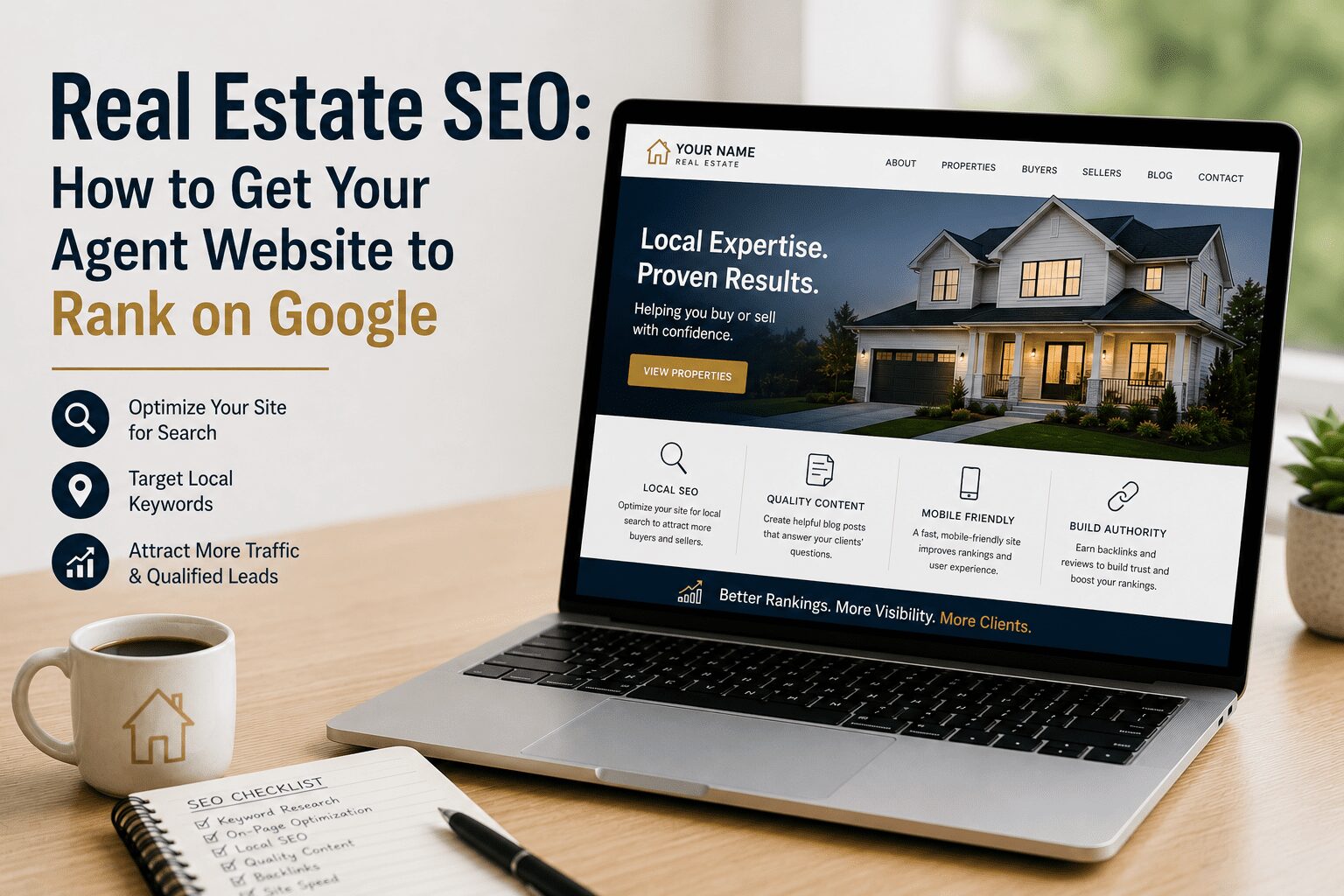
Most real estate agents know they should be doing SEO. Very few have a clear picture of what that actually means for a real estate website, how it differs from general SEO, and what a realistic timeline looks like for seeing results.
This is what I’ve learned from building my own real estate website into a lead generation asset and from watching what works and what doesn’t across the BREW sites my brothers Jeff and Paul Helvin have built through Ballen Brands over the years.
Why Real Estate SEO Is Different
Real estate search is intensely local. A buyer in Henderson, Nevada is not running the same search as a buyer in Henderson, Kentucky. Your competition for those searches is also local, which means you’re not trying to outrank Zillow for “homes for sale” nationally. You’re trying to outrank other local agents and brokerage pages for the specific searches buyers in your market are running.
That’s a more achievable target than most agents realize. National portals dominate broad searches. Local agents with well-built sites can rank competitively for neighborhood-level, zip code-level, and property-type-level searches. That’s where most of the buying intent is anyway.
The other thing that makes real estate SEO different is that your content strategy and your IDX setup work together. A properly configured IDX creates hundreds of indexable pages with real listing data. A consistent content strategy creates authority and answers questions buyers are asking before they start their property search. Both need to be in place for the full SEO picture to work.
Start With Site Architecture
SEO starts before you write a single word of content. The way your site is structured determines how search engines crawl it, what pages they index, and how authority flows through the site.
For a real estate website, this means having a clear hierarchy. Your homepage establishes the market you serve. City and neighborhood pages go one level deep. Property type and price range pages go another level. IDX search pages and individual listing pages sit within that structure.
A flat site with no logical structure doesn’t give search engines a clear picture of what you cover or how the pieces relate to each other. A well-structured site makes it obvious that you’re the authority for real estate in your specific market and sub-markets.
The BREW system Ballen Brands builds is structured with this architecture from the start. The showcase pages, community pages, and content hierarchy are built into the foundation rather than added as an afterthought. That matters because retrofitting site structure onto a poorly organized site is significantly harder than building it correctly the first time.
IDX Showcase Pages Are Your SEO Engine
This is the piece of real estate SEO that most agents underestimate. Your IDX showcase pages are pre-built search result pages that can rank on Google for specific property searches in your market.
A showcase page for “homes for sale in Summerlin under $600,000” is a page on your site with live MLS data, updated automatically, targeting a search that real buyers in your market are running. When that page ranks, buyers searching for exactly that thing land on your site, not on Zillow.
The agents who take this seriously build out 75 to 95 showcase pages organized by neighborhood, city, zip code, price range, property type, and feature. Each page is a potential ranking opportunity. Collectively, they make your site look like the most comprehensive source of property information in your market.
The technical requirement is that your IDX pages are crawlable. Many IDX setups create pages that search engines can’t properly index, which means all that listing content generates no organic traffic benefit. IDX Broker, configured correctly, allows for SEO-friendly page structure with customizable meta descriptions and titles. Getting this right at setup is critical. Fixing it later after the site has been indexed incorrectly is an uphill process.
Neighborhood and Community Pages Build Local Authority
Beyond IDX pages, community pages are the content layer that establishes you as the local expert for specific areas.
A well-written neighborhood page covers what it’s like to live there. The amenities, the schools, the typical price ranges, the things a buyer who doesn’t know the area would want to understand before they search for homes. This is the content that ranks for searches like “best neighborhoods in [city]” or “[neighborhood] real estate” and captures buyers who are still in research mode before they’re actively searching listings.
These pages also give your IDX showcase pages context. A neighborhood page that links to the relevant showcase pages creates a logical content cluster that search engines read as a coherent, authoritative resource on that area.
The BREW system includes community pages as a standard component. Agents who build these out for their top neighborhoods and cities create the content infrastructure that compounds over time as pages age, earn links, and climb in rankings.
Blog Content Captures the Top of the Funnel
Buyers and sellers don’t start their search by looking at listings. They start by asking questions. How much house can I afford in this market? Is it a good time to buy in [city]? What should I know about buying a home in a homeowners association? What’s the difference between pre-approval and pre-qualification?
These are searches that happen months before a buyer is ready to register on an IDX site. A blog that answers these questions puts your site in front of that buyer early. If they find useful information on your site, read several articles, and eventually start their property search, they’re likely to search on your site. You’ve been helpful to them for months. That builds trust before the first conversation.
Consistent blog content also signals to search engines that your site is active and authoritative. A site that publishes regularly, on relevant topics, earns more crawl frequency and more indexing than one that hasn’t been updated in six months.
The practical challenge is that consistent content production takes time. Agents who commit to one or two substantive posts per month over several years build a content library that becomes a real competitive asset. Agents who publish ten posts in January and then stop get very little benefit from the effort.
Technical SEO: The Foundation That Makes Everything Else Work
A site that loads slowly, breaks on mobile, or has technical errors that prevent proper indexing won’t rank regardless of how good the content is. Technical SEO is the foundation that everything else sits on.
The critical technical elements for a real estate website are page speed, mobile responsiveness, proper crawlability of IDX pages, a clean URL structure, correctly implemented metadata, and a sitemap that helps search engines find all your pages efficiently.
WordPress with Yoast SEO handles most of the metadata and sitemap requirements. Performance plugins like Smush and Hummingbird address site speed. These are standard components of the BREW system because they’re non-negotiable for a site that’s supposed to rank.
Mobile is particularly important for real estate. The majority of property searches happen on phones. A site that doesn’t render well on mobile loses those visitors before they have a reason to register.
Realistic Timeline for Real Estate SEO
This is where most agents get frustrated. SEO results don’t come in the first month or even the first quarter. Here’s a realistic picture of what to expect.
In the first three months, a new site gets crawled and indexed. Your showcase pages start appearing in search results, usually for long-tail, lower-competition searches first. You won’t see significant organic traffic yet.
Between three and six months, you start seeing consistent impressions in Google Search Console for your target keywords. Some community pages and showcase pages begin ranking on page two or three of search results. Traffic is modest but growing.
Between six months and a year, pages that have been consistently updated and supported by internal linking start moving to page one for lower-competition searches. Organic leads start coming in sporadically.
After a year of consistent effort, the compounding effect becomes visible. Multiple pages ranking for multiple searches, consistent organic lead flow, and a content library that’s earning traffic on autopilot. This is where agents who committed to the process separate from agents who gave up at month three.
Where to Start
The right starting point is a website built with SEO architecture in mind from the beginning. That means proper site structure, SEO-friendly IDX configuration, community pages, and the technical foundation that allows everything else to work.
If you’re building from scratch or evaluating whether your current site is set up to rank, Jeff and Paul at Ballen Brands can take a look. The BREW system was designed around the SEO requirements that matter for real estate specifically. They’ve been optimizing these sites in real markets for years. Reach them at 702-917-0755 or team@ballenbrands.com.
If you want to add IDX Broker to your existing WordPress site, the signup link on this page waives the $99 setup fee. Getting the IDX configuration right from the start is the most important technical SEO decision you’ll make for a real estate site.
Lori Ballen is a digital entrepreneur and content creator based in Las Vegas. She founded Ballen Brands, now owned and operated by her brothers Jeff and Paul Helvin.
Hey there! Just a quick heads-up: some of the links on this site are affiliate links, meaning I may earn a small commission if you make a purchase (including through the Amazon Associates program), at no extra cost to you. Occasionally, products featured here are gifted by brands.
I also use AI tools to help research and create content for you! While I love sharing strategies to help you succeed, please remember that everyone's journey is unique—individual results vary, and there are no guarantees. Thanks so much for stopping by!