This page contains affiliate links — if you click through and sign up or buy, I may earn a commission at no extra cost to you. I only ever recommend tools and programs I actually use.
How To Grow Your Creator Business Without Losing Your Voice
Blogging, Substack, AI, and video, answered in one sitting: how to use AI without sounding like AI, how to find your hook, and why chasing view time is the wrong metric.
Go deeper on building your creator business
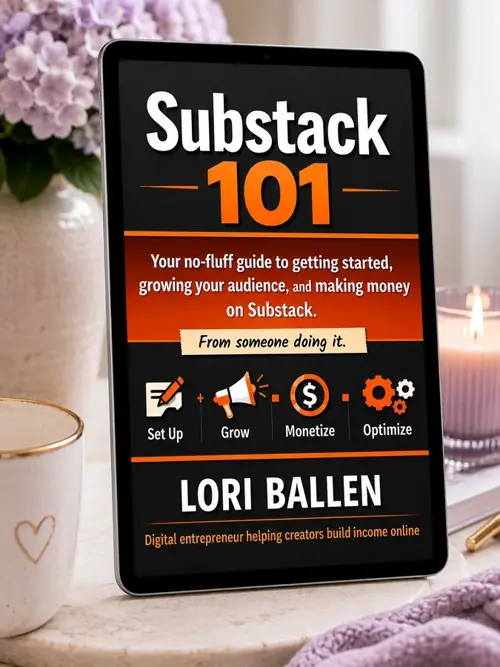
Substack 101
The exact framework for starting and growing a newsletter people pay for.
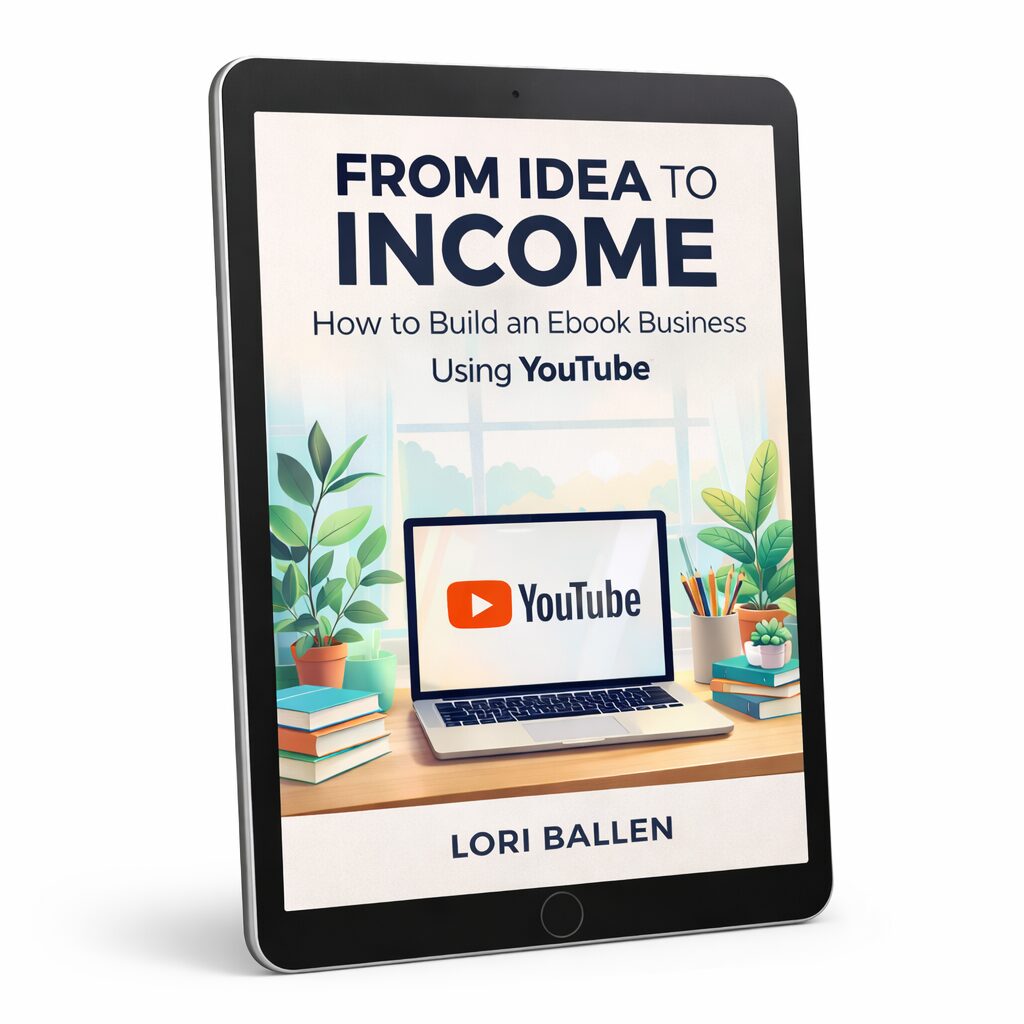
From Idea to Income
Turn one idea into a sellable digital product, step by step.
The tool that tells you the truth about a video
One of the links below is an affiliate link — if you sign up or buy through it I may earn a commission at no extra cost to you. I only ever share tools I actually use.
vidIQ
The channel analytics tool I check before I ever decide a video is not working.
The four questions I get asked the most
The habits behind consistent creator income
Check off each one as you try it in your own content.
“People follow us for us. They want our honesty, our style, our way of speaking, not a robot wearing our name.”
— Lori Ballen
Questions from the Q&A
Will an AI checker flag my Substack articles?
If AI does any of your editing, most checkers will flag it as AI even when every word and story is yours. That is a flaw in the checker, not a problem with using AI to clean up your own writing.
Do I need a script to make good videos?
Only if you are comfortable reading one and it still sounds like you. If a script makes you sound stiff or makes you lose your natural energy, skip it and speak from bullet points instead.
When should I turn on ads for my blog?
Wait until you have consistent monthly traffic, not just a handful of visits. Early on, ads pay very little and can hurt the reader experience more than they help your income.
How do I know who I am actually writing for?
Look at the season of life your audience is in, not just their age. Two people the same age can be in completely different financial and life stages, and your content should speak to the stage, not the number.
Full Video Transcript
Prefer reading to watching? Here is the whole video.
I got my first paid subscriber in January, right at the beginning of this year, and within four months I was a bestseller, which means getting over a hundred paid subscribers. I was shocked that people were still paying for blogs. You can absolutely use AI on Substack, and I do for every single article I write. But that doesn’t mean I’m telling AI, “Hey, write me an article about YouTube.” Here’s an example: I go for a walk, I take my phone with me, and I record my thoughts about what I want to talk about. I write my articles with my mouth because I don’t like sitting, and I already type all day long, so I don’t feel inspired by typing, I feel inspired by speaking. That’s just the way I do things.
After I brain-dump everything, I have Claude or ChatGPT clean it up, take out my ums, and turn it into an article, but it’s still my words. If you ran that through an AI checker, it would say it’s AI, but that’s ridiculous because it’s coming directly from me. If you have AI do any of your editing for you, it will flag as AI. You can turn off the ability for anyone to scan your article. Some people say they don’t care if it scans as AI because they use it anyway, and some people don’t use AI at all and it still scans as AI. Personally, I think the AI checker is going to go away.
Do I believe we should all go on Substack and just say, “AI, write me a blog post about being healthy at midlife”? No. I think that’s going to fail. People follow us for us. They want our way of speaking, our style, and they want us to be honest. I think it’s fine to voice-transcribe, and it’s fine to run an article through AI and ask, “What did I miss?” I just don’t think Substack is a great place to use AI and not be you. People notice that and pick up on the patterns pretty quickly. I think it’s going to get tougher and tougher on Substack to succeed that way.
One thing I do that could help those of you using AI is save all of my personal stories in it. For example, let’s say I go for a walk and take my phone and say, “I’ve got something exciting that happened yesterday. I lost five coaching clients last week, although that’s part of the normal purge. For a moment I had to reflect and wonder if it was me, if I did something wrong. But three days later I wound up with seven new coaching clients, and I realized the purge is just part of the process.” AI will save that story as part of a log. Then later, when I’m writing anything similar, it will say, “Do you want me to use your story about losing some clients but then picking up more?” And I’ll say, “Yeah, that’s a great idea, let’s put that story in there.”
Anytime I succeed at something, fail at something, I’m excited, struggling, mad, or happy about something, I dump it into AI. Toward the end of that conversation, I’ll ask, “What was this conversation really about?” And it will say something like, “I don’t think you even realize that what this conversation is really about is X.” And I’ll think, that’s my next article. I didn’t even realize what a good takeaway that would be for that audience, and then I build on it. So I never run out of ideas.
I think we’re going to start tuning out AI-generated content, because humans want humans. We’re looking for people where we can say, “I see myself in you.” There are a lot of us who are over fifty, and there’s a certain number of over-fifty influencers. Some I don’t watch because I don’t like their style, and others I really relate to because they’re more natural, more like me. I’ll watch them for beauty tips and hair tips. But if I think it’s a fake thing, I’m out of there.
When I started TikTok, I was making six figures a year doing mostly faceless content. I would literally hold out a makeup palette and say, “Laura Geller just released her new makeup palette,” and I’d sometimes make five thousand dollars in a day just doing that. It’s not as easy anymore. Can you still try? Sure, but it’s tougher. I think you do better creating a persona people can relate to, but can you still do the faceless stuff? Yes.
Can you do it on Pinterest? I’ve been testing it. Let’s say I’ve got software where I can take out the whole background and put a beach behind me, or remove my hand, or remove me entirely, or make it look like it’s sitting on a table. Those are some of the faceless things you could do, but I’m not finding that a lot of people click on that on Pinterest. I do have a cat tree that sells well there. I had my two cats sitting on top of it, the sun was coming in, the pool was behind them through the window, it was one of those perfect shots, and I took a quick picture and put it on Pinterest, and it did well.
I think your clothes could work too. Here’s one thing I love to do: I’ll stand in front of a mirror and take a picture of myself, but I put my phone right in front of my face when I take it. So you never see my face, but you see my body all the way down to my shoes. I’ll stand in the closet, that’s my favorite way to do fashion, especially being over fifty. They can love the outfit without having to see the wrinkles at the same time.
I know another lady on TikTok who’s really successful. She sets up a tripod pointed down so you see her from the neck down, and she’s got amazing energy. She’ll say, “Look at this great thing I picked up today, look at this outfit,” and do a little spin. There’s no face, only her body, so nobody would know who she was other than her sister, who might recognize her voice. So can it be done? Yes, it can.
First of all, I don’t script. I can’t be myself and read a script. There’s a YouTube brand called Think Media, I don’t know if you’ve followed them, they’ve been around for years. I watched that guy basically grow up on YouTube, and I used to love him so much more before he scripted his videos, because it was so authentic and so him, off the cuff. Now I can tell he’s reading, and he’ll try to go off on a little tangent and then bring it back, and I think, you just lost me again.
Some people can read a ten-minute script and it’s perfection, their energy is right, they’re so natural at it. Other people, you can really tell it’s not them. You’ve got to figure out which bucket you’re in. If you feel like you’re getting lost in the script and it’s not you anymore, you shouldn’t be scripting. I did the same thing. I thought I had to script so I would hold people’s attention.
One thing I got stuck on, and I don’t know if you can relate, is I kept hearing that you have to have more view time, the number one metric on YouTube. I ran my analytics through YouTube, and it basically told me where I was failing. But when I actually looked at my average view time, my channel was just barely above average. I wasn’t stuck on anything. If you tell AI you’re stuck on something, it will find you answers, but the truth was I didn’t need to change anything, I was already at the average.
The only way to get longer than that is to start running around the house changing scenes, more of a vlogging style, and I’m not going to do that. I’m going to show up and talk for twenty minutes at my kitchen table, that’s my style. Short form is for vlogging, for me, that’s where I’ll show where I’m at or show my house. But my sit-down style, at least for right now, is at my kitchen table.
The hook part can be learned. I realized I was actually doing hooks and didn’t even know it, just from all my years doing YouTube. When you open a video and say, “Welcome back,” nobody cares. But if you open with, “I cannot believe what I saw this morning,” that’s a hook, you’ve got their attention, you’ve piqued their curiosity. Or if you open with, “Digital products are the best thing I could have launched this year,” that’s a hook. I started learning to open a video with the most important thing I’m about to say, without it being overly structured, and to do it with some passion or curiosity.
Even without a lot of editing, this morning I made a video with my little light tripod sitting at the kitchen table, and it’s twenty-eight minutes long. Right before I came to talk to you, I went in, clipped out the front using CapCut, clipped out the end, and published it. It’s that easy without overthinking it.
AI can cause paralysis if you get too far in the weeds. Let AI give you ideas for videos, let it analyze your channel and tell you who you’re talking to, so you know the idea for the next video. AI is great at ideation. I’ll sit there and say, “Here’s kind of what I’m doing this week, what would be the sweet spot for a twenty-minute video?” And it’ll say, “How about this?” And I’ll think, bingo.
If I’m doing a video where I’m going to say, “Here are the eight ways I made money last month,” then I’ll have something in front of me, like my P&L statement or notes, because that’s the only time I’ll actually read something. Everything else just doesn’t work that way for me. You can hire a ten-thousand-dollar editor to come edit your video, and it’s not going to move you faster.
Here’s something important: a video is usually successful if YouTube first shows it to a very small number of your actual subscribers. If those subscribers engage, it shows it to the next perimeter of people, and then to non-subscribers who’ve never heard of you. So that first little bit is so important.
That’s why I’ve started doing things like the cats. I don’t do it on purpose, but it’s such a benefit, because the second somebody says, “Oh, I love your cat,” that’s engagement, and it causes YouTube to show it to the next bubble. I’ve also noticed that when I wear Gen X band t-shirts, Rolling Stones, Fleetwood Mac, AC/DC, the ones I wear for karaoke nights, I get way more interaction on my YouTube videos. Then YouTube shows it to the next perimeter, and if those people engage, it shows it to the next one after that. So you’re really focused on identifying that small group who watches your videos and getting them to engage.
I’ll ask a question, like, “I don’t even know if this is the right idea,” and I do that on purpose. I don’t really want their advice, I want their engagement. So I’ll say, “Is this a bad idea? Is selling my house a bad idea?” and let them go off in the comments and fight with each other, which is hilarious. Somebody will defend me, somebody else will say I shouldn’t sell my house, and that’s how it ends up going viral, if there’s a broad enough reach for it. You can see it on your channel, it’ll say, “This video is getting more engagement from your subscribers,” it’s literally telling you what’s working.
So you’ve got to learn what generates that engagement, and you’ve got to start off quick, that’s why everyone says open with a hook, it’s about getting their interest. Sometimes now I’ll literally start by walking on screen, sitting down, and pulling up my chair, and that captures attention because there’s movement on the screen. You’ll notice influencers on TikTok will put on lipstick or lip gloss, do their hair, put it in a ponytail while they’re talking to you. That’s done on purpose, it generates movement and people get more interested. The flickering candles behind me are on purpose too, people get curious about little things like that.
So that’s what you’re looking for. You start paying attention to what’s generating engagement on your videos, and you do more of that. There’s a tarot card reader I watch who has a dog named Chase, and as soon as the video opens, “Hey Virgo, welcome, Chase here,” everybody’s looking at the dog and commenting. He feeds Chase treats while starting the video and then puts him down for a nap, and that’s on purpose because he knows people are commenting on the dog. So bring in whatever it is that works for you.
One way to monetize a blog, a traditional WordPress or Wix blog, not Substack, is with ads. You put a little piece of code on your website, and when a visitor comes, ads pop up and you get a percentage of the ad revenue. Typically you’re only going to make a few dollars, maybe up to twenty dollars, for every thousand views. Your niche matters too. If you’re talking about money, budgeting, finance, health and fitness, or technology, those are higher-earning niches.
Let’s say ten dollars for easy math, if you got a thousand views on your website, you might make ten bucks. I usually tell people if you’re not getting at least a thousand views, don’t bother, because you’re taking away the user experience by adding ads, and it could hurt your traffic and rankings while you’re only making pennies. Work on traffic first, that’s an instance where I say build traffic first, you need more content and more eyeballs.
My website that makes about a thousand dollars a month has over fifty thousand views every month, and that’s all being driven from Pinterest, so it makes sense to have ads on it. The more views you get, the more you can apply with premium advertisers who help manage your website in a way that gets you better clicks and more money. I’ve never really gotten into that level on my own blogging because I monetize in other ways, but I know people making six figures a year generating traffic to their blog, a lot in home and garden, technology, finance, and health and fitness. Health, wealth, and relationships are the top-tier niches.
But you’ve got to spend a lot of time getting that traffic, and Google traffic isn’t what it used to be, so you’re going to be spending a lot of time figuring out Pinterest, pins, and driving people over. Would I suggest turning on ads at a hundred visits? No, I’d say you need at least a thousand visits a month before you think about monetizing that way, and Google AdSense is the usual starting place.
The number one demographic on Pinterest is Gen Z, and they’re looking for a really different type of vision board than millennials, Gen X, or boomers, it’s a different language and space. It’s much harder, but there’s a large and growing group of millennials and Gen Xers in the thirty-five to sixty-five range on Pinterest, which is a positive thing. You’ve got to look at what you’re creating and who the audience is, and really zero in on that.
You’ll notice if you go to my Pinterest now, I’ve literally started typing things like “I’m 55 and I’m selling my house,” because I realized I don’t want the Gen Zers and young millennials, I need elder millennials, Gen X, and boomers, that’s who my group is primarily. I said, I can either try to appeal to everybody, or focus on who I know I’m talking to, and I’ll be darned if it isn’t working, they’re starting to click. So really know who your audience is and try not to take a broad approach, really focus in.
For example, let’s say the age range of your audience on YouTube is thirty-five to fifty-five, that sounds way too broad to me, because those are completely different seasons of life. At fifty-five, we’re downsizing, becoming empty nesters, selling our houses. At thirty-five, we’re building, having kids, buying houses, making the biggest investment purchases of our lives. How do you talk to those two people the same way? I think you need to hone in on a particular group.
Say the forty to fifty range, they’ve got middle schoolers and high schoolers, some still have younger kids, they’re still moving up, still buying bigger houses, but starting to think about retirement, putting money away for their kids’ college, thinking about credit. They’ve got money now to spend, they’re starting to step into wealth building. So think of it not as an age but as a season of life, who are you actually talking to.
You might still be talking about budgeting and the best places to get credit cards if you’re in your thirties, but if you’re in your fifties or sixties you’re talking about travel hacks, how to get the most free flights, it’s such a different generation. If I were you, I’d really get clear on who it is you’re talking to and start customizing every piece of content for that person.
Ready to turn your creator business into a system?
Not ready to buy yet? Get Letters from Lori for more like this.
Hey there! Just a quick heads-up: some of the links on this site are affiliate links, meaning I may earn a small commission if you make a purchase (including through the Amazon Associates program), at no extra cost to you. Occasionally, products featured here are gifted by brands.
I also use AI tools to help research and create content for you! While I love sharing strategies to help you succeed, please remember that everyone's journey is unique—individual results vary, and there are no guarantees. Thanks so much for stopping by!
