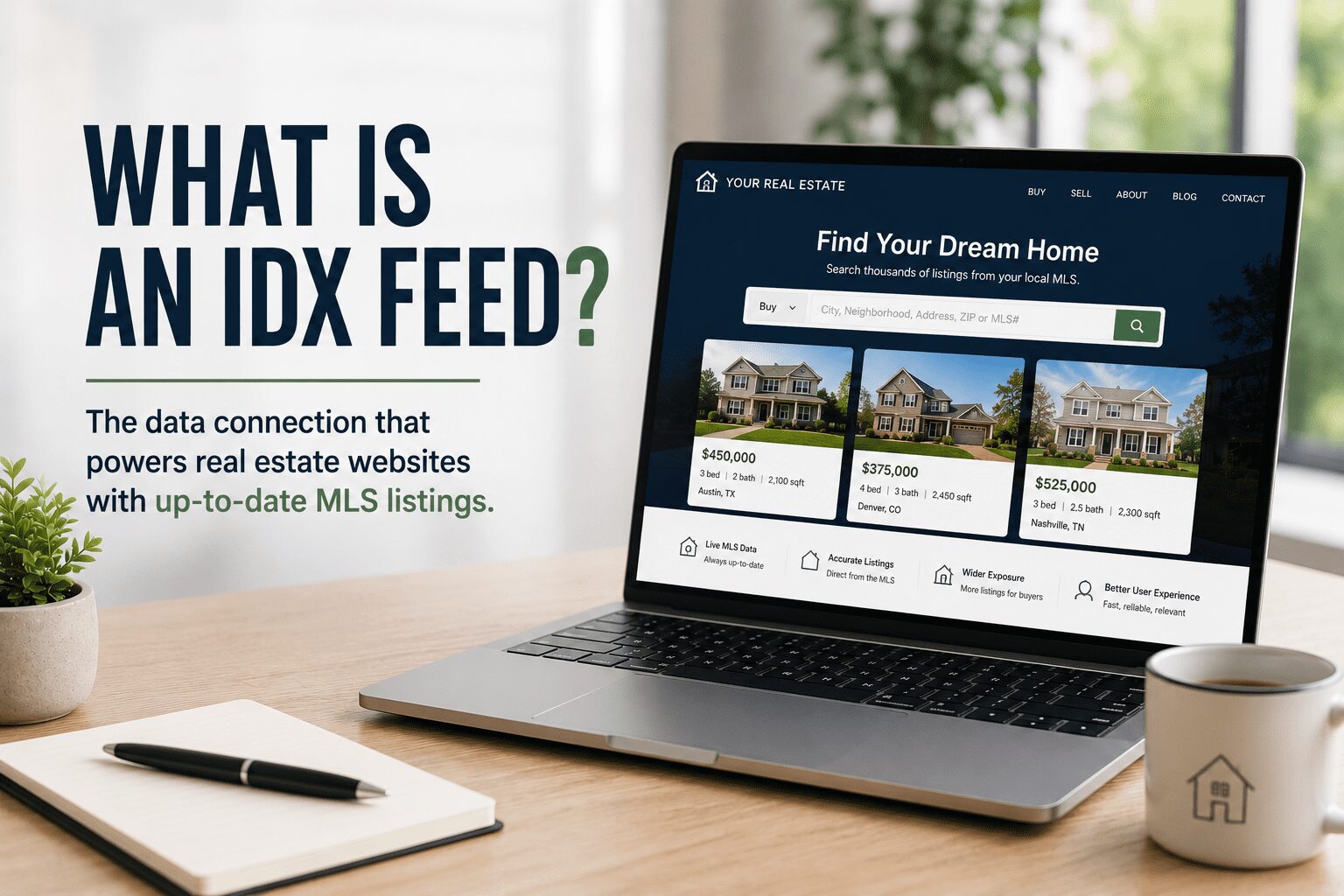
When a buyer searches for homes on your real estate website, they are looking at live MLS data. That data did not appear by magic and it is not stored in a static database on your website. It arrives through an IDX feed, which is an active data connection between your local MLS and your website that updates regularly to reflect the current state of the market. Understanding how that feed works helps you make better decisions about your IDX provider, your showcase page structure, why some sites are more current than others, and what happens when the feed has problems.
What an IDX Feed Is
An IDX feed is a data connection between your local MLS and your IDX provider. The MLS maintains a database of all active, pending, and recently sold listings in your market. Your IDX provider establishes an authorized connection to that database through an agreement with the MLS and pulls listing data on a regular schedule. That data, including property details, photos, listing status, and price history, flows to your website and populates the search results that buyers see when they search your IDX.
The feed is not universal. Each MLS has its own data standards, its own IDX rules, and its own authorized vendor list. An IDX provider that operates in one state may not be authorized to pull data from an MLS in another state. This is one of the first things to verify when choosing an IDX provider, that they have an active authorization to pull data from your specific MLS.
The IDX rules established by the MLS govern what data can be displayed publicly, how it must be attributed, how long sold listings can remain visible on public-facing agent sites, and what disclosure language must appear on IDX pages. These rules vary by MLS and are a condition of participation in the IDX program. Violating the MLS IDX rules can result in losing access to the data feed entirely, which would take your entire listing search offline.
How Often the Feed Updates
Feed update frequency varies by IDX provider and by MLS. The best IDX providers update their feeds every fifteen to thirty minutes, which means the listings on your site are rarely more than half an hour behind the current MLS status. Some IDX providers update hourly. Others update once or twice per day. The frequency matters most in competitive markets where properties move quickly.
A buyer who finds a listing on your site and decides to call about it, only to be told it went under contract three hours ago because your feed only updates twice a day, has a frustrating experience that reflects on your site even though the problem is the data feed’s lag rather than anything you did wrong. A feed that updates every fifteen to thirty minutes means buyers are seeing information that is close to real time, which reduces the likelihood of that kind of disappointment and increases the credibility of your site as a reliable source of current listing information.
IDX Broker updates frequently and the feed quality is one of the reasons I have used and recommended it for years. When I was actively selling real estate in Las Vegas, having current data on my site was not optional. The Las Vegas market during competitive periods was moving fast enough that a daily-update feed was essentially useless for buyers who were ready to act quickly.
What Data Comes Through the Feed
A standard IDX feed includes the publicly displayable information from each MLS listing. The listing address, price, property type, number of bedrooms and bathrooms, square footage, lot size, year built, listing date, days on market, listing agent name and brokerage disclosure, MLS number, property photos up to the maximum the MLS allows, and the property description written by the listing agent. Some feeds include virtual tour links when the listing agent has provided one. Open house schedule data is included in feeds where the MLS makes it available.
What is not included in IDX feeds is private remarks, showing instructions, agent-to-agent notes, and any other internal MLS communication that is restricted from public display under MLS rules. The full picture of a listing that an agent sees in the MLS is different from what a buyer sees on an IDX site, and that distinction is intentional and governed by MLS rules rather than by the IDX provider.
How the Feed Creates Your Showcase Pages
Showcase pages in IDX Broker are pre-built search result pages that display listings from the feed filtered by specific criteria. When you create a showcase page for Summerlin homes for sale, IDX Broker uses the feed to populate that page with every active listing in Summerlin that matches your filter parameters. When a new Summerlin listing hits the MLS, it appears on your Summerlin showcase page on the next feed update. When a Summerlin listing goes under contract, it drops off the active search results on the next feed update and moves to a pending status.
This automation is what makes showcase pages valuable over time. You build the page once, configure the search parameters, optimize the title and meta description for SEO, and the page stays current indefinitely as the feed updates. You do not have to manually add or remove listings. The feed handles all of that automatically, which means your pages are always showing current inventory without any ongoing maintenance on your part beyond keeping the site live and the IDX subscription current.
Why Feed Quality Matters for SEO
The IDX feed populates your showcase pages with real listing data. The more current and complete that data is, the more useful those pages are to buyers and the more substantive content search engines have to evaluate when determining how to rank them. A feed that is stale, incomplete, or that produces listing pages rendered in a format Google cannot properly crawl generates less SEO value regardless of how well your showcase page titles and structures are configured.
Individual listing detail pages created by the IDX feed can also rank in Google search for property-specific queries. A buyer who searches a specific MLS number or address may find your listing detail page in the results. This is a secondary ranking benefit of a well-configured IDX feed that most agents are not aware of.
Getting the feed connected, authorized with your MLS, configured correctly within the IDX platform, and integrated with properly structured showcase pages is the technical foundation that everything else in your real estate website’s SEO strategy sits on. Jeff and Paul at Ballen Brands handle this as part of the BREW system setup, ensuring the feed is configured correctly and the showcase pages are structured to benefit from it. Reach them at 702-917-0755 or team@ballenbrands.com. The IDX Broker signup link on this page waives the $99 setup fee.
Lori Ballen is a digital entrepreneur and content creator based in Las Vegas. She founded Ballen Brands, now owned and operated by her brothers Jeff and Paul Helvin.
Hey there! Just a quick heads-up: some of the links on this site are affiliate links, meaning I may earn a small commission if you make a purchase (including through the Amazon Associates program), at no extra cost to you. Occasionally, products featured here are gifted by brands.
I also use AI tools to help research and create content for you! While I love sharing strategies to help you succeed, please remember that everyone's journey is unique—individual results vary, and there are no guarantees. Thanks so much for stopping by!