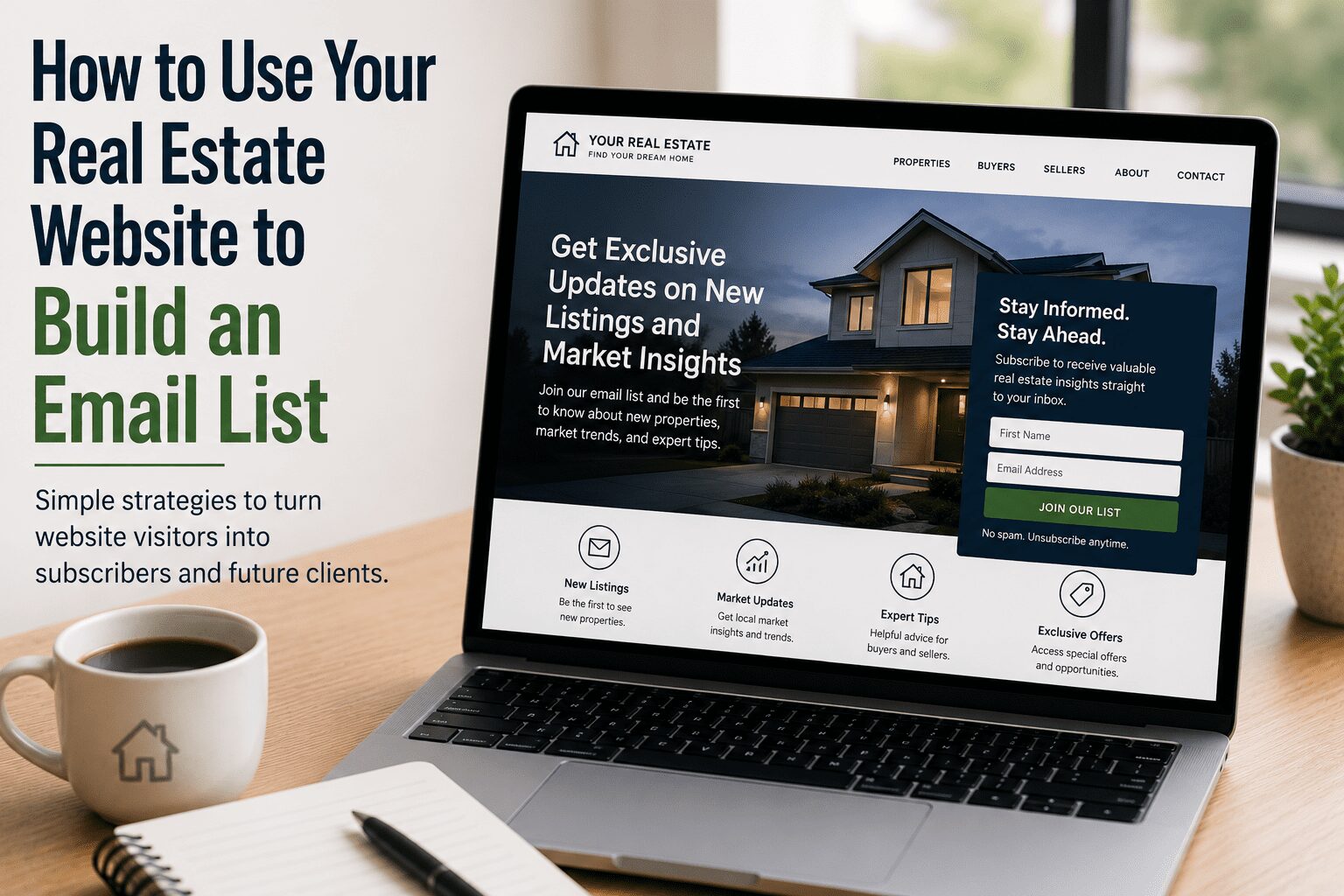
Social media will tell you that you need to be everywhere to build a real estate business online. That is not accurate. Social media audiences belong to the platform. Your website audience belongs to you. A buyer or seller who joins your email list from your website is a contact you own permanently, that you can communicate with whenever you choose, through a channel that no algorithm controls and no platform policy change can cut off. A follower on any social media platform is none of those things.
Building an email list from your real estate website is one of the highest-leverage activities available to a real estate agent operating online. The list compounds over time in value as it grows. The contacts on it become more valuable as they move through their buying or selling timeline. And the channel itself becomes more stable and more reliable than any social media platform because you own it.
Why Email Still Outperforms Social for Real Estate
An email list is an audience you control. When you send an email to your list, it reaches everyone who opted in. The delivery is not subject to an algorithm that decides who sees what based on engagement signals, ad spend, or platform priorities. In real estate, where the buying and selling cycle spans months or years and where staying in front of a warm audience over time is one of the most valuable things you can do, email’s direct delivery model has a significant practical advantage over social media.
Average email open rates in real estate run between twenty and thirty percent, which is dramatically higher than the organic reach on most social media platforms for non-advertising content. A newsletter sent to a list of 1,000 people reaches 200 to 300 people who actively read it. A social media post sent to 1,000 followers may reach fifty to one hundred people depending on the platform’s current algorithm behavior. The difference in effective reach is significant and becomes more significant as platform algorithms prioritize paid content over organic posts.
Email also has a fundamentally different relationship dynamic than social media. A buyer or seller who subscribes to your email list has explicitly opted in to receiving communication from you. That explicit opt-in creates a different level of engagement and permission than the passive following relationship of social media. People who want to hear from you open your emails. People who casually follow you on Instagram scroll past your posts.
IDX Registration: Your Highest Volume Source
Every buyer who registers on your IDX site to save a search or set up listing alerts is a potential email subscriber. The contact information they provide during IDX registration, name, email address, and often phone number, flows directly into your CRM through the IDX integration. If that CRM is connected to your email marketing platform, new IDX registrants can be added to appropriate email sequences automatically.
This is the highest-volume source of email contacts for most agent websites because it captures buyers at the moment they demonstrate active interest. A buyer who registers to set up listing alerts for three-bedroom homes in a specific zip code is a buyer who wants to hear about new listings in that area. That is exactly the kind of contact that benefits from being on your email list for the duration of their search.
The technical connection between IDX Broker, your CRM, and your email marketing platform needs to be configured intentionally rather than assumed. Confirming that new IDX registrations flow into the right email sequence rather than sitting in a CRM contact record that never receives any follow-up is one of the most important setup steps in the entire system. A site that generates IDX registrations but never follows up with those contacts through email is capturing leads and wasting them.
Lead Magnets: Getting Subscribers Who Are Not Ready to Search
Visitors who are not ready to register on the IDX and search listings need a different reason to give you their email address. Lead magnets are specific, valuable pieces of content offered in exchange for a name and email. They convert visitors who are in the early research phase of their buying or selling journey rather than visitors who are actively searching for specific properties.
A neighborhood guide for the areas you serve, delivered as a PDF after email signup, captures buyers who are researching neighborhoods but not yet searching listings. A first-time buyer guide for your market captures buyers who are still building their understanding of the process. A monthly market report for sellers captures homeowners who are watching market conditions before deciding to list. A home preparation checklist for sellers captures homeowners who are considering listing in the next few months.
The lead magnet should be relevant to the page it appears on rather than generic across the entire site. A buyer guide offer embedded in a neighborhood page about Summerlin converts better than a generic newsletter signup box. A home value estimate offer embedded in a seller resources page converts better than either. Matching the offer to the visitor’s apparent intent at that specific point in their journey is what produces meaningful conversion rates from lead magnets.
Opt-In Forms and Pop-Ups Done Right
Pop-up forms on real estate websites have a poor reputation because most of them are configured badly. A pop-up that fires immediately when a visitor lands on any page of the site is an interruption before the visitor has found any value. That kind of pop-up converts at a very low rate and creates a negative first impression that affects the rest of the visit. Visitors who feel interrupted close the pop-up and often leave the site immediately.
A pop-up configured to fire after a visitor has been on the site for sixty to ninety seconds converts at a meaningfully higher rate because it appears after the visitor has already found something worth staying for. An exit-intent pop-up that appears when the visitor is about to leave the page is another effective trigger because it catches people at the moment they are leaving rather than the moment they are arriving. A scroll-triggered form that appears when a visitor reaches the bottom of a long blog post converts well because completing the post signals genuine interest in the topic.
Inline forms embedded within content, placed naturally within a relevant paragraph or at the end of a blog post, convert at lower rates than pop-ups but create zero interruption and maintain a positive user experience. For sites where the user experience matters more than maximum conversion rate, inline forms are the appropriate choice.
What to Send Once You Have the List
A list that never hears from you is a list that forgets who you are. The email addresses you collected from IDX registrations, lead magnet downloads, and opt-in forms represent people who were interested enough in your content or your search tool to give you their contact information. Failing to maintain that relationship with regular, useful communication wastes the capture investment.
Monthly market updates for your area give your list a reason to stay subscribed and keep your name in their inbox throughout their research period. New listing alerts for buyers who have expressed interest in specific areas keep the property search relationship active even when they are not actively visiting your site. Blog post notifications bring warm contacts back to your site when you publish relevant new content. Seasonal buying or selling advice gives you a reason to email your list at logical times throughout the year without feeling like you are reaching out without a reason.
The goal is to be the agent they think of when they are finally ready to make a move, which may be months or years after they first gave you their email address. Consistent email presence over that entire timeline is how you stay top of mind without being intrusive.
The BREW system from Ballen Brands is built with the lead capture infrastructure to make email list building possible, including IDX registration flow, opt-in form placement, and CRM integration. Jeff and Paul can help configure the system so contacts flow correctly from your website into your email marketing platform. Reach them at 702-917-0755 or team@ballenbrands.com.
Lori Ballen is a digital entrepreneur and content creator based in Las Vegas. She founded Ballen Brands, now owned and operated by her brothers Jeff and Paul Helvin.
Hey there! Just a quick heads-up: some of the links on this site are affiliate links, meaning I may earn a small commission if you make a purchase (including through the Amazon Associates program), at no extra cost to you. Occasionally, products featured here are gifted by brands.
I also use AI tools to help research and create content for you! While I love sharing strategies to help you succeed, please remember that everyone's journey is unique—individual results vary, and there are no guarantees. Thanks so much for stopping by!