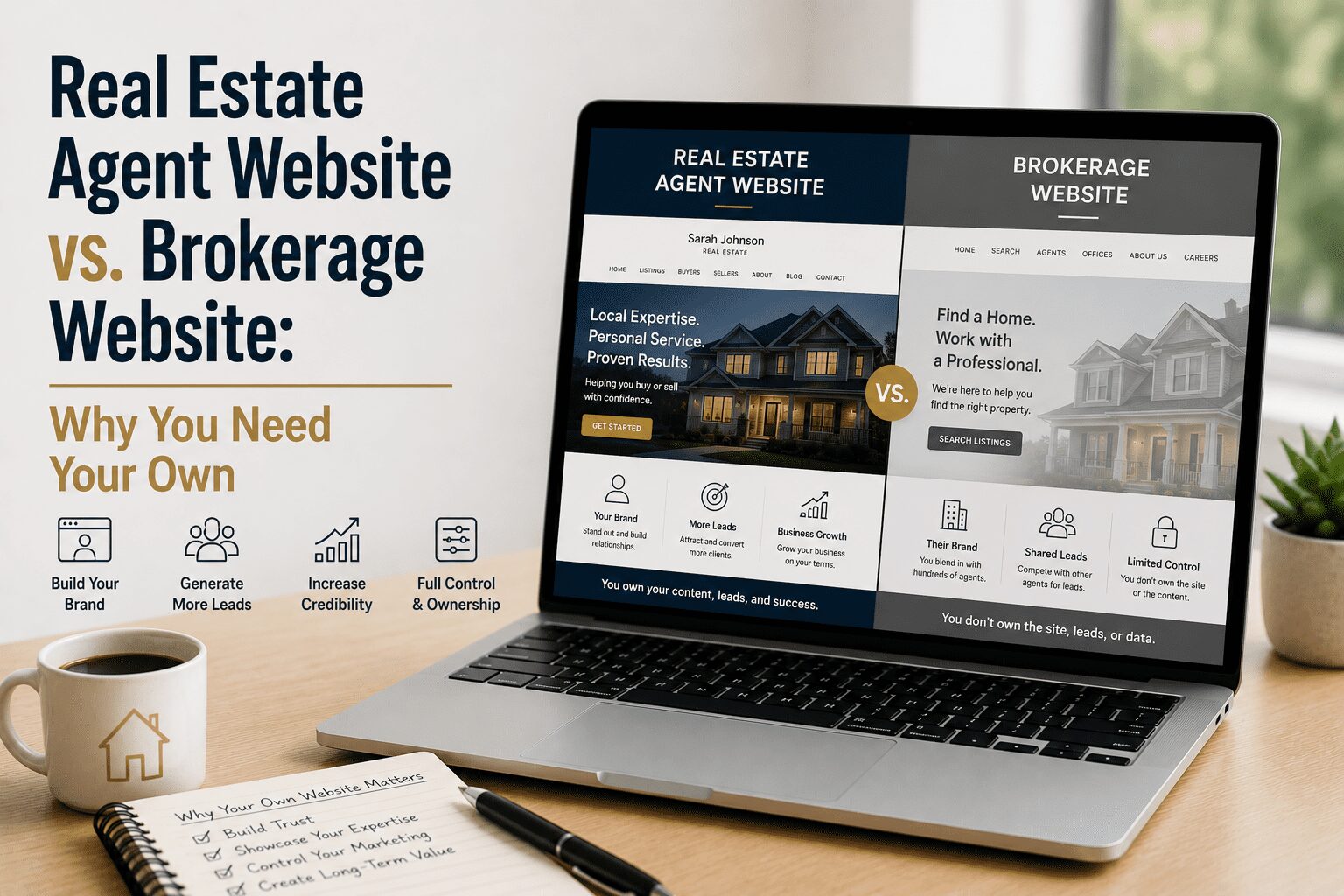
Your brokerage gave you a website. It has your photo, your contact information, and maybe a search tool powered by the brokerage’s IDX. It looks professional. It probably took you about fifteen minutes to set up.
It also doesn’t belong to you. And that’s the problem.
Most agents don’t think about this until they’re already in the middle of a transition. A brokerage change, a market shift, a business pivot. That’s when they find out that everything they built on someone else’s platform stays behind when they leave.
Here’s why your own website isn’t optional if you’re serious about building a real estate business that belongs to you.
What a Brokerage Website Actually Is
A brokerage website is a page within the brokerage’s domain. It’s a profile, not a website. Your name and photo sit inside the brokerage’s brand, on the brokerage’s URL, inside the brokerage’s system.
Any leads that come through that page go through the brokerage’s system first. Depending on how the brokerage operates, those leads may be distributed to other agents, routed through a follow-up system you don’t control, or simply kept in a database you can’t access once you leave.
Any content on that page, any reviews, any search history, any SEO value that page has accumulated, belongs to the brokerage domain. When you leave, it stays.
You can’t take it with you. You can’t redirect it. You start from zero at your next brokerage.
What Your Own Website Gives You
A website you own operates on your domain, under your brand, with your content. Every lead it generates comes directly to you. Every page you publish builds authority on your domain. Every month of SEO work compounds on an asset that belongs to you regardless of where you hang your license.
When you switch brokers, your website moves with you. You update the brokerage information in your footer and keep everything else. Your content. Your leads. Your domain authority. Your search rankings. None of that resets.
This is the foundational argument for owning your website. It’s not about features. It’s about who owns the asset you’re building.
The SEO Gap Is Real and It Grows Over Time
Search engine optimization takes time. A domain that has been publishing consistent, relevant content for two or three years has advantages that a brand new domain simply can’t replicate quickly. Authority builds slowly and compounds.
Every year you spend building content and links on a brokerage domain is a year of SEO equity you won’t be able to transfer. Agents who recognize this early and start building on their own domain accumulate an advantage that becomes harder for newer agents to close over time.
Your own website, consistently maintained, becomes one of the most durable competitive advantages in your market. The brokerage website gives you none of that.
Brand Control Matters More Than Most Agents Admit
Your brokerage website makes you look like a brokerage agent. Your own website makes you look like you.
For agents building a personal brand around a specific niche, neighborhood, client type, or approach, the brokerage template is a constraint. You can’t control the design, the messaging, the content strategy, or the user experience. You get what the brokerage built for everyone.
Your own website gives you full control over how you present yourself, what content you prioritize, how buyers and sellers experience your brand, and what impression they leave with. That matters at every price point and especially in competitive markets where differentiation is the job.
IDX on Your Own Site vs. IDX on the Brokerage Site
Most brokerage websites include some form of property search. Buyers can use it, which means buyers can stay on the brokerage site rather than needing yours.
What the brokerage IDX doesn’t do is send those leads to you specifically. It captures buyer information for the brokerage. Depending on the brokerage’s lead routing system, you may or may not receive those leads, and when you do, you may be competing with other agents in the same office for the same buyer.
IDX on your own website sends every registration directly to you. There’s no routing system, no distribution, no competition. The buyer searched on your site, registered on your site, and is now your lead.
I built my real estate lead generation system on WordPress with IDX Broker. My brothers Jeff and Paul Helvin at Ballen Brands now build and support that same system for other agents through the BREW (Ballen Real Estate Website) platform. It’s configured specifically so that IDX drives leads directly to the agent, with showcase pages built for SEO and lead capture tools set up to convert. Reach them at 702-917-0755 or team@ballenbrands.com if you want to talk through what a properly built site looks like for your market.
The Portability Argument Is the Strongest One
Real estate agents change brokerages. Markets shift. Teams dissolve and reform. Business models evolve. An agent who is solo today might be running a team in three years and back to solo in five.
Through all of that, your own website stays yours. The domain authority you’ve built, the content you’ve published, the leads in your CRM connected to your site, none of that is affected by what brokerage name is on your business card.
Agents who’ve built on their own platform for five or ten years have something that simply can’t be replicated quickly. That’s a real competitive moat, built one piece of content and one indexed page at a time.
You Can Have Both
Having your own website doesn’t mean ignoring the brokerage profile. Keep it updated. It’s additional search surface area and it reinforces your credibility. But treat it as a secondary asset, not your primary web presence.
Your own website is where you invest your content, your SEO effort, and your lead generation infrastructure. The brokerage page is where buyers might find you first and then click through to learn more about you on your own domain.
Build both. Own one.
Where to Start
If you don’t have your own website yet, the first decision is platform. WordPress gives you ownership, flexibility, and the best environment for IDX integration and SEO. A proprietary platform, even a good one, puts you at the mercy of that company’s decisions about pricing, features, and longevity.
The BREW system Ballen Brands builds is WordPress-based, integrated with IDX Broker, and structured from the ground up for lead generation. Jeff and Paul can walk you through what a site built for your specific market would look like. Call them at 702-917-0755 or email team@ballenbrands.com.
If you want to set up IDX Broker yourself, the signup link on this page waives the $99 setup fee. The platform is there. Getting it configured correctly is the work that makes the difference.
Either way, start building on something you own. The longer you wait, the more ground you’re giving to agents who already have.
Lori Ballen is a digital entrepreneur and content creator based in Las Vegas. She founded Ballen Brands, now owned and operated by her brothers Jeff and Paul Helvin.
Hey there! Just a quick heads-up: some of the links on this site are affiliate links, meaning I may earn a small commission if you make a purchase (including through the Amazon Associates program), at no extra cost to you. Occasionally, products featured here are gifted by brands.
I also use AI tools to help research and create content for you! While I love sharing strategies to help you succeed, please remember that everyone's journey is unique—individual results vary, and there are no guarantees. Thanks so much for stopping by!


