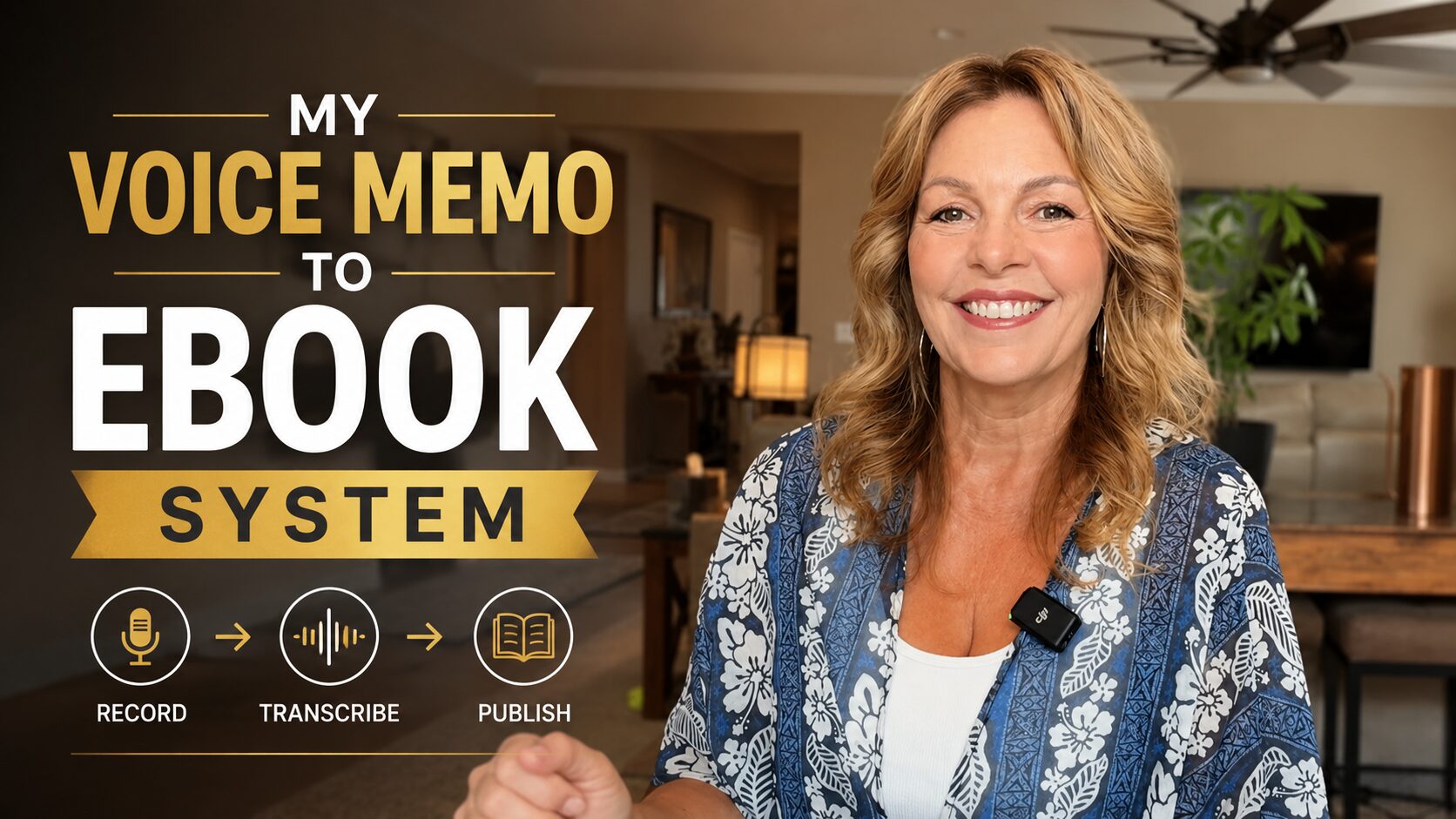
For years I’d sit down to write an ebook and freeze.
Not because I didn’t know the material. I know my material cold. I’ve been blogging since AOL told you that you had mail.
The problem was the keyboard. Something about sitting down to type turned me into a robot. Stiff, careful, nothing like how I actually teach when there’s a real person in front of me.
Then I figured out the thing that changed everything: I’m better out loud than I am on the page.
So I stopped fighting it. Now I don’t write my ebooks. I talk them.
Here’s the whole system, the way I really do it.
Step one: I record myself teaching it on a walk
Most of the year I take a two-mile walk, and I bring my phone.
I open up a voice tool and I just start teaching. Out loud, like there’s a student walking next to me. I’ll say something like, “Okay, let me tell you exactly how I build a lead magnet for a blog post that’s already getting traffic,” and then I just go.
I don’t script it. I don’t try to say it perfectly.
And here’s the trick that makes it actually work. I don’t stop when I run out of things to say.
When I think I’m done, I ask for questions back. I’ll literally say, “Now ask me questions about what I just explained, so I know what I left out.”
That back-and-forth is what turns a rambly walk into a complete teaching. All the gaps I’d never notice on my own get filled in.
I use Wispr Flow for the voice-to-text part, because talking is about four times faster than typing and it keeps the words sounding like me.
Step two: I let the messy transcript come first, then shape it
This is where most people get it backwards.
They try to outline first and then fill it in. I do the opposite. I let the messy transcript exist first, then I shape it into something afterward.
I take that transcript and I feed it into Claude, and I tell it what I want it to become. A free one-page lead magnet. A seven-page starter guide. A forty-page ebook I can sell.
The transcript is the raw knowledge and the voice. The structure comes second.
I’m not asking AI to know my business. I’m handing it my business, in my own words, and asking it to organize what’s already there.
And I want to be really clear about this part, because it matters.
The knowledge is mine. The voice is mine. The stories are mine. The tool is the editor and the formatter, not the author. It’s the assistant who finally remembers how I like things laid out.
If you skip the recording and just ask AI to write you an ebook from nothing, you’ll get something generic that sounds like everybody else.
The recording is the product. Everything after it is just cleanup.
Step three: I fix the layout by talking, not dragging boxes
The first version is always rough.
Too much white space. The footer in the wrong spot. A page that cuts off at the bottom.
This used to be the part I dreaded most. It meant opening a design tool and dragging boxes around for an hour, never quite getting the spacing right.
Now I just say what’s wrong.
“You’re chopping off the bottom of page one, move that down to page two.” “Tighten it up so the content flows with no gaps.” “Put my website in the footer with a copyright and the date.”
One thing at a time.
The first few rounds are slow, I won’t pretend they’re not. But every fix gets remembered, so the next ebook comes out cleaner without me even asking.
That’s the whole reason it speeds up. I’m not getting better at design. The system is just learning how I like things.
Step four: I split one recording into a free thing and a paid thing
Once I’ve got a clean draft, I decide where the line goes.
The free version is valuable but thin. It solves one decision, fast.
The paid version is thicker, because it sells the execution. The freebie says, “Here’s what to do.” The product says, “Here’s exactly how to do it.”
That gap between them is the whole reason anyone upgrades.
So one voice memo, on one walk, becomes both. A free lead magnet that captures the email, and a paid ebook the funnel sells later.
Same knowledge. Two products. Two jobs.
The full loop, so you can steal it
Here’s the whole thing in order.
Record yourself teaching one thing you already know, out loud, like a student is right there with you.
Ask for questions back so you fill the gaps you’d have missed.
Feed that transcript into an AI tool and tell it what format you want it to become.
Fix the layout by saying what’s wrong, one thing at a time, instead of designing it by hand.
Split it into a free version that solves the decision and a paid version that delivers the execution.
That’s it. That’s the system.
And the reason it works isn’t the tools. It’s that you’re finally building from what you already know, instead of trying to manufacture something new at a blank keyboard.
You don’t have to do it exactly like me. Maybe you’re a writer and typing is where you shine. Great, do that instead.
But if you’ve been sitting on a product idea because the making of it feels like too much, try talking it out first.
The thing you’ve been overthinking is probably already finished in your head. You just have to say it out loud.
The tools I mentioned: I use Wispr Flow for voice-to-text. I sell my finished products through Fourthwall, which connects to my YouTube shopping shelf, and I run my email funnels through Kit. These are affiliate links, which means I may earn a commission if you sign up, at no extra cost to you. I only recommend tools I actually use.
Hey there! Just a quick heads-up: some of the links on this site are affiliate links, meaning I may earn a small commission if you make a purchase (including through the Amazon Associates program), at no extra cost to you. Occasionally, products featured here are gifted by brands.
I also use AI tools to help research and create content for you! While I love sharing strategies to help you succeed, please remember that everyone's journey is unique—individual results vary, and there are no guarantees. Thanks so much for stopping by!