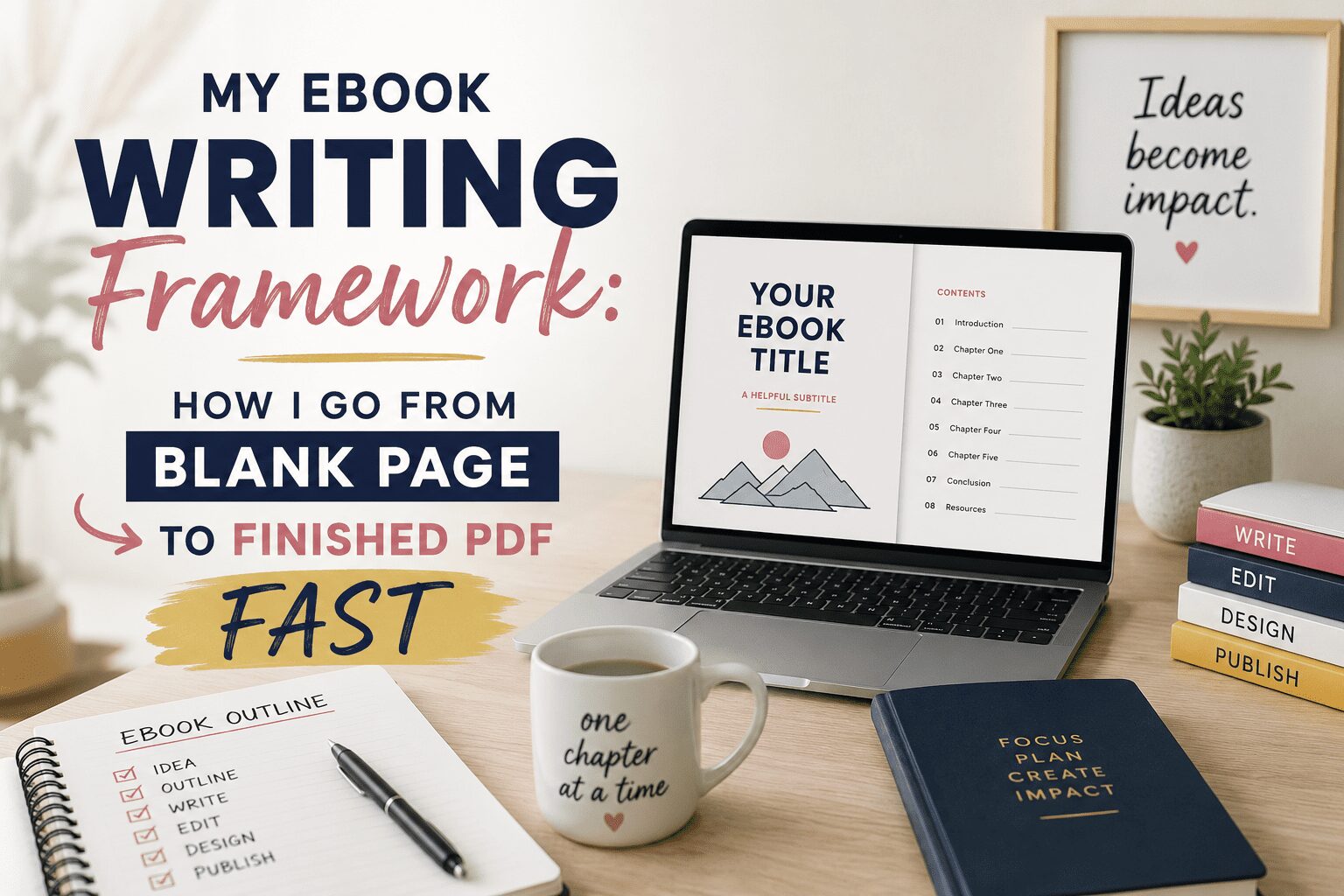
The blank page is not the problem most people think it is. The blank page is actually the symptom. The real problem is not knowing what you are trying to say before you start saying it. Every ebook I have struggled to write was an ebook where I started writing before I finished thinking.
Every ebook I wrote fast was one where I had done the structural work before I opened a single document. The framework I use now consistently produces a finished, readable first draft in two focused work days. I cover the full ebook creation process, from topic validation through the YouTube strategy that drives sales, in my ebook From Idea to Income: How to Sell eBooks and PDFs Using YouTube, available at ballenpublishing.com for $27. Here is the writing framework specifically.
The Framework Starts Before You Write
I do not open a writing document until I have a complete working outline. The outline is a list of every section the ebook will contain, in the order they will appear, with one sentence describing what each section will cover. If I cannot write that one sentence for a section, the section is not ready to be written yet. The one-sentence test forces me to know what I am saying before I try to say it.
The outline also tells me the scope and flow of the ebook at a glance. I can read through the section headings and immediately sense whether the progression makes logical sense, whether I am covering too much or too little, and whether the order serves the reader’s learning sequence. Fixing structural problems in an outline takes five minutes. Fixing them in a finished draft takes five hours.
How I Build the Outline
I start the outline with the end in mind. What should the reader be able to do or know after reading this ebook that they could not before? That outcome is the destination. Every section in the outline should move the reader closer to that destination. Sections that do not serve the destination get cut before I write a word.
I then work backwards from the destination. If the reader needs to know X to accomplish the outcome, what do they need to know before X? And before that? This reverse-engineering process produces a logical learning sequence where each section builds on what came before. The reader never feels lost because each new idea has been set up by the ideas that preceded it.
I write the outline in Google Docs with each section heading formatted as an H2. Below each H2, I write two to three bullet points describing the specific content that section will cover. Those bullets become my writing prompts when I sit down to write each section. They ensure that every section covers what I planned rather than drifting into tangents or stopping short of the necessary depth.
The Section-by-Section Writing Method
I write ebooks one section at a time, not one chapter at a time. Each section is a self-contained unit with a clear opening that states what the section is about, a body that delivers the content efficiently, and a closing that either summarizes the key point or leads naturally into the next section. This tripartite structure applies to every section regardless of length.
Writing one section at a time also makes the process psychologically manageable. I am not writing an ebook. I am writing a section that happens to be part of an ebook. The distinction matters because a section feels completable in one sitting. An ebook does not. When every writing session ends with a completed section rather than a partially finished chapter, the momentum stays intact.
Voice and Tone Rules I Write By
I write ebooks in the same voice I use in my blog posts and YouTube scripts. First person, direct, no academic language, no passive voice, no filler phrases. If a sentence does not add information, I delete it. If I can say something in eight words that I currently said in sixteen, I use eight.
Short paragraphs. Two sentences is my default maximum. After every two sentences, I start a new paragraph. This creates the visual rhythm that makes the ebook feel readable rather than dense, and it forces me to be more precise because I cannot pad a thought by extending a paragraph indefinitely.
I avoid transitions that explain what I am about to say rather than saying it. Phrases like “in this section, we will cover” and “as mentioned above” are filler. I cut them and start directly with the content they were introducing. The reader does not need to be warned about what is coming. They need the thing that is coming.
The First Draft vs. The Edit
I write the first draft without editing. The editing brain and the writing brain cannot operate simultaneously with any efficiency. When I write and edit at the same time, I write slowly and edit superficially. When I write without editing and then edit without writing, both processes are faster and more thorough.
The first draft is allowed to be imprecise, repetitive, and occasionally incoherent. Its job is to exist. The edit’s job is to make it good. The two tasks require different mental modes, different levels of critical distance from the material, and different relationships with the blank page. Keeping them separate is not a preference. It is an efficiency principle.
Editing for Ebooks Specifically
Editing an ebook is different from editing a blog post or a piece of journalism. An ebook buyer is paying for the content. They expect depth and completeness. The edit needs to ensure that every promise made in the title and the sales page is delivered inside the ebook, and that no section ends before it has actually answered the question it opened with.
I edit in two passes. The first pass is structural: I read through the ebook quickly and flag any sections that feel incomplete, any places where the sequence does not flow logically, and any promises from the introduction that the content does not fulfill. The second pass is line-level: I read slowly and cut everything that is not earning its place. By the end of the second pass, the ebook is typically 10 to 20 percent shorter than the first draft, and significantly more useful.
Using the YouTube Transcript Shortcut
One of the highest-leverage tactics in my ebook writing framework is starting from a YouTube video transcript rather than from a blank page. If I have already recorded a video on the topic the ebook covers, YouTube generates a transcript of that video automatically. The transcript is a rough first draft of the ebook’s content in conversational language.
I export the transcript, clean up the spoken-language quirks that do not work in print, restructure it into the outline format, and expand each section to the depth the ebook format requires. A 15-minute video transcript produces roughly 2,000 words of draft content. A 40-page ebook needs roughly 8,000 to 10,000 words. Three or four videos on related topics can generate most of an ebook’s first draft without starting from blank pages at all.
The Timeline That Works for Me
My ebook writing timeline from outline to finished first draft is typically two focused work days for a 40 to 60 page ebook. Day one is the outline and the first half of the sections. Day two is the second half and a light structural edit. Day three is the detailed line edit and the final read-through.
That three-day timeline only works because the framework eliminates the decisions that slow most writers down. The topic is already validated, the outline is already complete, the voice rules are already established, and the editing process is already defined before I write the first sentence. The writing itself, once the structure is set, is just execution.
Writing the Ebook Is Not the Hard Part
The hard part is building the system that sells the ebook after it is written. The writing framework gets you the product. The YouTube strategy, the Pinterest distribution, and the automated sales funnel are what generate the income from that product over time. Getting those pieces right is the difference between an ebook that earns for years and an ebook that earns for two weeks.
The complete system is in my ebook From Idea to Income: How to Sell eBooks and PDFs Using YouTube. It is $27 at ballenpublishing.com and covers the writing and formatting process, the cover design, the sales page, the YouTube traffic strategy, and the automated funnel that keeps the product earning without ongoing active effort. The writing framework gets you started. The system is what makes it worthwhile.
Hey there! Just a quick heads-up: some of the links on this site are affiliate links, meaning I may earn a small commission if you make a purchase (including through the Amazon Associates program), at no extra cost to you. Occasionally, products featured here are gifted by brands.
I also use AI tools to help research and create content for you! While I love sharing strategies to help you succeed, please remember that everyone's journey is unique—individual results vary, and there are no guarantees. Thanks so much for stopping by!