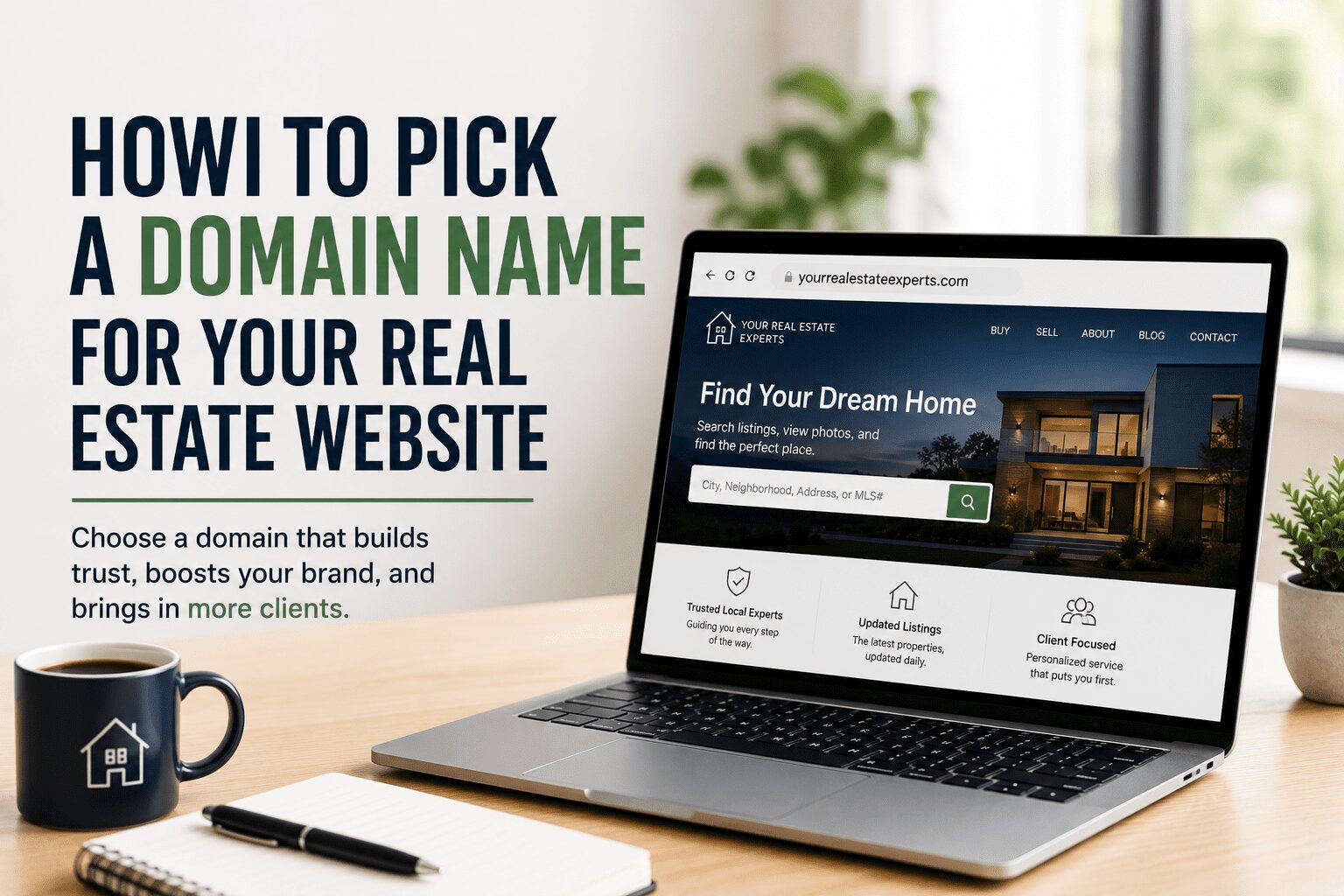
Your domain name is the one piece of your online presence that is genuinely difficult to change later without significant cost and disruption. You can rewrite your content, switch platforms, redesign your site, change your IDX provider, and update your brand positioning. Changing your domain means rebuilding all of your accumulated SEO authority from scratch, redirecting traffic from an old domain that may or may not pass its full link equity, and potentially losing years of ranking progress in the process. The domain decision is worth more careful thought than most agents give it when they are in the middle of getting a website up and running and treating the domain name as a formality.
Your Name vs. A Market Keyword Domain
The most common choice real estate agents face is between a personal name domain and a market keyword domain. Both have genuine arguments in their favor, and understanding those arguments helps you make a decision that fits your specific situation rather than defaulting to whichever option comes to mind first.
A personal name domain like JohnSmithRealEstate.com or JaneHendersonHomes.com is portable across brokerages, markets, and business model changes. If you change brokerages, the domain still works. If you expand to a new geographic area, the domain still works. If you decide to become a team lead and the team name is not your personal name, the domain still works as a legacy brand. It is your name and it travels with you through every change the business goes through over a multi-decade career.
A market keyword domain like LasVegasHomesForSale.com or HendersonNVRealEstate.com has a theoretical SEO advantage for the specific searches contained in the domain name. The theory was stronger ten years ago, when exact-match domain names received significant algorithmic preference in Google’s rankings. Google has substantially reduced that preference over time through multiple algorithm updates specifically designed to level the playing field between keyword domains and branded domains. Today, a well-built site on a personal name domain with strong content, properly configured IDX, and genuine domain authority will consistently outrank a keyword domain with thin content, a poor IDX setup, or limited age and authority.
The portability argument typically wins for agents who plan to be in the business for a decade or more. Your name does not expire with a market, a brokerage, or a particular specialization. A market-specific domain limits your options in ways that become painful if anything in your business changes. Agents who started with a market keyword domain and then relocated, changed their focus, or merged with a team built on a different brand have learned this lesson expensively.
What If Your Name Is Already Taken
Common names create domain availability challenges because another person with the same name or a different agent may have already registered the .com. The right response is to find a variation that still works rather than using an alternative extension or accepting a domain with a hyphen or an awkward addition.
Variations that typically work well include adding a location identifier to your name, YourNameLasVegas.com or YourNameNevada.com, adding a real estate descriptor, YourNameRealEstate.com or YourNameHomes.com or YourNameRealty.com, or using your first name and last initial or last name and first initial if your full name is unavailable. The goal is to keep your actual name as the primary identifiable element while finding a suffix or prefix that creates a workable domain that is still clearly yours.
Practical Rules for Evaluating Any Domain
Keep it short. Domains that are easy to say out loud in a conversation, easy to type correctly from memory, and easy to spell without ambiguity get shared more easily, typed correctly more often, and remembered longer. Every character beyond what is necessary is a liability. If the domain takes more than five seconds to spell out in a phone call, it is probably too long.
Use .com without exception in most cases. There are dozens of domain extensions available including .realtor, .homes, .properties, and various country-specific options. None of them have achieved the default recognition and typing behavior that .com has established over thirty years of internet use. People type .com automatically when entering a domain they heard rather than read. If someone else has the .com for your ideal domain and you take the .realtor version instead, you will send a meaningful percentage of your direct traffic to them by accident every time someone types the address from memory.
Avoid hyphens. A domain like real-estate-agent-las-vegas.com is worse in every measurable way than a non-hyphenated alternative. Hyphens look like spam when written out, are impossible to say out loud without specific instruction, are routinely omitted when typed, and create brand confusion in every context where the domain appears. If the non-hyphenated version of a domain is taken, find a different approach rather than adding hyphens.
Check for unintended word combinations before you buy. Without spaces or hyphens, some domain names combine into words or phrases that look different from what the registrant intended. Read the domain as a single string of characters before purchasing and consider how it looks on a business card, in an email signature, and on a yard sign where there is no visual break between words.
Register It in Your Name and Protect It
Register the domain through your own account at a reputable registrar such as Google Domains, Namecheap, or GoDaddy. Never allow a web company, a brokerage, or any other party to register the domain in their name on your behalf. If a business relationship ends, the party who is technically the registered owner of the domain controls it. Agents who let someone else register their domain have lost websites, traffic, and years of accumulated SEO authority when those relationships ended. The domain should be in your personal account from day one without exception.
Enable auto-renew from the moment the domain is registered. Domain names that lapse can be registered by other parties within hours of expiration. Domain squatters monitor lapsed registrations specifically for valuable names. An expired domain that has accumulated years of traffic and authority is a high-value target. Paying a registration fee in perpetuity is a trivial cost compared to the risk of losing the domain.
Consider registering common misspellings of your domain and common alternative extensions if the risk of traffic loss from typos is meaningful. For high-traffic sites, the small annual cost of holding defensive domain registrations is worth the protection.
The Domain Is the Address, Not the Website
Once the domain is secured, the website is what makes it worth having. The domain is the address. What lives at that address, the IDX search, the showcase pages, the neighborhood content, the lead capture system, and the follow-up infrastructure, is what determines whether the domain becomes a lead generation asset or just an internet address that exists but does not produce anything.
Jeff and Paul at Ballen Brands build the BREW system on your domain, on a platform you own, configured for lead generation and SEO from day one. The domain decision is step one. Reach them at 702-917-0755 or team@ballenbrands.com to discuss what comes next.
Lori Ballen is a digital entrepreneur and content creator based in Las Vegas. She founded Ballen Brands, now owned and operated by her brothers Jeff and Paul Helvin.
Hey there! Just a quick heads-up: some of the links on this site are affiliate links, meaning I may earn a small commission if you make a purchase (including through the Amazon Associates program), at no extra cost to you. Occasionally, products featured here are gifted by brands.
I also use AI tools to help research and create content for you! While I love sharing strategies to help you succeed, please remember that everyone's journey is unique—individual results vary, and there are no guarantees. Thanks so much for stopping by!