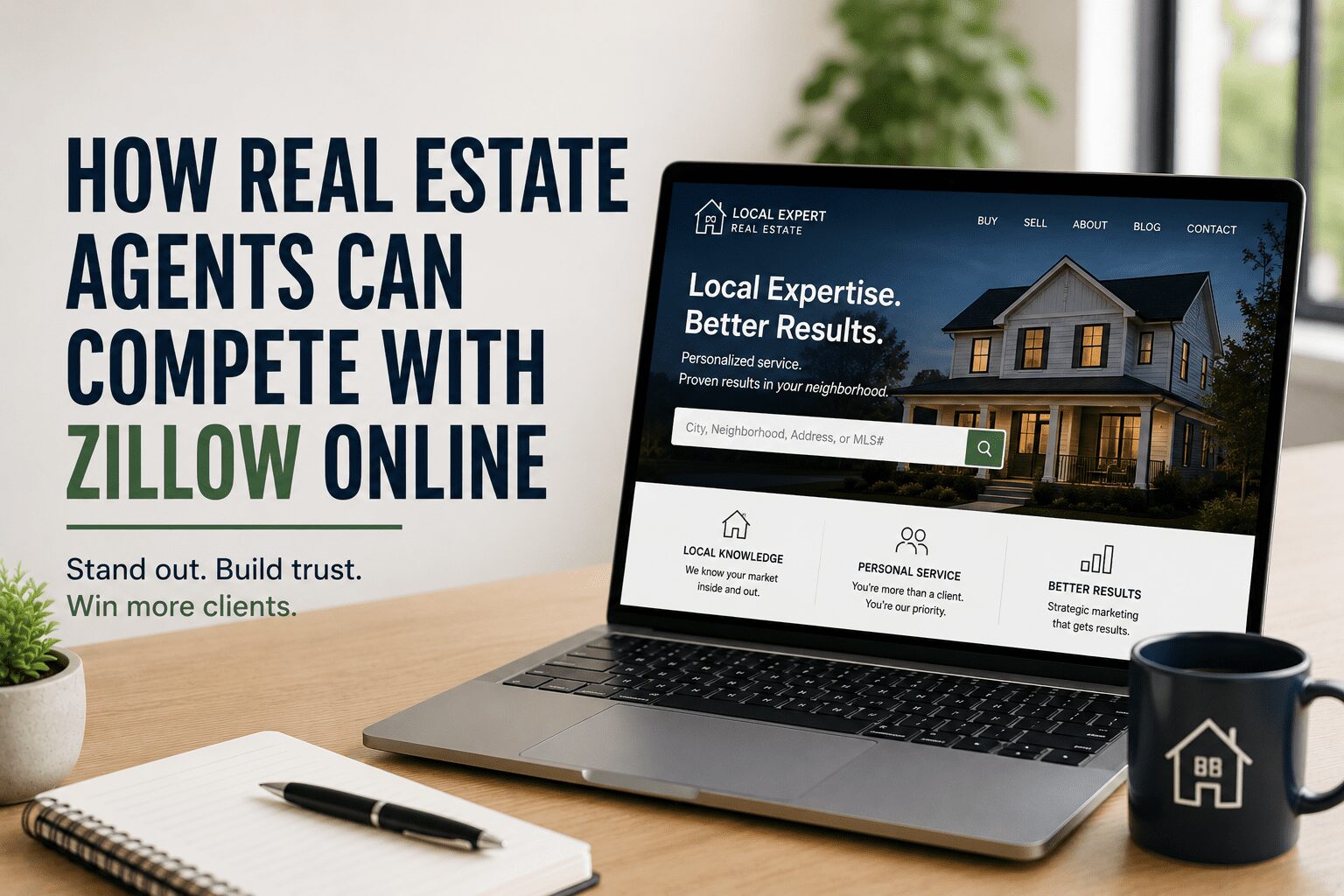
Competing with Zillow on the internet sounds like an absurd goal for an individual real estate agent. Zillow has hundreds of millions in funding, thousands of engineers, massive domain authority built over decades, and entire teams dedicated to technical SEO, content production, and user experience optimization. Trying to outrank them on broad searches like homes for sale in Las Vegas is not the right approach and is not achievable in any practical timeframe for most agents.
But competing with Zillow is not about winning every search. It is about winning the specific searches where your site can realistically rank and where the leads you capture are more valuable than what Zillow delivers. There are specific places where local agents can compete effectively and some where they actually have structural advantages over Zillow that no amount of engineering budget can overcome.
Compete at the Neighborhood Level, Not the City Level
Zillow dominates homes for sale in Las Vegas. The domain authority, the volume of indexed listing pages, and the years of accumulated SEO signals on that specific search make it effectively uncompetitive for a local agent to target directly. But Zillow does not have the same lock on homes for sale in Desert Shores Las Vegas, or ranch homes in Henderson under $500,000, or gated communities in Summerlin. The more specific and geographic the search, the more achievable it becomes for a local agent with a properly configured site and relevant neighborhood content.
Building showcase pages for every neighborhood, community, price range, and property type in your market, combined with neighborhood content pages written by someone who actually knows those areas, creates an indexed page library that covers search territory Zillow’s broad approach does not optimize for at the same granularity. That is where the agent has a realistic competitive opening.
A buyer searching for homes in a very specific community with very specific criteria, the kind of buyer who is far along in their research and close to being ready to work with an agent, runs searches that are less competitive than the broad city searches. Winning those specific searches consistently produces a smaller but meaningfully higher-quality lead flow than competing for a fraction of a position on the broad city searches Zillow dominates.
Compete on Local Knowledge
Zillow is a data platform. It is exceptionally good at displaying listing data, aggregating market statistics, and providing the kind of information that can be extracted from a database and structured on a page. It cannot tell a buyer what it is actually like to live in a specific neighborhood as opposed to the adjacent one three miles away. It cannot compare the character of two Summerlin communities for a family with young children weighing school options and commute routes. It cannot tell a relocating executive which neighborhood in Henderson matches their lifestyle expectations based on what they are leaving behind in their current city.
You can. Content that requires genuine local expertise to write accurately is content that Zillow cannot produce and that AI-generated neighborhood summaries cannot match credibly. A neighborhood guide that reads like it was written by someone who has sold homes in that area, who knows which cul-de-sacs are quieter, which communities have better maintained common areas, and which master-planned neighborhoods have the amenities that specific buyer types consistently prioritize, is a fundamentally different product from a page that aggregates statistical data and lists nearby schools.
That local knowledge advantage is most powerful in the research phase of the buying journey, before the buyer has committed to a neighborhood or an agent. A buyer who finds your detailed, specific, locally grounded neighborhood content before they ever see a Zillow listing arrives at the relationship with your brand already partially established. That is a head start that Zillow’s data-driven approach cannot create.
Compete on Lead Exclusivity
A lead that registers on Zillow gets contacted by multiple agents within seconds of registering. In many markets, Premier Agent leads are sent to three or four agents simultaneously, who are all competing for the same buyer’s attention with the same instant follow-up. The buyer experience is one of immediate, often aggressive outreach from multiple strangers who have no prior relationship with them and no contextual knowledge of what they were looking for beyond the property they clicked on.
A lead that registers on your IDX site contacts you and only you. There is no competition from other agents for the same buyer at the moment of registration. The buyer who found your site through a neighborhood guide they bookmarked and returned to twice, who spent twenty minutes searching your IDX, saved four properties, and set up a listing alert is a different prospect than someone who clicked a contact button on a Zillow listing at 11pm. The quality difference is real and it translates to meaningfully higher conversion rates from first contact to actual client relationship.
Compete in the Seller Research Phase
Zillow has moved aggressively into seller services with its various buyer programs and agent matching features. But sellers who are beginning to research what their home is worth, what the market looks like in their neighborhood, and which agents have specific expertise in their area are running searches that are often better answered by local agent content than by Zillow’s platform-focused seller experience.
Market reports and analysis content that covers your specific neighborhoods gives you presence in the seller research process before a seller is ready to request an agent match from a portal. A seller who found your Summerlin market update, read your selling guide for the Las Vegas market, and used your home valuation tool to get an initial estimate before ever contacting you arrives at the listing conversation with more pre-existing trust than one who found you through a Zillow agent match request. That trust advantage is worth cultivating specifically because Zillow cannot create it by definition.
The Right Website Foundation
Competing online as a local agent requires a website that is specifically built for it. IDX properly configured and indexed. Showcase pages structured for neighborhood-level searches. Content written with genuine local expertise. Page speed that does not drive buyers away before they see your listings. A lead capture system that routes registrations to you exclusively and triggers immediate follow-up.
Every one of these elements needs to be right for the competitive strategy to work. A site with good content but slow performance loses buyers before they see the content. A site with fast performance but poor IDX configuration never ranks for the neighborhood searches where the agent has an advantage. The whole system has to work together.
The BREW system from Ballen Brands is built to support exactly this kind of local competition with the portals. I built my own real estate website on this foundation because I needed a system that could actually generate leads from organic search without paying Zillow for the privilege. My brothers Jeff and Paul have taken that system and made it available to agents in other markets. Reach them at 702-917-0755 or team@ballenbrands.com. The IDX Broker signup link on this page waives the setup fee.
Lori Ballen is a digital entrepreneur and content creator based in Las Vegas. She founded Ballen Brands, now owned and operated by her brothers Jeff and Paul Helvin.
Hey there! Just a quick heads-up: some of the links on this site are affiliate links, meaning I may earn a small commission if you make a purchase (including through the Amazon Associates program), at no extra cost to you. Occasionally, products featured here are gifted by brands.
I also use AI tools to help research and create content for you! While I love sharing strategies to help you succeed, please remember that everyone's journey is unique—individual results vary, and there are no guarantees. Thanks so much for stopping by!