Clicky

  • About
    • Affiliate Disclosure
    • Ballen Academy
    • Contact Us
    • Privacy Policy
    • Youtube
  • Loris Tools
  • Lori Ballen’s Blog
    • Affiliate Marketing Strategies
    • Blogging Strategies
    • Branding Strategies
    • Digital Products
    • Financial Freedom
    • Marketing Tools and Resources
  • Substack
Saturday, January 17, 2026
  • Login
❤️ Lori Ballen
No Result
View All Result
Ballen Blueprint Coaching
eBooks
Get a Website
  • About
    • Affiliate Disclosure
    • Ballen Academy
    • Contact Us
    • Privacy Policy
    • Youtube
  • Loris Tools
  • Lori Ballen’s Blog
    • Affiliate Marketing Strategies
    • Blogging Strategies
    • Branding Strategies
    • Digital Products
    • Financial Freedom
    • Marketing Tools and Resources
  • Substack
Ballen Blueprint Coaching
eBooks
Get a Website
No Result
View All Result
❤️ Lori Ballen
No Result
View All Result
Home Youtube Channel
The Youtube Algorithm Secret To Viral Shorts No One Is Talking About

The Youtube Algorithm Secret To Viral Shorts No One Is Talking About

in Youtube Channel
Reading Time: 16 mins read
Share on FacebookShare on Twitter

This website contains affiliate links. Some products are gifted by the brand. As an Amazon Associate, I earn from qualifying purchases. The content on this website was created with the help of AI.

Table of Contents

Toggle
  • The Great Deception Why Your High-Retention Shorts Are Dying
  • The “God-Tier” Signal Unveiling Active Rewatchability
  • The Psychology of a Rewatch Why We Hit Replay
  • The Architect’s Toolkit How to Engineer Rewatchability
  • A New Hierarchy of Metrics Where Rewatchability Ranks
  • Rewatchability in Action Hypothetical Case Studies
  • Your Next Steps
  • Conclusion Your New North Star

While I share money-making strategies, nothing is "typical", and outcomes are based on each individual. There are no guarantees.

Are your Shorts dying?

You pour your heart and soul into them. You nail the hook, you keep the energy high, you check the analytics and see a great audience retention score… and then, crickets. The video slams into a wall at a few hundred, maybe a few thousand views, and just flatlines. You’re left staring at the graph, wondering what on earth you did wrong.

Everyone tells you the same thing: “Focus on watch time! Get people to the end!” You’ve done that. You have Shorts with an average view percentage of 90%, even 100%, and they still fail to break out. So, what gives?

It’s because you’ve been told to focus on the wrong thing. You’ve been chasing a metric that’s really just the cost of entry. It’s time to talk about the signal that truly matters—the one that acts as a powerful multiplier for everything else. This is what separates the Shorts that get a thousand views from the ones that get ten million.

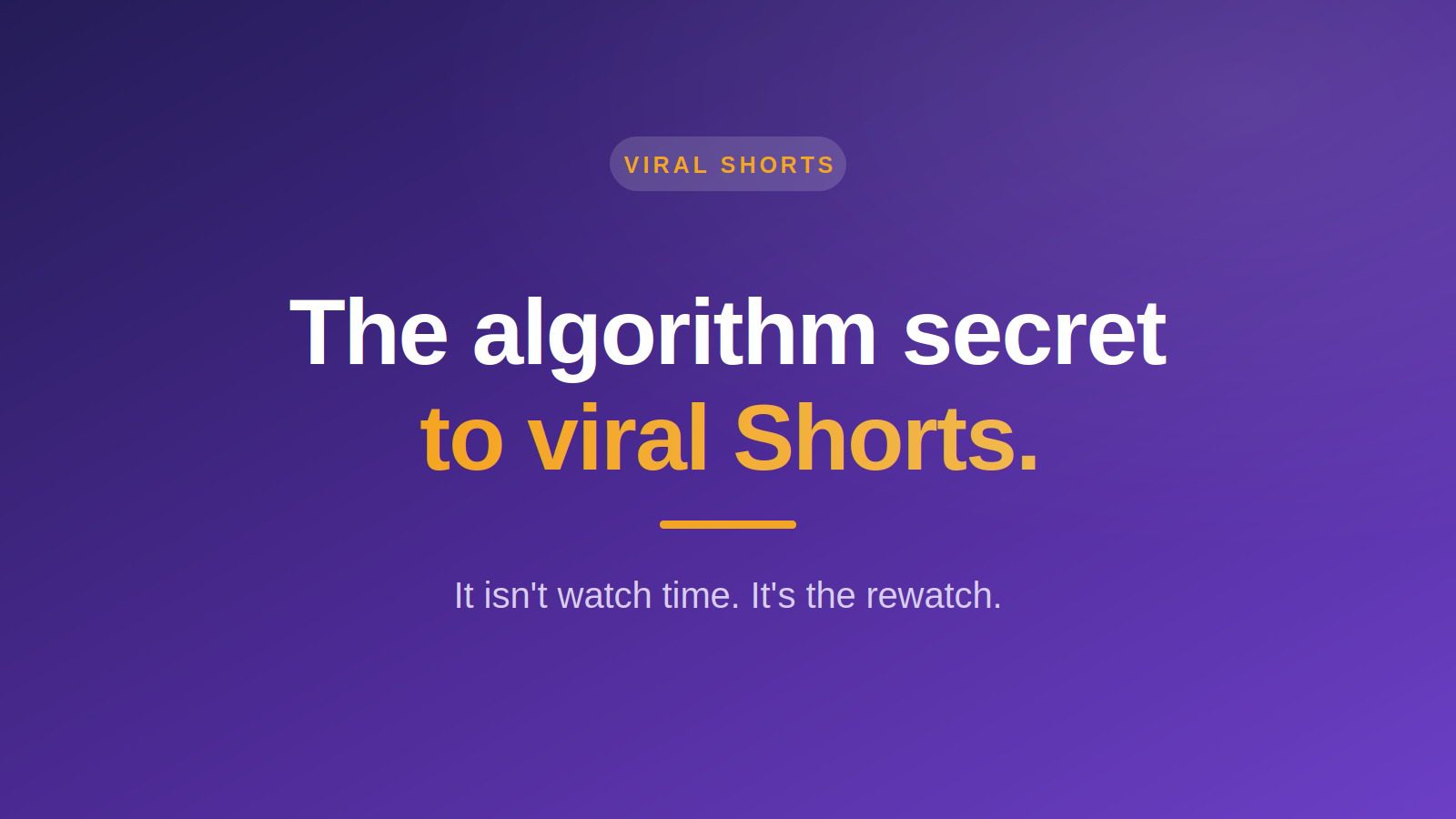
This is the secret no one is talking about. And it’s not watch time. It’s not your like-to-view ratio. It’s not how many comments you get.

The most powerful, yet misunderstood, signal you can send the YouTube Shorts algorithm is something I call ‘active rewatchability.’ It’s the art and science of getting a viewer to immediately, and intentionally, watch your video a second, third, or even fourth time.

In the next few minutes, I’m going to completely reframe how you think about making a YouTube Short. We’re going to expose why the old advice is incomplete, break down the specific theory behind the power of a rewatch, and I’m going to give you a concrete toolkit to start engineering this into every single video you make from now on. This is the missing piece.

The Great Deception: Why Your High-Retention Shorts Are Dying

Let’s be honest, it’s one of the most frustrating feelings for a creator. You have a video idea you know is gold. You execute it perfectly. The first few hours of data look incredible. The audience retention graph is a beautiful, flat line. The swipe-away rate is low. By all conventional wisdom, this Short should be taking off. You go to bed expecting to wake up to a viral hit, only to find it completely dead in the water. The view velocity has fallen off a cliff.

What happened? You fell for the great deception. Now, this deception isn’t some malicious lie; it’s just a massive oversimplification of how the Shorts algorithm actually works. We, as a creator community, have latched onto a couple of key metrics as the be-all and end-all of success: Audience Retention and Swipe-Away Rate. We’re told if you can just get people to watch your whole video and not swipe, the algorithm will reward you with endless reach.

And to be crystal clear, those metrics are vital. You can’t have a successful Short with awful retention. Think of high audience retention and a low swipe-away rate as the price of admission. It’s what you pay to even get a seat at the table. It tells the algorithm your video isn’t garbage. It signals competence. But competence isn’t virality. Competence just gets you your initial test run.

The algorithm, in its first phase, shows your Short to a small “seed audience.” This is just an initial test with a few hundred or thousand viewers. During this test, the algorithm is checking those baseline signals. Did they watch to the end? Yes. Did they swipe away immediately? No. Check, check. Your video passed the first audition.

But this is where most videos die. Because passing an audition doesn’t mean you get the starring role. For the algorithm to take your video from that small seed audience to a bigger one, and then an even bigger one, it needs a much stronger signal. It needs a signal of exceptional quality. It’s looking for a video that doesn’t just satisfy a viewer, but one that obsesses them.

You’re competing against millions of other Shorts that also have good retention. In a world where everyone is optimizing for watch time, the signal loses its power. When every video has 95% retention, how does the algorithm choose the next viral hit? It looks for something more. It looks for a behavior that’s far less common and says much more about the content. It looks for the rewatch. That active, conscious decision by a viewer to watch your video again, right away. That’s what can trigger the cascade we call ‘going viral.’ This isn’t about a passive loop; it’s about creating a powerful user behavior that most creators are completely ignoring.

The “God-Tier” Signal: Unveiling Active Rewatchability

So, what is this “rewatchability” signal, and why is it such a powerful idea? Let’s break down the theory. At its core, the YouTube algorithm is a recommendation engine built to do one thing: maximize viewer satisfaction and keep people on the platform longer.

A single 30-second Short, even if watched to 100%, only adds 30 seconds to that goal. It’s a good signal, but it’s a limited one. But when a viewer rewatches that 30-second Short, it instantly becomes a 60-second watch time. Three watches? That’s 90 seconds. From the algorithm’s point of view, a video that generates an average view duration of over 100% is a unicorn. It’s content that’s punching way above its weight. A rewatch is the ultimate form of audience retention—it’s retention beyond the video’s timeline.

But here’s where it gets more interesting. My theory is that the algorithm is getting smart enough to tell the difference between different types of rewatches. There’s the ‘accidental rewatch’ and the ‘intentional rewatch.’

The accidental rewatch happens with a perfect loop, where the end seamlessly connects to the beginning. The viewer might not even notice it started over. This is good! It definitely boosts your average view duration and is a positive signal that many creators use successfully.

However, the ‘intentional rewatch’ is, in my framework, a far more powerful signal. This is when a viewer makes a conscious choice to see your content again. They might physically drag the progress bar back to the start. They watch it, process it, and then let it loop on purpose because they want to understand something, see a detail again, or re-experience a feeling. It’s that “Wait, what was that?” or “I have to see that again” moment.

Why is this so much more powerful? Because it shows a level of engagement beyond just passive viewing. The viewer has gone from being a content consumer to an active participant. They are so intrigued, confused, or delighted that they’re willing to invest more of their time and attention to dig deeper. This behavior screams to the algorithm, “This piece of content is exceptionally valuable. It has layers. It’s not just disposable; it’s sticky.”

Look, nobody outside of YouTube knows the exact formula, but if we build our content with this theory in mind, we gain a massive strategic edge. An intentional rewatch isn’t just a data point about watch time; it’s a data point about cognitive and emotional investment. It tells the algorithm your video sparked curiosity, created surprise, or delivered information so densely that it demanded a second look.

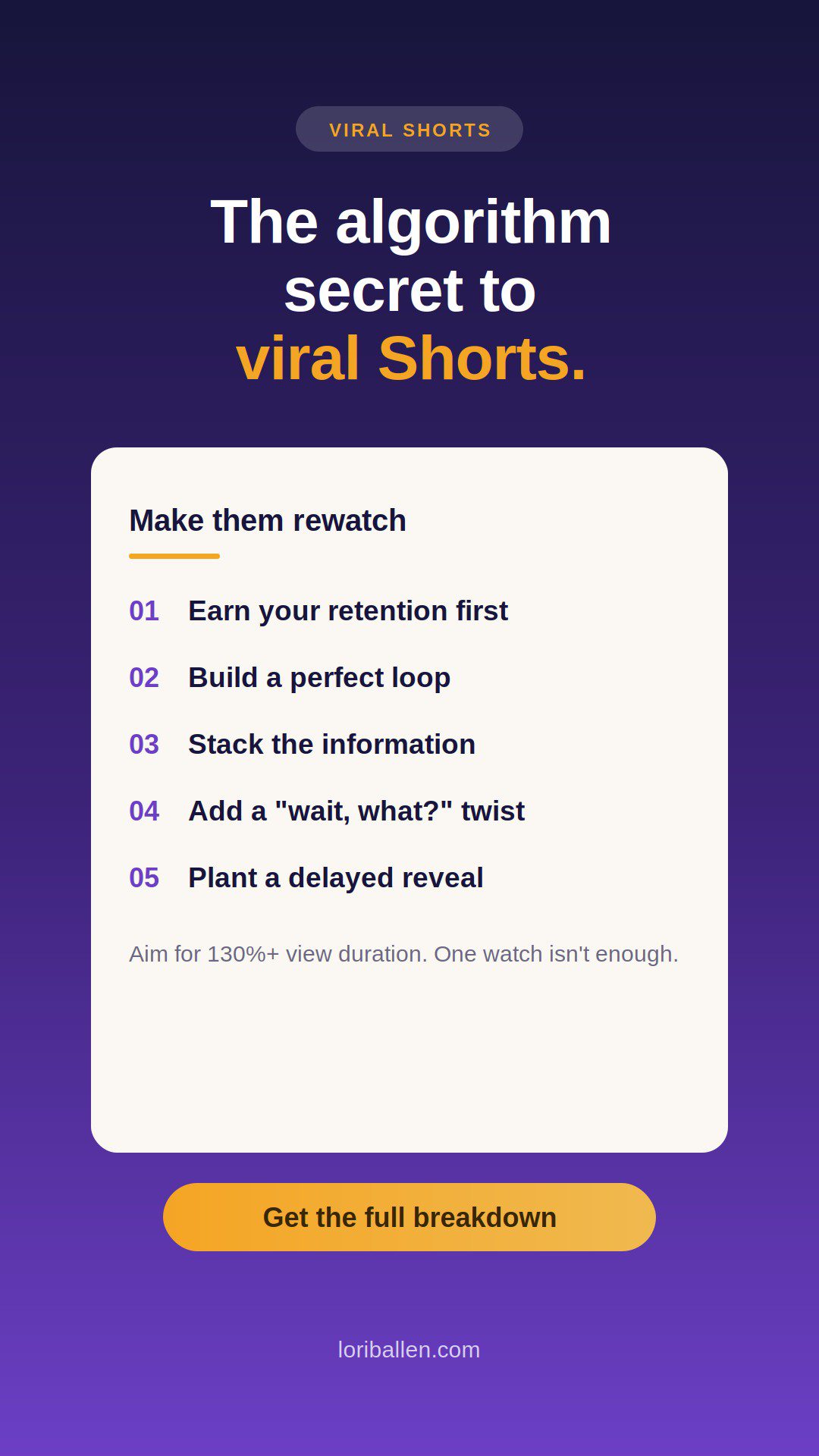
This is the holy grail. While everyone else is fighting for a 100% completion rate, you should be aiming for 130%, 150%, or even 200% average view duration. You get there by shifting your focus from simply keeping the viewer, to compelling them to start all over again. All the metrics work together—completion rate, likes, comments, shares—but a strong rewatch rate can be a massive amplifier for everything else, turning a good Short into a viral phenomenon.

The Psychology of a Rewatch: Why We Hit Replay

To build in rewatchability, we have to get inside the viewer’s head. Why would a person, with an infinite feed of new content a thumb-flick away, choose to reject novelty and return to something they just saw? The decision happens in a split second, and it’s usually driven by a few powerful triggers.

Information Density

This is when you pack so much value or detail into a short time that it’s impossible to process in one go. Think of a rapid-fire tutorial showing five life hacks in 15 seconds. Or a screen full of text that reveals a shocking statistic, but it’s only visible for 1.5 seconds. The viewer sees it, knows there was valuable info, but also knows they missed the details. Their brain’s natural desire for closure kicks in. To resolve that tension, they watch it again. They’re not just rewatching; they’re studying.

The “Wait, What?” Moment

This is all about breaking patterns. Our brains are pattern-recognition machines on autopilot as we scroll: dancing video, talking head, cute animal. The “Wait, what?” moment happens when you show the viewer something that completely shatters their expectations. A visual that doesn’t make sense. A statement that seems contradictory. A six-second plot twist. For example, a cooking video that starts with someone putting a sneaker in the oven. The viewer’s brain glitches. “Did I just see that right?” To confirm or deny what they saw, they have to rewatch.

Emotional Resonance

This is about creating a feeling so potent and concise that the viewer wants to experience it again. This is the magic behind so many viral wholesome moments, incredible feats, or perfect comedic beats. Think of a baby’s giggle, a soldier’s homecoming, a perfectly executed prank. The first time, you feel the emotional payoff—the joy, the awe, the laughter. The feeling is so good, you want another hit of that dopamine. So you watch it again, not for information, but for emotion.

Structural Perfection

This is less about psychology and more about clever craftsmanship, most often seen in the Perfect Loop. When a video ends on the exact same visual and audio frame it began with, it creates a seamless transition. For a moment, the loop is invisible. This is great for boosting metrics, but the real psychological trick is when the viewer realizes it’s a loop. There’s a moment of appreciation for the cleverness. “Oh, that was smart.” That appreciation can lead to an intentional rewatch just to admire the craft.

Understanding these four triggers—Information Density, the “Wait, What?” Moment, Emotional Resonance, and Structural Perfection—is the key. You’re no longer just making a video; you’re designing an experience to activate these psychological levers.

The Architect’s Toolkit: How to Engineer Rewatchability

Okay, that’s the “why.” Now for the “how.” This is your toolkit, a set of repeatable techniques to build rewatchability into your Shorts.

Technique 1: The Perfect Loop

This is a foundational skill. Your last frame must be identical to your first, and the audio needs to flow seamlessly. This takes planning. If you start by pointing at a blank wall, you have to end in that exact same position. If you say a sentence, the sound of the last word has to blend into the first.

  • Example: A creator says, “Here’s the secret to making any habit stick…” They explain the tip, and their final line is, “…and that’s why you have to know that…” The end of “that” can be edited to flow right back into “Here’s the secret…” The cut is masked by the continuous flow.
  • Why it works: It’s the easiest way to capture an ‘accidental rewatch’ and instantly push your average view duration over 100%.

Technique 2: Information Stacking

This is how you trigger Information Density. You’re building layers of value that are impossible to absorb in one pass. Use rapid-fire text overlays. While you’re talking, flash keywords or supplementary tips on screen for only a second or two. The viewer can’t listen to you, read the main captions, and catch the bonus info all at once. Or, present a list incredibly quickly. “Here are the 7 books that changed my life,” then flash the covers on screen for three seconds total. No one can read all seven. They’re forced to pause or rewatch.

  • Example: In a fitness Short about proper squat form, as you explain the main movement, text could flash on screen saying “Engage Core,” then “Heels Down,” then “Chest Up.” The viewer hears the main instruction but sees the micro-cues, prompting a rewatch to catch them all.
  • Why it works: It respects the viewer’s intelligence and rewards their attention. You’re signaling that your content has depth and is worth studying.

Technique 3: The Mid-Video Plot Twist

This is how you manufacture a “Wait, what?” moment by subverting expectations in the middle of the story. Start with a familiar premise and then pivot—hard.

  • Example: A cooking Short begins. “I’m going to show you how to make the perfect chocolate chip cookies.” The creator mixes flour, sugar, eggs. It’s all very normal. Then, instead of chocolate chips, they dump in a jar of pickles. The viewer’s brain stalls. “Wait… pickles?” The absurdity makes them question what they saw, forcing a rewatch to confirm they weren’t hallucinating.
  • Why it works: It shatters the passive scrolling state and makes your Short unforgettable in a sea of sameness. The confusion demands to be resolved, and the easiest way is to hit replay.

Technique 4: The Delayed Reveal

This technique builds suspense with a visual hook that’s only explained at the very end, forcing a rewatch for context. Start your video with something bizarre in the background that has nothing to do with your topic. For instance, you’re giving business advice, but there’s a pineapple wearing sunglasses on your desk. You never mention it. You deliver your content as if it’s totally normal. Then, in the last second, a text overlay appears that says, “The pineapple told me to say that.”

  • Example: A tech reviewer explains a new phone feature while wearing one ski glove. They never acknowledge it. The video ends. The viewer is left thinking, “Okay, good info, but… why the glove?” That unresolved question can be so nagging that it makes them rewatch, hunting for clues they might have missed.
  • Why it works: It creates two layers to your video: the surface content and the background mystery. Viewers who notice it feel clever and are motivated to rewatch to solve it.

By mastering these four techniques, you stop being just a content creator and become a behavioral architect. You’re not just hoping for engagement; you’re designing for it.

A New Hierarchy of Metrics: Where Rewatchability Ranks

Now, let’s be clear. Focusing on rewatchability doesn’t mean you ignore everything else. It’s not about replacing the old rules; it’s about adding a new, more powerful layer on top. Here’s a more accurate way to think about your Shorts metrics—a pyramid of signals.

The Foundation: Audience Retention & Views vs. Swipes

This is where Audience Retention and Views vs. Swipes Away live. As we said, this is the cost of entry. It’s non-negotiable. You must make a video people are willing to watch to the end. And make no mistake, experts and analytics are clear: retention is still king. Your first job is to create a well-paced video that holds attention. Without this, the pyramid crumbles.

The Middle: Likes, Comments, and Shares

This tier includes Likes, Comments, and Shares. These are incredibly valuable because they are explicit signs of satisfaction. A ‘Like’ is a direct “I enjoyed this.” A ‘Comment’ shows deeper thought. A ‘Share’ is the ultimate endorsement—a viewer staking their own reputation on your content. These signals confirm to the algorithm that your video isn’t just being watched, but actively enjoyed. A video with high retention and high engagement is a strong candidate for more views.

The Apex: Rewatchability

This is where Rewatchability sits. A rewatch, especially one that pushes your Average View Duration past 100%, is the multiplier. It’s the signal that takes a video the algorithm already knows is good (from the foundation and engagement signals) and convinces it that the video is exceptional.

Think of it like this:

  • High Retention tells the algorithm: “This video is competent.”
  • High Engagement tells the algorithm: “This video is well-liked.”
  • High Rewatchability tells the algorithm: “This video is addictive. We need to show this to more people.”

This model also clarifies the role of metadata like your Title and Hashtags. These aren’t on the pyramid; they’re the signposts that lead people to the pyramid. Your title is crucial for that initial discovery, helping the algorithm find your first seed audience. But once that happens, the real SEO of Shorts takes over. And that SEO isn’t based on keywords; it’s based on viewer behavior. Your title gets the first view, but your content’s rewatchability gets the millionth view.

So don’t stop caring about retention or engagement. See them as part of a whole. Build your foundation, sprinkle in moments that encourage interaction, and then, apply the architect’s toolkit to engineer those moments of surprise and value that make people hit replay.

Rewatchability in Action: Hypothetical Case Studies

Let’s make this real. Imagine three Shorts, each built around a rewatchability trigger.

Case Study 1: The Fitness Niche

Imagine a Short titled: “Fix Your Posture In 10 Seconds.” Its core trigger is Information Density. It opens on a creator hunched over a laptop, with text saying “THIS is killing your back.” They look at the camera and say, “You can fix it in 10 seconds.” Then, for five seconds, they perform four distinct movements in rapid succession. As they do each move, text flashes for just one second: “1. Scapular Retraction,” “2. Thoracic Extension,” “3. Cervical Flexion,” “4. Pelvic Tilt.” The Short ends with them standing perfectly straight, smiling, with a final text overlay: “Rewatch to learn the moves.” It’s impossible to learn all four moves in one go. The high-value promise (fix your posture) motivates viewers to rewatch and study each step, driving the average view duration way over 150%.

Case Study 2: The Cooking Niche

Think of a Short titled “My Grandma’s Secret Ingredient…” It uses the “Wait, What?” Moment. It starts with a beautiful shot of apple pie. A voiceover says, “Everyone says my grandma’s apple pie is the best. They just don’t know her secret.” We see a quick montage of making the pie—it all looks delicious and normal. Then, right before putting it in the oven, the creator grabs a pepper grinder and adds a tiny, almost unnoticeable dash of black pepper. The final shot is someone’s eyes widening in delight as they take a bite. The first time, 90% of people will miss the pepper. But the title creates an unresolved question. They’ll rewatch, looking for the secret, and on the second or third view, they’ll spot it. “Wait… was that PEPPER?” That “Aha!” moment is so satisfying it turns a simple recipe into a treasure hunt.

Case Study 3: The Tech/Productivity Niche

Picture a Short: “This AI Tool Writes My Emails,” built on Emotional Resonance and Information Stacking. It starts with a split screen: on the left, a stressed creator furiously typing; on the right, the same person is relaxed, sipping coffee. The voiceover says, “This used to be me. Now, this is me. Here’s why.” We then see a screen recording of an AI tool. The creator types a simple prompt, and the AI generates a perfect, professional email in seconds. The text of the email scrolls by too quickly to read. The video ends with the creator sipping coffee again as the name of the tool appears on screen. The emotional hook is the universal pain of corporate emails. But the rewatchability comes from two layers: viewers will rewatch to catch the name of the tool, and they’ll rewatch and pause to actually read the email the AI wrote to see how good it is.

Your Next Steps

These aren’t just tricks; this is a fundamental shift in strategy. It’s about respecting the viewer’s time by giving them something so valuable or intriguing that they choose to spend more of it with you.

If you’re ready to stop guessing and start architecting your own virality, then subscribe to the channel. I’m always decoding the algorithm and sharing the strategies that are working right now.

And for my next video, I want to tackle your biggest problems. So, comment below with the single biggest struggle you’re facing with your YouTube Shorts. I’ll be reading every single one.

Conclusion: Your New North Star

For too long, we’ve been playing a guessing game, chasing metrics that only tell half the story. The truth is, in the hyper-competitive Shorts feed, being “good enough” to be watched to the end is no longer good enough.

Your new North Star isn’t just retention; it’s re-engagement. For every single Short, your goal is to answer the question: “What reason am I giving my viewer to watch this again, right now?” Is it information they missed? A surprise they need to confirm? A feeling so good they need to feel it twice?

This shift in focus from passive viewing to active re-engagement is the single biggest advantage you can give yourself as a Shorts creator. It turns you from a content provider into an experience designer. It’s the difference between making a video people watch and making a video people remember.

Stop focusing on just stopping the scroll. Start focusing on reversing it. Don’t just hold their attention; captivate it so completely that they are compelled to give you more. Engineer your loops, stack your value, create your “wait, what?” moments, and build your content with so much purpose that one watch is simply not enough.

That is the secret. That is how you turn a few hundred views into a few million. Now go build.

Previous Post

The Only Content Creator Tools You Need In 2026

Next Post

12 Content Types That Convert Followers Into Buyers

Lori Ballen

Lori Ballen

I'm a full-time blogger. I teach entrepreneurs how to get more website traffic, generate leads, and make more money online. This website contains affiliate links that benefit me. Take a Course Get a Website Try my Tools

Related Posts

This 2% Thumbnail Metric Is Why Your Youtube Channel Has No Views
Youtube Channel

This 2% Thumbnail Metric Is Why Your Youtube Channel Has No Views

December 20, 2025

Most creators think their content is the problem—but it’s their thumbnails. Learn how a small 2% change can revive your channel and boost your views instantly. Start fixing your click-through rate today.

Your Youtube Channel Isn’t Dead It’s Just Making These Mistakes
Youtube Channel

Your Youtube Channel Isn’t Dead It’s Just Making These Mistakes

December 15, 2025

Learn how to grow on YouTube by fixing common mistakes that kill your channel’s momentum. Discover data-driven strategies to increase views, retention, and subscribers.

25 Profitable Video Ideas For Creators Who Hate Being On Camera
Youtube Channel

25 Profitable Video Ideas For Creators Who Hate Being On Camera

December 20, 2025

Discover 25 faceless YouTube video ideas that actually make money. Perfect for creators who want to stay off-camera and still grow a profitable channel. Learn how to turn your creativity into income — start building your faceless brand today.

I Hacked The YouTube Algorithm For More Views
Youtube Channel

I Hacked The YouTube Algorithm For More Views

December 20, 2025

Tired of following the same old YouTube growth tips? Discover the unconventional strategy that actually works, bringing in thousands of views. Learn how I cracked the algorithm with one simple shift. Get the inside scoop and apply it today!

Next Post
12 Content Types That Convert Followers Into Buyers

12 Content Types That Convert Followers Into Buyers

Leave a Reply

Your email address will not be published. Required fields are marked *

This site uses Akismet to reduce spam. Learn how your comment data is processed.

About Me

Lori Ballen

Lori Ballen

Content Creator

Welcome! I'm Lori Ballen—digital entrepreneur, affiliate marketing expert, and creator of content that keeps earning long after it's published. I teach creators and bloggers how to turn videos, blogs, and automation into scalable income streams with freedom at the core. Here you’ll find tips, tools, and real talk on building a content-driven business that works for you.

Search This Website

No Result
View All Result

Join me on Substack

Categories

  • Affiliate Marketing Strategies (64)
  • Blogging Strategies (163)
  • Branding Strategies (1)
  • Business Ideas (13)
  • Canva (4)
  • Content Marketing (10)
  • Digital Marketing (5)
  • Digital Products (20)
  • Etsy (2)
  • Financial Freedom (9)
  • Make Money Online (13)
  • Make Money with Youtube (2)
  • Marketing Tools and Resources (10)
  • Mindset and Motivation (2)
  • Pinterest (84)
  • Print on Demand (3)
  • Side Hustles (37)
  • Social Media Strategies (7)
  • Things to Sell (1)
  • Travel (11)
  • Website Design (1)
  • Work From Home Strategies (2)
  • Youtube Channel (18)

Popular

  • websites like omegle

    15 Best Get Paid to Chat Apps

    1843 shares
    Share 704 Tweet 440
  • ChatGPT Prompts: The Ultimate Resource for Bloggers, Writers, and Content Creators

    2448 shares
    Share 455 Tweet 285
  • How to Delete a Pin from Pinterest [Step by Step Tutorial]

    8904 shares
    Share 402 Tweet 251
  • The Ultimate Guide to Affiliate Marketing Strategy on Instagram: A Beginner’s Blueprint

    845 shares
    Share 330 Tweet 207
  • How I Use ChatGPT to Create Affiliate Blogs

    1987 shares
    Share 302 Tweet 189
How I Build a Pinterest-Focused Affiliate Blog That Earns on Autopilot
Affiliate Marketing Strategies

How I Build a Pinterest-Focused Affiliate Blog That Earns on Autopilot

by Lori Ballen
January 14, 2026
0

I built my affiliate blog to run like a publishing machine — built on Pinterest, powered by automation, and monetized...

Read moreDetails
Why It’s Not Too Late to Build a Profitable Creator Business Over 50

Why It’s Not Too Late to Build a Profitable Creator Business Over 50

January 9, 2026
How To Start a Book Blog And Make Money (and Actually Succeed)

How To Start a Book Blog And Make Money (and Actually Succeed)

January 7, 2026
25 Pinterest Hacks To Drive $5K In Affiliate Sales

25 Pinterest Hacks To Drive $5K In Affiliate Sales

January 5, 2026
How to Build Your First $5,000 Digital Product Funnel With Pinterest

How to Build Your First $5,000 Digital Product Funnel With Pinterest

January 5, 2026

Instagram

  • Tabs fell in love with my Dyson air wrap on the cruise, so I gave it to her. I wanted to get the new one anyway so I could review all the attachments on the newer model. Time to go test her out!! I’m obsessed with how my hair looks when it’s curled with the air wrap!  I have eight cat trees sitting here waiting for me to assemble so I better get busy.
  • Future homesite? Maybe.
  • Gabe is not objecting to testing out all of the new cat furniture!! I had no idea he was a hammock cat!
  • Waiting for mom to start unboxing so he can have his five minutes of fame. #influencerlife
  •  When you go to your pantry to grab something and find somebody staring at you 😂
  • For some reason, cruise money feels like monopoly money. I’d have a hard time paying that same price on a massage at home. I suddenly on a cruise ship. I’m a Baller 😂
  • Another one of my pics made Amazon ads! The best part of this is that I still get paid commissions, even though they are running the ad. Just because I uploaded my picture to my influencer hub. ♥️
  • Years ago, I opened a spreadsheet and named two columns, Pain and joy. 

Anything in the day that drained my energy, gave me a headache, or made me cry, went in the pain column. 

Everything that made me woo-hoo, gave me energy, or made me happy went in the joy column. 

Once I listed everything that brought me pain, I began to move out of those activities and tasks. I heavily pursued everything that brought me joy.

My entire business changed, and now I only work in the joy column. And my life followed
  • There is a time for hustle. But there’s also a time for systems so that you can breathe. Anything done twice should have a system. And before you know it, you’re making money every day without the hustle or time on task. #productivity #hustle #business

Welcome Back!

Login to your account below

Forgotten Password?

Retrieve your password

Please enter your username or email address to reset your password.

Log In

Add New Playlist

No Result
View All Result
  • About
    • Affiliate Disclosure
    • Ballen Academy
    • Contact Us
    • Privacy Policy
    • Youtube
  • Loris Tools
  • Lori Ballen’s Blog
    • Affiliate Marketing Strategies
    • Blogging Strategies
    • Branding Strategies
    • Digital Products
    • Financial Freedom
    • Marketing Tools and Resources
  • Substack

© 2025 Lori Ballen