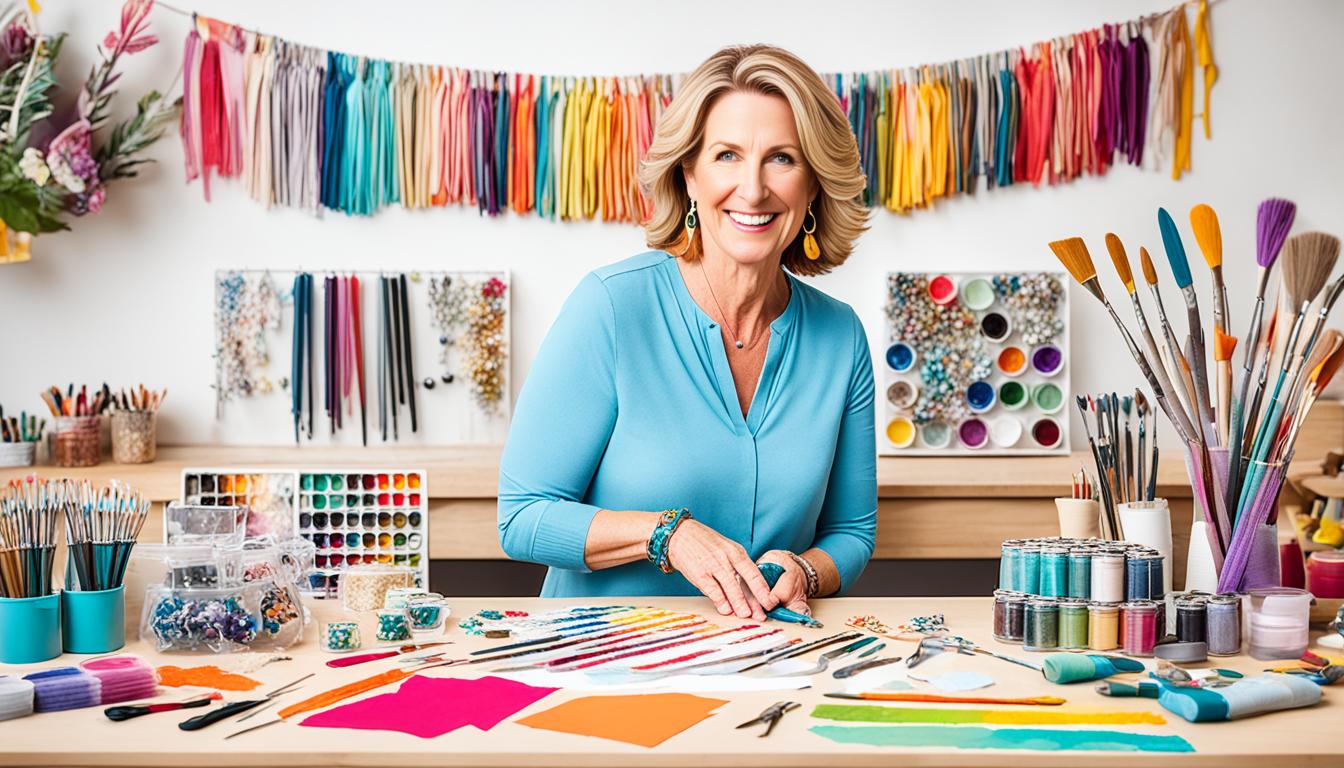
Crafting has become one of the most accessible and rewarding side hustles for mothers over 40 who want to monetize their creative talents without requiring advanced technical skills or significant startup capital. Whether you’re skilled at knitting, jewelry making, woodworking, painting, or any other craft, the market for handmade products has exploded with platforms like Etsy making it possible to sell globally from your home. Many moms over 40 are generating $2,000-10,000+ monthly from craft businesses they started in their spare time, proving that age is absolutely no barrier to entrepreneurial success. The advantage mature entrepreneurs have is discipline, life experience, and the ability to identify real customer problems and solve them with thoughtful craftsmanship.
Why Crafting Is Perfect for Moms Over 40
Moms over 40 have distinct advantages in the crafting business that younger entrepreneurs often lack—established taste, attention to detail, understanding of customer service, and the ability to manage projects methodically. These aren’t skills you learn in a course; they come from decades of living, working, and creating. A 45-year-old woman who’s been crafting for 20 years understands quality, durability, and customer needs in ways that purely technical young entrepreneurs may not.
The flexibility of craft-based side hustles is unmatched for women with family responsibilities. You control your hours completely. If you have a grandchild to watch Tuesday afternoon, you work Wednesday morning instead. There’s no boss, no schedule, no meetings. You create products when you have time and energy, then sell them around your other commitments.
The startup costs for crafting businesses are remarkably low compared to other entrepreneurial ventures. If you already have craft supplies and tools, your initial investment might be zero—just time to create inventory. Even if you need to purchase supplies, startup costs typically run $200-1,000 to create enough inventory for your first Etsy shop or local craft fair.
Choosing Your Crafting Niche
Play to Your Existing Skills
The easiest path to a profitable craft business is monetizing skills you already have and deeply enjoy. If you’ve been knitting for 30 years, don’t start a jewelry business. If you’re skilled at painting, don’t suddenly switch to woodworking. Your existing expertise means faster, higher-quality production and genuine passion that shows in your work.
Customers can taste the difference between work created by someone with genuine passion versus someone trying to follow a trend. The market is saturated with generic crafts made purely for profit. Genuine craft businesses built on authentic passion stand out and attract loyal customers.
Identify a Specific Niche Market
Don’t try to sell generic jewelry or generic home decor—target a specific customer with specific needs. Instead of “jewelry,” think “minimalist jewelry for professional women over 50.” Instead of “home decor,” think “farmhouse wall art for cottage-style homes.” These specific niches command higher prices and face less competition than generic categories.
A mom selling hand-poured candles scented with “calming essential oil blends for women going through menopause” will outperform a mom selling generic unscented candles. Specificity creates demand and justifies premium pricing.
Research Market Demand Before Creating Inventory
Before investing significant time and money creating inventory, research whether actual customers want what you’re planning to make. Search Etsy for products similar to what you want to create. Look at bestsellers in your potential niche. Check how many reviews they have (reviews indicate sales). Browse Facebook groups where your potential customers gather and see what they discuss and request.
This research takes 2-3 hours but can save you from creating 50 units of something nobody wants. Validation comes from market research, not from thinking an idea is great.
Platforms for Selling Crafts
Etsy: The Default Platform for Handmade
Etsy is the obvious choice for most craft sellers because it’s the world’s largest marketplace for handmade goods, attracting millions of active buyers specifically searching for unique handmade items. Setup is simple, the platform handles payments and shipping logistics, and you reach a built-in audience without needing to drive traffic from zero. Etsy takes roughly 10-15% in fees, leaving you with 85-90% of revenue.
The key to Etsy success is optimizing your product titles, descriptions, and tags for search visibility. A product titled “Handmade Necklace” will be invisible. A product titled “Minimalist Copper Necklace for Women, Geometric Modern Jewelry, Boho Necklace Gift for Her” ranks for dozens of search terms and drives consistent traffic.
Pinterest Traffic for Craft Products
Pinterest is the second-most important traffic source for craft sales, second only to Etsy search. Use PinClicks to create eye-catching pins for your craft products and distribute them strategically. Pinterest users actively search for craft inspiration, DIY tutorials, and handmade gifts. A single pin can drive hundreds of clicks to your Etsy listing.
Many successful craft sellers attribute 30-50% of their sales to Pinterest traffic they generate themselves. Spending 30 minutes weekly creating and scheduling pins can double your monthly sales over several months.
Local Craft Fairs and Markets
Don’t overlook local craft fairs, farmer’s markets, and pop-up craft markets as powerful sales channels. These events allow you to connect with customers face-to-face, get direct feedback, make sales instantly (no shipping delays), and build local reputation. Many craft sellers generate $500-2,000 per fair, with minimal additional marketing required.
Starting with 2-4 local markets monthly can generate $1,000-4,000 monthly in addition to online sales. Markets also provide opportunities to test new designs and get customer feedback before investing in larger inventory.
Your Own Shopify Store
As your craft business grows, building your own Shopify store lets you capture full revenue without platform fees eating into profits. You can use
Creating Quality Craft Products Efficiently
Streamline Your Production Process
The key to profitable crafting is creating products efficiently without sacrificing quality. Document your production process, identify bottlenecks, and systematize the workflow. If you’re hand-pouring candles, batch-pour 20 at once rather than one at a time. If you’re hand-painting art prints, paint the background on 10 pieces simultaneously rather than finishing one completely before starting the next.
Efficiency means you can produce more inventory in less time, increasing your hourly earnings dramatically. A process taking 4 hours to produce one item is never profitable. A streamlined process producing 10 items in 4 hours becomes viable.
Invest in Slightly Better Tools
Don’t cheap out on basic tools—the difference between $20 scissors and $50 quality scissors means hours of saved time and better results. If you’re creating products professionally, investing in mid-tier tools and equipment is essential for quality and speed.
However, avoid expensive equipment before validating that customers actually buy your products. Prove demand first with basic tools, then upgrade equipment as sales justify the investment.
Create Product Variations, Not Completely New Products
Rather than constantly creating new designs, create variations of proven designs in different colors, sizes, or styles. This approach multiplies your product catalog without proportionally increasing the work. If your “minimalist necklace” design sells well in silver, create it in copper, rose gold, and bronze. Each variation is a separate Etsy listing.
Variations typically take 20% of the time required for completely new designs while often earning similar revenue. This leverage is how craft businesses scale without burnout.
Pricing Your Crafts for Profit
Price Based on Value, Not Time
Never price handmade goods based on how long they took to create—price based on the value customers perceive and the price the market will bear. A handmade ceramic bowl might take 4 hours to create, but if customers will only pay $25, pricing it at $50 to justify your time simply won’t sell.
Conversely, a simple design that takes 10 minutes but solves a real problem for customers can justify $30-50 pricing. Value isn’t correlated with creation time; it’s correlated with customer perception of value.
Use the 3x Rule
A basic pricing rule for handmade items is the 3x rule: multiply your material costs by 3 to get your selling price. If materials cost $10, price the item at $30. This covers materials, time, overhead, and profit. If you can’t maintain 3x margin, either your material costs are too high or your market won’t support the value of your craft.
For premium or highly specialized items, use 4-5x margin—handmade jewelry often commands 4-5x material cost markup due to labor intensity and market expectations.
Test Pricing Through Variations
Create two Etsy listings for essentially the same product at different price points and monitor which sells more. If the higher-priced version sells just as well, you’re leaving money on the table. If the lower-priced version dominates, you’re underpricing. Testing reveals optimal pricing faster than guessing.
Building Your Craft Business Brand
Use Ideogram for Product Photography and Design
Professional product photography is critical for craft sales—poor photos kill conversions regardless of product quality. Ideogram can help generate lifestyle images and design elements for your product listings, social media, and marketing. You photograph your actual products, but Ideogram helps create polished lifestyle photography showing your products in use.
Invest in basic photography setup—a simple backdrop, phone tripod, and good natural lighting dramatically improve photo quality without expensive equipment. Product photography directly impacts conversion rates, making this investment critical.
Tell Your Story
Moms over 40 have rich stories—years of experience, a journey that led to crafting, the reason you create these specific products. Share your story in your Etsy “About” section, on Pinterest, and everywhere customers interact with your brand. The mom who started crafting to heal from divorce, the grandmother creating gifts for her grandkids, the woman who finally pursued her lifelong passion—these stories create emotional connection.
Customers buy from people they like and trust, not from faceless product listings. Your authentic story becomes your unfair competitive advantage.
Build an Email List
Collect email addresses from customers and people interested in your products, then email them about new designs, special offers, and limited collections. Email subscribers have 20-30% higher purchase rates than cold traffic because they’ve already demonstrated interest. Blueprint Coaching covers effective email marketing strategies that multiply customer lifetime value.
Scaling Your Craft Business
From Maker to Manager
At a certain point, your craft business growth becomes limited by how much you personally can produce. When you’re consistently selling out of inventory and have 3-month waiting lists, it’s time to scale by outsourcing production. You can hire friends or family members to help with the most time-consuming tasks, allowing you to focus on design and sales.
The transition from solo maker to managing other makers requires systems, quality control, and clear instructions, but it unlocks exponential revenue growth. Many craft businesses plateau at $2,000-3,000 monthly because the creator won’t delegate. Those who do delegate often reach $10,000+ monthly within a year.
Create Digital Products Alongside Physical Crafts
Create complementary digital products—patterns, tutorials, design templates—that leverage your expertise without physical production limits. A knitter could sell knitting patterns, a jewelry maker could sell design templates, a painter could sell digital art files. Digital products scale infinitely without additional production.
Common Craft Business Mistakes
The biggest mistake is creating products without validating that customers want them. Many craft makers spend months creating beautiful designs that don’t sell. Validate demand before investing significant time and money.
Another common error is underpricing, either from imposter syndrome or not understanding your value. Handmade products are premium products. Pricing them at bargain rates teaches customers to undervalue your work and destroys your profit margins.
Finally, avoid neglecting marketing, assuming Etsy’s algorithm will magically send traffic. Top sellers spend significant time on Pinterest, email marketing, and community engagement. Products don’t sell themselves—visibility creates sales.
Recommended Tools
- Ideogram – Product photography and lifestyle design generation
- Shopify – Build your own craft product store
- Blueprint Coaching – Craft business strategy and growth training
- PinClicks – Pinterest pin creation and distribution for craft sales
FAQ
How much money can I realistically earn selling crafts?
Earnings vary widely based on product type, pricing, time invested, and sales effort, but successful craft sellers commonly earn $1,000-3,000 monthly within their first year and $5,000+ monthly within 2-3 years. Premium handmade items in competitive niches can generate $10,000+ monthly. Your earning potential is primarily limited by how much time you want to invest.
Is it too late to start a craft business at my age?
No—moms over 40 have distinct advantages: established skills, financial stability to absorb initial losses, customer service experience, and the discipline to follow through. Many of the most successful craft businesses are started by women over 40 who finally decide to monetize skills they’ve developed over decades.
How do I deal with competition in Etsy craft markets?
Focus on specificity and quality, not competing on price. Rather than selling generic handmade candles competing against 100,000 other candle sellers, focus on a specific niche—luxury soy candles with mood-boosting essential oils for women over 50. Specificity eliminates competition.
How much inventory should I create before launching?
Launch with 20-30 items representing 5-8 different designs, giving you enough variety to appear established without massive upfront inventory investment. You’ll learn which designs sell and which don’t, then adjust your production accordingly. Too much inventory wastes money; too little looks unprofessional.
Can I sell crafts without an Etsy shop?
Yes—you can sell through local markets, your own website, Instagram, Facebook groups, or consignment shops. However, Etsy is the easiest platform to start on because it handles payment processing, provides built-in traffic, and handles most logistics. Consider Etsy your foundation, then expand to other channels as you grow.
Keep Learning
Develop your craft business skills through these resources:
- Enroll in courses at Ballen Academy
- Browse books and guides at loriballen.com/books
- Subscribe to weekly insights at Lori Ballen’s Substack
- Watch tutorials on YouTube
Hey there! Just a quick heads-up: some of the links on this site are affiliate links, meaning I may earn a small commission if you make a purchase (including through the Amazon Associates program), at no extra cost to you. Occasionally, products featured here are gifted by brands.
I also use AI tools to help research and create content for you! While I love sharing strategies to help you succeed, please remember that everyone's journey is unique—individual results vary, and there are no guarantees. Thanks so much for stopping by!