Clicky

  • About
    • Affiliate Disclosure
    • Ballen Academy
    • Contact Us
    • Privacy Policy
    • Youtube
  • Loris Tools
  • Lori Ballen’s Blog
    • Affiliate Marketing Strategies
    • Blogging Strategies
    • Branding Strategies
    • Digital Products
    • Financial Freedom
    • Marketing Tools and Resources
  • Substack
Saturday, January 17, 2026
  • Login
❤️ Lori Ballen
No Result
View All Result
Ballen Blueprint Coaching
eBooks
Get a Website
  • About
    • Affiliate Disclosure
    • Ballen Academy
    • Contact Us
    • Privacy Policy
    • Youtube
  • Loris Tools
  • Lori Ballen’s Blog
    • Affiliate Marketing Strategies
    • Blogging Strategies
    • Branding Strategies
    • Digital Products
    • Financial Freedom
    • Marketing Tools and Resources
  • Substack
Ballen Blueprint Coaching
eBooks
Get a Website
No Result
View All Result
❤️ Lori Ballen
No Result
View All Result
Home Make Money Online
10 Ways I Make Money on Pinterest (and What Actually Works)

10 Ways I Make Money on Pinterest (and What Actually Works)

in Make Money Online, Pinterest
Reading Time: 15 mins read
Share on FacebookShare on Twitter

This website contains affiliate links. Some products are gifted by the brand. As an Amazon Associate, I earn from qualifying purchases. The content on this website was created with the help of AI.

Table of Contents

Toggle
  • I Monetize Pinterest Clicks with Blog Ads (Yes, Views = Money)
  • I Turn Pinterest Traffic into Paydays with In-Post Affiliate Links
  • I Build Pinterest Product Roundups That Fast-Track “Add to Cart”
  • I Write Pinterest Idea Posts That Inspire First, Sell Naturally
  • I Use Direct Pinterest Affiliate Pins—Rarely, Strategically, Effectively
  • I Ride Pinterest Seasonality—Q4 Is Where I Cash In
  • I Batch My Pinterest Pins so Consistency Doesn’t Burn Me Out
  • I Let Pinterest Analytics Tell Me What to Double Down On
  • I Scale My Pinterest Workflow with PinClicks, ChatGPT, Ideogram, Tailwind, Lasso
  • I Stack Pinterest Revenue—Ads + Affiliates + Timing on Every Pin

While I share money-making strategies, nothing is "typical", and outcomes are based on each individual. There are no guarantees.

I’m a Gen X content creator. I make about $30,000 a month in digital marketing, but it doesn’t all come from one thing. It comes from multiple streams—ads, affiliate marketing, coaching, digital products—and I pivot based on what’s working. Some months one stream is higher, some months it dips, and that’s fine. That’s how content creation really works.

Pinterest is one of those streams. It’s not my biggest, but it’s steady. Currently, Pinterest generates approximately $1,000 per month for me. And that’s from a workflow that takes me maybe an hour a day, sometimes less. I don’t sit here with a rigid agenda. I wake up, grab my coffee, check my analytics, see where the money came from the previous day, and then I act on that inspired flow.

If I notice a spike in fall décor pins, I’ll create more. If a blog post on storage ideas is getting traffic, I’ll batch more pins for it. That’s the whole game—watching the patterns and leaning into them.

I’ve been on Pinterest for years—real estate, keto recipes, digital marketing, you name it. I’ve tested just about every angle, and here’s the truth: the old-school blog + pin strategy still works. And when you layer on ads, affiliate links, and seasonal trends, you can absolutely make money here.

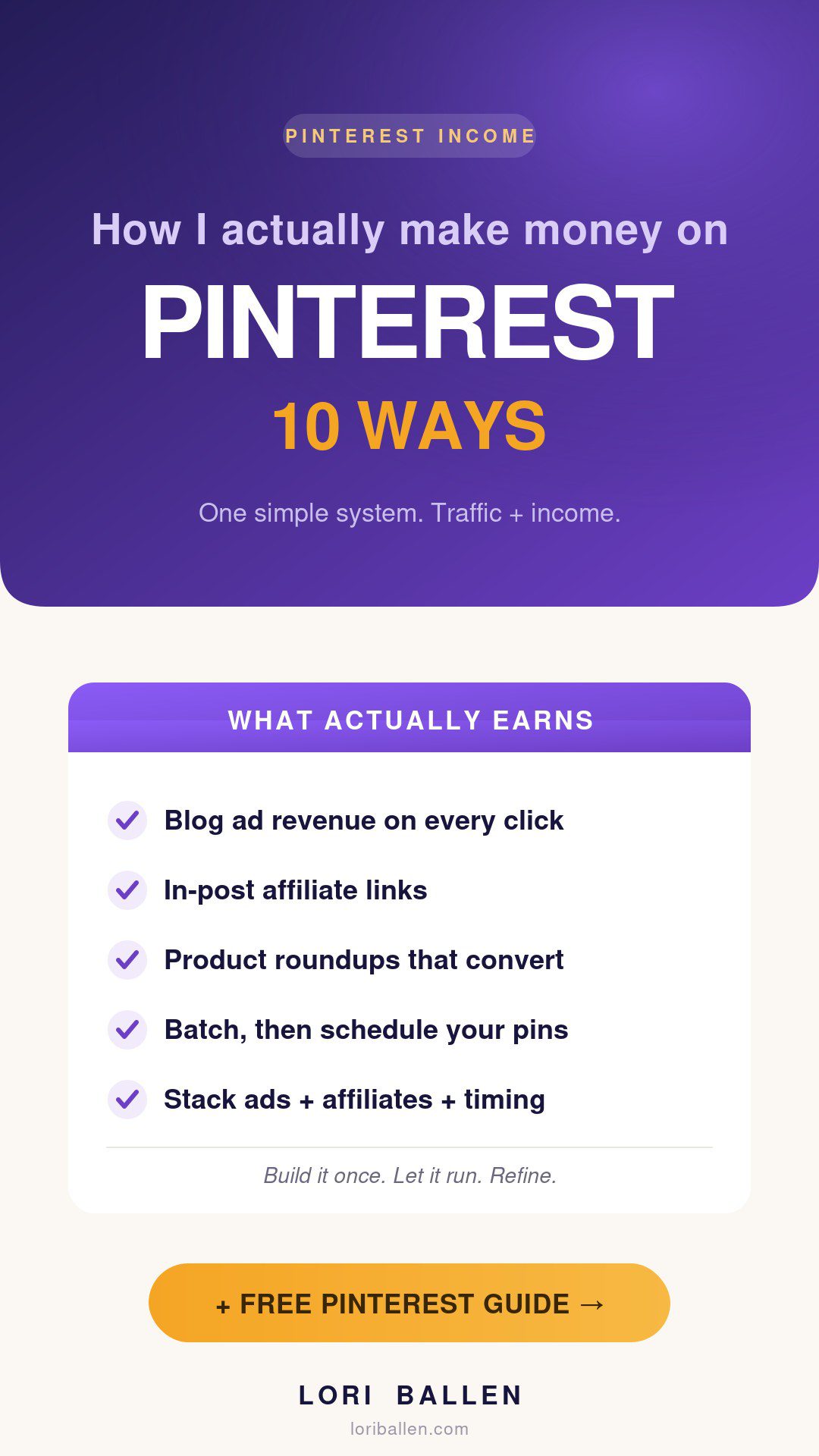
In this post, I’m breaking down the 10 ways I personally make money on Pinterest today.

I Monetize Pinterest Clicks with Blog Ads (Yes, Views = Money)

This is the foundation of how I monetize Pinterest. Every pin I create points back to a blog post. Once someone clicks, they land on my site where ads are running—and that means money, even if they don’t buy a single product.

Here’s how it works. You create a blog, apply to an ad network, and place their code on your site. The most basic option is Google AdSense, which approves smaller sites quickly. Once you hit certain traffic thresholds, you can apply for “premium” networks like Mediavine or Raptive.

I tested both. When I switched from AdSense to Mediavine, my RPM (earnings per 1,000 pageviews) actually dropped. After 90 days of testing, I moved back to AdSense—and for my niche, it outperformed. That’s why testing matters. Don’t assume the “big” networks are always better.

What determines your ad income isn’t just the network—it’s your niche, the quality of your traffic, and your seasonal timing. For example, in Q4 (October–December), advertisers pay more, and Pinterest traffic surges. That’s when my RPMs jump.

The beauty of this model is that it scales. One pin can keep driving traffic to a blog post for months, and every visit earns ad revenue whether or not the reader clicks an affiliate link. It’s set-it-and-forget-it income that stacks as your library of posts and pins grows.

I Turn Pinterest Traffic into Paydays with In-Post Affiliate Links

his is my favorite way to monetize Pinterest, hands down. I love affiliate marketing. There’s nothing better than recommending a product I already use, dropping the link in my blog, and getting paid when someone else buys it. No inventory, no customer service, no shipping—just clean commissions.

This is my favorite way to monetize Pinterest, hands down. I love affiliate marketing. There’s nothing better than recommending a product I already use, dropping the link in my blog, and getting paid when someone else buys it. No inventory, no customer service, no shipping—just clean commissions.

Here’s how it looks in practice. I write a blog post that’s already getting traffic from Pinterest, like “How to Host a Girls’ Craft Night.” Inside that post, I’ll list out supplies—candles, paint kits, wine glasses—and every one of those items is linked with my Amazon Associates account. When someone clicks and shops, I earn.

I’ve also done this with ambassador programs. For example, I started wearing necklaces from Katia Designs because I liked the style. Then I joined their ambassador program. Now when I blog about layering jewelry or share ideas for concert outfits, I can link to those necklaces with my code. Katia gives me a commission, my readers get a discount—it’s a win-win.

Here’s the catch with Pinterest: they don’t like it if you just keep spamming the same affiliate link over and over. That’s why the blog is so powerful. Every post has a unique URL. So instead of 10 pins all pointing to the same necklace link, I create a blog post like “3 Ways to Style Layered Necklaces,” put the affiliate link inside, and send all my pins to that post. Pinterest is happy, the user gets value, and I still make commissions.

To make the links stand out, I use a tool called Lasso. It turns plain affiliate links into beautiful product boxes and comparison tables. Instead of a boring blue link, you’ve got a polished display with images and buttons that drive more clicks. It also helps me manage all my links in one place so nothing gets lost.

I Build Pinterest Product Roundups That Fast-Track “Add to Cart”

If you want fast results on Pinterest, nothing beats a good product roundup. Pinterest users love list-style posts because they’re searching for ideas and comparisons. They’re not looking for one random product—they want options.

Here’s how I do it. I go into Amazon and look for the bestsellers in a category. For example, I created a post called “The Best Hidden Shoe Storage Systems.” All I did was pull the top-rated, most reviewed products, write a quick description for each one, and link them with my Amazon Associates account. Then I made pins pointing to that roundup. Within days, it started making sales.

Another one I tested was reverse osmosis water systems. Same process: grab the best-reviewed models, line them up in a blog post, add affiliate links, and publish. Pinterest users click because they want to compare before buying, and that blog post does the work for them.

The key here is that these posts serve both the reader and the algorithm. Pinterest loves “10 Best” and “Top Picks” style content because users save it. And advertisers love it because it leads directly to purchases.

I don’t overcomplicate it. I give the roundup a clear title, make sure it solves a problem people are actively searching for, and design multiple pins that highlight different angles. One pin might focus on “Small Space Shoe Storage,” another on “Hidden Storage Ideas.” They all point to the same blog, but each has a different hook.

Roundups still work because they deliver what Pinterest users came for—ideas they can act on immediately. And when they do, that’s commissions in my pocket.

I Write Pinterest Idea Posts That Inspire First, Sell Naturally

This is one of my favorite angles because it’s pure Pinterest. People go to Pinterest for inspiration first. They’re not typing in “buy necklace” or “shop shoe rack.” They’re typing in “girls craft night ideas,” “cozy fall living room,” or “hot cocoa bar setup.” That’s where the money starts—by giving them the idea they were already searching for.

For example, I saw “craft night” popping up in PinClicks, so I created a blog post on how to host a girls’ craft night. Inside, I listed three or four activities like candle-making or painting wine glasses, then dropped affiliate shopping lists under each one. It wasn’t just a list of products—it was an idea they could save and share. That post makes money because it feels valuable and inspires action.

Another time, I noticed a trend where almost every winter pin had hot cocoa in it. Cozy mugs, holiday décor, kids in pajamas—it was everywhere. So, I built a blog post called “12 Hot Cocoa Bar Ideas” and created pins to match. Again, I added affiliate links to mugs, trays, and toppings. The post wasn’t about selling—it was about inspiring. But it still sold.

That’s the whole point: instead of forcing my niche onto Pinterest, I reverse-engineer what users are already doing there. If they’re saving cozy living room ideas, I write about that. If they’re saving baby shower inspiration, I write about that. Then I layer in affiliate links that naturally fit the vibe.

When you approach Pinterest this way, you stop chasing traffic and start matching demand. And the income follows.

I Use Direct Pinterest Affiliate Pins—Rarely, Strategically, Effectively

Let me be clear on this one—Pinterest does allow direct affiliate pins, but if you abuse it, you’ll get shut down fast. That’s why I only use this strategy in very specific cases.

Here’s an example. I wear necklaces from Katia Designs. I joined their ambassador program, which gives me a commission link and a discount code for my audience. If I take a beautiful photo of the necklace styled on a flat lay or hanging from a jewelry stand, and I post that on Pinterest with my ambassador link, that’s fine. It’s relevant, it’s on-brand, and it creates value.

What you can’t do is spam Pinterest with a bunch of random pins that all point to the same product link. That’s where people get into trouble. Pinterest doesn’t want to feel like a giant ad board. They want inspiration first.

So my rule is this: if I’m linking directly to an affiliate product, the pin has to look like it belongs on Pinterest. It needs to inspire—whether that’s showing how to style a layered necklace, how to decorate with cozy throws, or how to set up a fall table. The product fits inside the inspiration, not the other way around.

But most of the time, I don’t even bother with direct links. I’d rather create a blog post, drop the affiliate links inside, and send all my pins there. That way, every post has a unique URL, my account stays safe, and I’m still getting the commissions.

Direct affiliate pins are a tool in the toolbox, not the whole system. Use them strategically, not as your main play.

I Ride Pinterest Seasonality—Q4 Is Where I Cash In

If there’s one season where Pinterest really pays off, it’s Q4. Fall into Christmas is when traffic explodes and advertisers spend the most. That’s when I lean hard into seasonal and holiday content.

Here’s what that looks like. In September, I start building fall-themed posts: cozy living rooms, pumpkin recipes, fall outfits, DIY wreaths. By October, it’s all about Halloween crafts and décor. In November, I shift into Thanksgiving tables, fall recipes, and gift guide prep. By December, I’m running full-on Christmas—gift ideas for best friends, boyfriend gifts, hot cocoa bars, holiday parties, you name it.

The reason this works is because Pinterest users are planners. They’re not searching the day before Christmas. They’re searching weeks, even months, in advance. If I want my pins to be ranking and circulating during December, I need them live by October.

And the money side is real. Ad RPMs (earnings per 1,000 pageviews) shoot up in Q4 because advertisers are spending big. At the same time, affiliate links convert better because people are in buying mode. It’s the perfect storm.

So if you’re only going to focus on Pinterest part of the year, make it Q4. That’s when the work compounds fastest and the commissions stack highest.

I Batch My Pinterest Pins so Consistency Doesn’t Burn Me Out

This is one of the simplest but most powerful parts of my Pinterest system: I don’t create pins one at a time. I batch them.

Here’s what I mean. Let’s say I just published a blog on “10 Cozy Fall Living Room Ideas.” Instead of designing one pin and hitting publish, I’ll sit down and make 10 or 20 variations. Different colors, different overlay text, different hooks. One might say “Cozy Fall Living Room Ideas,” another might say “Rust Aesthetic Living Rooms,” another might focus on “10 Décor Tips for Fall.” Same blog, different entry points.

Why does this matter? Because Pinterest is about volume and variety. You don’t know which headline or image is going to take off. Sometimes it’s the one you least expect. By batching, I give myself more chances to win without spending all week designing.

Then I load those variations into Tailwind and schedule them to drip out. That way, Pinterest sees fresh content publishing every day, even if I’m off doing something else. My account looks active, my pins keep circulating, and traffic compounds.

This strategy also saves mental energy. When I’m already in design mode, I crank them out in one sitting. Then I don’t have to think about it again for days. It’s about working smarter—batch once, publish many.

That’s how you keep the “always publishing” system alive without burning yourself out.

I Let Pinterest Analytics Tell Me What to Double Down On

If there’s one thing that separates hobby pinners from money-makers, it’s testing. I don’t guess what works on Pinterest. I track, I test, and I pivot.

Here’s my routine. Every morning, I check analytics. I look at what pins were saved the most, which posts drove the most clicks, and where the commissions or ad revenue came from. If I see a spike, I double down. If something flops, I don’t waste time on it.

For example, when I noticed a surge in fall aesthetic pins, I created more fall content. When my hot cocoa bar post started gaining traction, I batched more pins around it. That’s the pattern—watch what’s already working and do more of it.

I also pay attention to RPMs (revenue per thousand views). If a post is getting traffic but not earning much, I’ll test new affiliate placements or optimize the ad layout. Sometimes small tweaks—like moving an affiliate link higher in the post or adding a product box with Lasso—can make a big difference.

And here’s the part most people don’t do: I’m not afraid to run experiments that might fail. I’ve tested different ad networks, different post formats, even AI-generated articles. Some worked, some didn’t. But the testing is what gives me clarity.

The bottom line? Pinterest is an idea engine. Analytics tell you which ideas people actually want. Your job is to spot the pattern early and ride the wave.

I Scale My Pinterest Workflow with PinClicks, ChatGPT, Ideogram, Tailwind, Lasso

I started on Pinterest doing everything manually—writing the blogs, designing the images, posting by hand. And honestly, you can still do it that way when you’re new. But once you start seeing traffic, tools are what let you scale without burning out.

Here’s my stack. PinClicks is where I start, because it tells me what people are actually saving and searching for. Instead of guessing, I know the exact keywords and aesthetics that are trending. From there, I move into ChatGPT to draft blog outlines and intros. I don’t let AI run wild—I direct it. I guide the tone, test one section at a time, and refine until it feels valuable.

Once the blog is outlined, I generate images with Ideogram. It creates long, vertical Pinterest-style graphics that actually look like they belong on the platform. To speed things up, I’ll sometimes use Harpa, which is a Chrome extension that keeps my prompts connected to the page I’m working on.

After the content and pins are ready, I load them into Tailwind to schedule everything out. This way, I can batch 20 pins in one session and know they’ll drip out for weeks, keeping my account active without me being glued to the platform.

Finally, for affiliate management, I use Lasso. It pulls my links into clean product displays, comparison tables, and call-to-action boxes. Instead of a boring text link buried in a paragraph, my readers see polished displays that drive clicks.

Could I do all this without the tools? Sure. But they save me hours and let me keep Pinterest running as one income stream while I focus on others. The tools don’t make the strategy work—they just make it faster and easier to scale.

I Stack Pinterest Revenue—Ads + Affiliates + Timing on Every Pin

The real money on Pinterest isn’t in picking one strategy and running with it—it’s in stacking them. One pin can earn in three different ways at the same time: ad revenue, affiliate commissions, and seasonal timing.

Here’s how it plays out. Let’s say I write a blog post on “12 Hot Cocoa Bar Ideas.” When a Pinterest user clicks that pin, three things happen. First, they land on my blog where ads are running—instant income even if they don’t click anything else. Second, they see affiliate links to mugs, trays, and toppings. If they buy, that’s commissions. Third, because I timed it in Q4, advertisers are paying higher RPMs and buyers are already in shopping mode, which multiplies both revenue streams.

That’s why I never rely on just one method. If I only did affiliate links, I’d miss ad income. If I only did ads, I’d miss commissions. If I only did Q4, I’d miss traffic in spring and summer. By layering all three, every pin and every post has multiple chances to make money.

It’s not complicated—it’s just strategic. Pinterest drives the traffic. The blog captures it. Ads and affiliates monetize it. And when you stack all those layers, you create a compounding system that pays you whether you’re at your desk or not.

Final Thoughts

Pinterest is one of the easiest platforms to turn inspiration into income when you know how to approach it. I don’t treat it like a hustle—I treat it like a system. Every pin points to a blog, every blog runs ads and affiliate links, and the content keeps working long after I’ve moved on. That’s how I built Pinterest into a steady income stream without adding hours to my day.

If you’re ready to set up your own Pinterest system, start with my Pinterest eBooks. I break down the exact strategies, prompts, and workflows I use so you can skip the guesswork and get straight to what works.

Grab your copy of my Pinterest guide today and turn your pins into profit.

Previous Post

Pinterest Marketing for Gen X: My 1-Hour-a-Day Workflow

Next Post

How I Became an over 50 TikTok Influencer and Made $25,000 in One Month

Lori Ballen

Lori Ballen

I'm a full-time blogger. I teach entrepreneurs how to get more website traffic, generate leads, and make more money online. This website contains affiliate links that benefit me. Take a Course Get a Website Try my Tools

Related Posts

How To Start a Book Blog And Make Money (and Actually Succeed)
Make Money Online

How To Start a Book Blog And Make Money (and Actually Succeed)

January 7, 2026

This guide is your complete, step-by-step blueprint to launch a book blog and, more importantly, turn your passion into a paycheck.

25 Pinterest Hacks To Drive $5K In Affiliate Sales
Affiliate Marketing Strategies

25 Pinterest Hacks To Drive $5K In Affiliate Sales

January 5, 2026

In this guide, I’m sharing the exact 25 strategies I used to scale my affiliate commissions past that $5,000 a month mark, without creating a single product of my own. These are the tweaks that took me from feeling...

8 Apps Like Phrendly To Make Money
Make Money Online

8 Apps Like Phrendly To Make Money

December 21, 2025

Are you looking to make extra cash while connecting with others? Look no further! In this guide, we’ll introduce you to the top money-making chat apps, including apps like Phrendly to make money, that offer a variety of opportunities...

A pin on Pinterest can be deleted for a variety of reasons. Whatever the reason, here's how to delete a pin on Pinterest
Pinterest

How to Delete a Pin from Pinterest [Step by Step Tutorial]

December 21, 2025

A pin on Pinterest can be deleted for a variety of reasons. Whatever the reason, here's how to delete a pin on Pinterest

Next Post
How I Became an over 50 TikTok Influencer and Made $25,000 in One Month

How I Became an over 50 TikTok Influencer and Made $25,000 in One Month

Leave a Reply

Your email address will not be published. Required fields are marked *

This site uses Akismet to reduce spam. Learn how your comment data is processed.

About Me

Lori Ballen

Lori Ballen

Content Creator

Welcome! I'm Lori Ballen—digital entrepreneur, affiliate marketing expert, and creator of content that keeps earning long after it's published. I teach creators and bloggers how to turn videos, blogs, and automation into scalable income streams with freedom at the core. Here you’ll find tips, tools, and real talk on building a content-driven business that works for you.

Search This Website

No Result
View All Result

Join me on Substack

Categories

  • Affiliate Marketing Strategies (64)
  • Blogging Strategies (163)
  • Branding Strategies (1)
  • Business Ideas (13)
  • Canva (4)
  • Content Marketing (10)
  • Digital Marketing (5)
  • Digital Products (20)
  • Etsy (2)
  • Financial Freedom (9)
  • Make Money Online (13)
  • Make Money with Youtube (2)
  • Marketing Tools and Resources (10)
  • Mindset and Motivation (2)
  • Pinterest (84)
  • Print on Demand (3)
  • Side Hustles (37)
  • Social Media Strategies (7)
  • Things to Sell (1)
  • Travel (11)
  • Website Design (1)
  • Work From Home Strategies (2)
  • Youtube Channel (18)

Popular

  • websites like omegle

    15 Best Get Paid to Chat Apps

    1843 shares
    Share 704 Tweet 440
  • ChatGPT Prompts: The Ultimate Resource for Bloggers, Writers, and Content Creators

    2448 shares
    Share 455 Tweet 285
  • How to Delete a Pin from Pinterest [Step by Step Tutorial]

    8904 shares
    Share 402 Tweet 251
  • The Ultimate Guide to Affiliate Marketing Strategy on Instagram: A Beginner’s Blueprint

    845 shares
    Share 330 Tweet 207
  • How I Use ChatGPT to Create Affiliate Blogs

    1987 shares
    Share 302 Tweet 189
How I Build a Pinterest-Focused Affiliate Blog That Earns on Autopilot
Affiliate Marketing Strategies

How I Build a Pinterest-Focused Affiliate Blog That Earns on Autopilot

by Lori Ballen
January 14, 2026
0

I built my affiliate blog to run like a publishing machine — built on Pinterest, powered by automation, and monetized...

Read moreDetails
Why It’s Not Too Late to Build a Profitable Creator Business Over 50

Why It’s Not Too Late to Build a Profitable Creator Business Over 50

January 9, 2026
How To Start a Book Blog And Make Money (and Actually Succeed)

How To Start a Book Blog And Make Money (and Actually Succeed)

January 7, 2026
25 Pinterest Hacks To Drive $5K In Affiliate Sales

25 Pinterest Hacks To Drive $5K In Affiliate Sales

January 5, 2026
How to Build Your First $5,000 Digital Product Funnel With Pinterest

How to Build Your First $5,000 Digital Product Funnel With Pinterest

January 5, 2026

Instagram

  • Tabs fell in love with my Dyson air wrap on the cruise, so I gave it to her. I wanted to get the new one anyway so I could review all the attachments on the newer model. Time to go test her out!! I’m obsessed with how my hair looks when it’s curled with the air wrap!  I have eight cat trees sitting here waiting for me to assemble so I better get busy.
  • Future homesite? Maybe.
  • Gabe is not objecting to testing out all of the new cat furniture!! I had no idea he was a hammock cat!
  • Waiting for mom to start unboxing so he can have his five minutes of fame. #influencerlife
  •  When you go to your pantry to grab something and find somebody staring at you 😂
  • For some reason, cruise money feels like monopoly money. I’d have a hard time paying that same price on a massage at home. I suddenly on a cruise ship. I’m a Baller 😂
  • Another one of my pics made Amazon ads! The best part of this is that I still get paid commissions, even though they are running the ad. Just because I uploaded my picture to my influencer hub. ♥️
  • Years ago, I opened a spreadsheet and named two columns, Pain and joy. 

Anything in the day that drained my energy, gave me a headache, or made me cry, went in the pain column. 

Everything that made me woo-hoo, gave me energy, or made me happy went in the joy column. 

Once I listed everything that brought me pain, I began to move out of those activities and tasks. I heavily pursued everything that brought me joy.

My entire business changed, and now I only work in the joy column. And my life followed
  • There is a time for hustle. But there’s also a time for systems so that you can breathe. Anything done twice should have a system. And before you know it, you’re making money every day without the hustle or time on task. #productivity #hustle #business

Welcome Back!

Login to your account below

Forgotten Password?

Retrieve your password

Please enter your username or email address to reset your password.

Log In

Add New Playlist

No Result
View All Result
  • About
    • Affiliate Disclosure
    • Ballen Academy
    • Contact Us
    • Privacy Policy
    • Youtube
  • Loris Tools
  • Lori Ballen’s Blog
    • Affiliate Marketing Strategies
    • Blogging Strategies
    • Branding Strategies
    • Digital Products
    • Financial Freedom
    • Marketing Tools and Resources
  • Substack

© 2025 Lori Ballen